企业回购股票

Search documents
美股15年长牛的背后,有一个关键推手经常被忽视!
Jin Shi Shu Ju· 2025-09-26 09:47
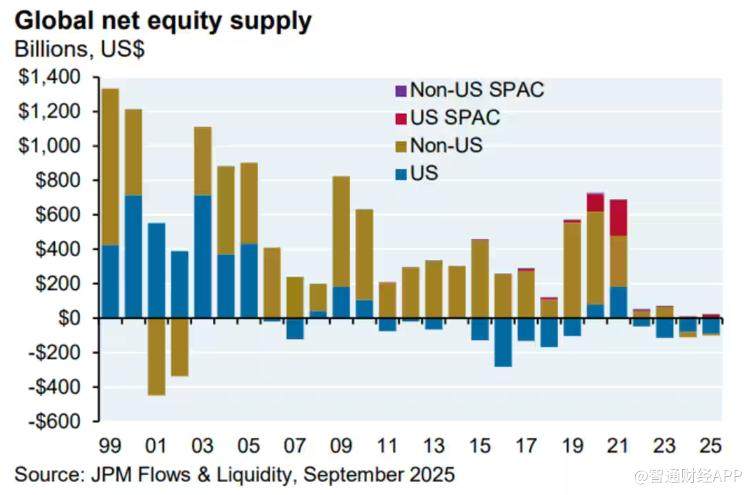
Core Insights - The article discusses the steady rise of the U.S. stock market post-financial crisis, attributing it to various factors including expanding profit margins of large corporations and the significant impact of tech giants like Microsoft and Apple on the global economy [1][3] - A critical point raised is the supply-demand imbalance in the stock market, which is considered a key factor in maintaining market resilience against volatility [1][3] Group 1: Market Dynamics - The supply of U.S. stocks has been on a declining trend since 2011, with a notable exception during the COVID-19 pandemic when IPO activity surged [3] - Corporate stock buybacks have been identified as a significant driver of this declining supply trend [3] - Despite a decrease in the proportion of fixed income pension plan inflows relative to the total market capitalization of the S&P 500, an annual influx of $1.5 trillion still needs to find investment opportunities [3] Group 2: Market Performance - Since 2011, investors have faced multiple stock market sell-offs, but only two have evolved into bear markets: the bear market in 2022, which resulted in the worst annual performance for the S&P 500 since 2008, and the brief sell-off in March 2020 due to the pandemic [3] - The article notes that the U.S. stock market indices, including the S&P 500, Dow Jones, and Nasdaq, experienced a decline, marking the first simultaneous three-day drop since March [3]

美股为何涨势不休?摩根大通策略师称这一因素或是关键推手
Zhi Tong Cai Jing· 2025-09-25 22:29
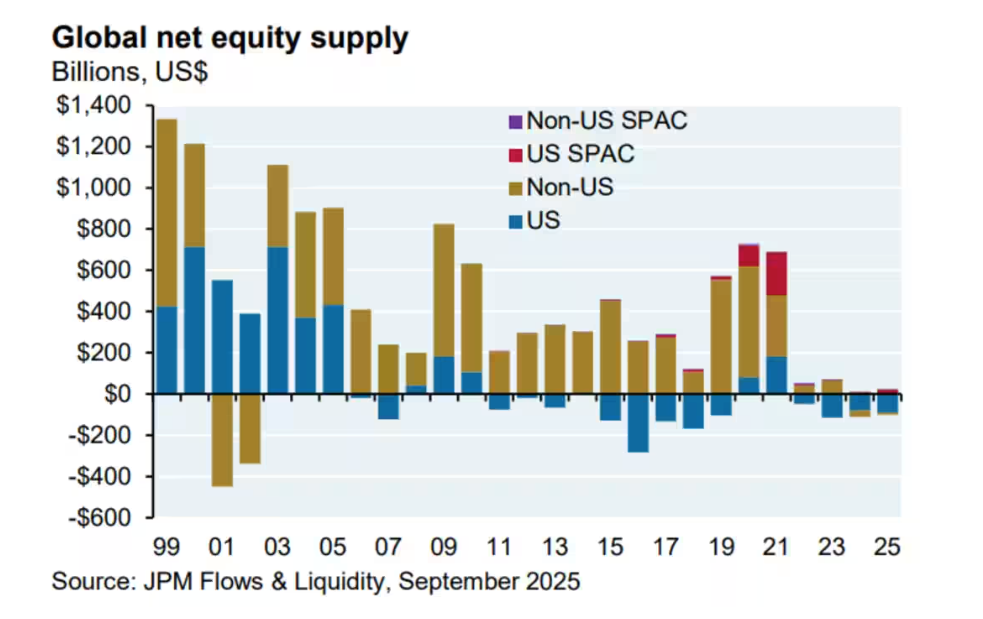
Core Insights - The U.S. stock market has been on a steady rise since the 2008 financial crisis, supported by expanding profit margins and reduced earnings volatility among large corporations [1] - A significant factor driving the long-term increase in U.S. stocks is the imbalance in supply and demand within the stock market, as highlighted by Michael Cembalest from J.P. Morgan Asset Management [4] Group 1: Market Supply Dynamics - Since 2011, the net supply of U.S. stocks has been declining, providing a "buffer" for the market during various shocks [4] - The overall supply of U.S. stocks, measured by market capitalization, has contracted since 2011, with the exception of a temporary increase during the IPO boom in 2020 [4] - Major stock buybacks by companies have been a key factor in the reduction of supply [4] Group 2: Demand Factors - Continuous inflows from pension plans, including fixed income and defined contribution plans, have provided stable buying support for the stock market [4] - Although the proportion of these inflows relative to the total market capitalization of the S&P 500 has decreased in recent years, approximately $1.5 trillion still needs to find investment targets each year [4] Group 3: Market Resilience - The U.S. stock market has shown unexpected resilience despite multiple sell-off periods since 2011, with only two instances evolving into full-blown bear markets: the March 2020 crash due to COVID-19 and the bear market in 2022, which resulted in the worst annual performance for the S&P 500 since 2008 [4] - The recent performance of major U.S. indices indicates a cautious short-term market sentiment, as evidenced by a decline across all three major indices for the first time since March of this year [5]