自回归架构

Search documents
世界模型,是否正在逼近自己的「ChatGPT时刻」?
Xin Lang Cai Jing· 2025-12-02 11:22
Core Insights - The discussion highlights the emerging focus on world models in AI, with significant contributions from leading scholars like Li Feifei and institutions such as the Chinese Academy of Sciences and Nanjing University [1][3] Group 1: Definition and Applications of World Models - World models are defined as predictive models that forecast the next state given the current state and action sequences, with applications in autonomous driving and embodied intelligence [3] - The ultimate goal of world models is to create a 1:1 representation of the world, although practical modeling will vary based on specific tasks [3] Group 2: Data and Model Training Challenges - A key dilemma in developing world models is whether to prioritize model creation or data collection, with examples from autonomous driving highlighting the limitations of available data [5] - Experts propose a mixed approach of generating synthetic data alongside real data to enhance model training [5] Group 3: Technical Implementation Paths - There are differing opinions on the technical paths for world model development, with some advocating for the integration of physical information while others emphasize the importance of creative generation [6] - The discussion includes the potential of combining diffusion and autoregressive architectures to improve model performance [7] Group 4: Future Outlook and Commercialization - Experts speculate that the "ChatGPT moment" for world models may occur in approximately three years, contingent on the availability of high-quality long video data [8] - The commercialization of world models faces challenges in both B2B and B2C sectors, particularly in defining the value of generated video data [8][9]

世界模型,是否正在逼近自己的「ChatGPT时刻」?
机器之心· 2025-11-29 01:49
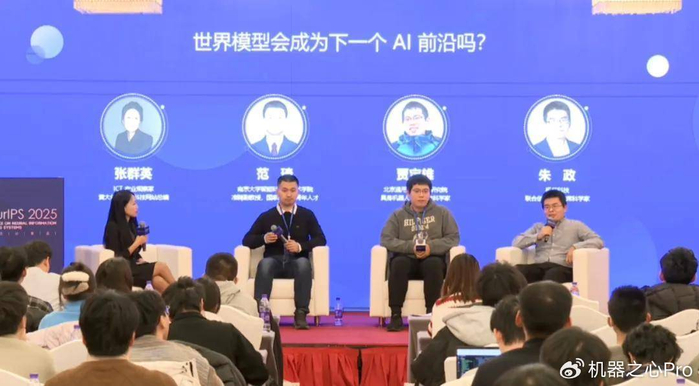
Core Viewpoint - The article discusses the emerging focus on "world models" in the AI field, highlighting its potential applications and the ongoing debates among experts regarding its definition, construction, and commercialization [1][3]. Definition of World Models - Experts provided various definitions of world models, with key perspectives including: - A predictive model that forecasts the next state based on current conditions and action sequences, with applications in autonomous driving and embodied intelligence [4]. - A framework for AI to predict and assess environmental states, evolving from simple game worlds to complex virtual environments [4]. - An ambitious goal to create a 1:1 model of the world, acknowledging the impracticality of such precision but emphasizing purpose-driven modeling [4]. Construction of World Models - A central dilemma in developing world models is whether to prioritize model creation or data collection. Experts discussed: - The challenge of training models with limited data, particularly in autonomous driving, where most data is collected under ideal conditions [5]. - The importance of high-quality data for specific applications to enhance model performance [5]. - A proposed iterative approach where initial models generate data that can be used for further training [5]. Technical Implementation Paths - There are notable disagreements among experts regarding the technical paths for world models: - Some advocate for incorporating physical information into models, while others suggest a more pragmatic approach based on specific needs [7]. - The potential for models to evolve towards purely generative forms as capabilities improve [7]. Architectural Debate: Diffusion vs. Autoregressive - Experts shared their views on the suitability of diffusion versus autoregressive architectures for world models: - Diffusion models are seen as more aligned with the physical generation of content, reflecting how the brain decodes complex signals [8]. - There is a trend towards integrating different architectures to enhance model performance, recognizing the strengths of both diffusion and autoregressive methods [9]. Future of World Models - The timeline for achieving a "ChatGPT moment" for world models is uncertain, with estimates suggesting it may take around three years to realize significant breakthroughs [10]. - The current lack of high-quality long video data poses a significant challenge, with existing models primarily generating short clips [10]. - The commercialization of world models faces challenges in defining value for both business-to-business (B2B) and business-to-consumer (B2C) applications [10][11]. Conclusion - The roundtable discussion highlighted the vibrant and diverse nature of the world model field, emphasizing its potential for growth while acknowledging the challenges related to data, computational power, and technical direction [13].