自首认定

Search documents
三堂会审丨受贿数额和自首情节认定问题分析
Zhong Yang Ji Wei Guo Jia Jian Wei Wang Zhan· 2026-02-04 00:49
Core Viewpoint - The article discusses the case of Zhang, a former official, who was found guilty of corruption and political misconduct, detailing the legal proceedings and implications of his actions [2][6][10]. Group 1: Case Background - Zhang, a member of the Communist Party since July 1990, held various positions including Party Secretary and Principal at a vocational school [5]. - From 2013 to 2024, Zhang accepted bribes totaling over 7.37 million RMB and attempted to evade scrutiny by forming alliances with accomplices [6][19]. Group 2: Investigation and Legal Proceedings - Zhang voluntarily reported his misconduct to the local disciplinary committee on July 1, 2024, leading to an investigation and subsequent detention [7]. - On November 20, 2024, he was expelled from the Party and dismissed from public office, with the case being forwarded for prosecution on November 22, 2024 [8][10]. Group 3: Sentencing and Financial Implications - On January 23, 2025, the court sentenced Zhang to seven years and six months in prison and imposed a fine of 500,000 RMB, with the judgment now in effect [10][22]. - Zhang's actions included returning part of the bribe and attempting to conceal the relationship with the briber, which were analyzed under the political discipline regulations [15][19]. Group 4: Handling of Illicit Gains - Zhang invested 2 million RMB of the bribe money in government bonds, generating 114,000 RMB in interest, which is considered illegal gains and subject to confiscation [16][17]. - The court ruled that the interest earned from the illicit funds must be returned to the state, emphasizing that such actions do not constitute money laundering [18][22].

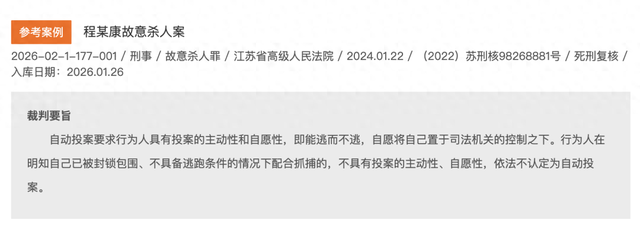
程某康刺死女友后躲藏,被包围后下楼配合抓捕,辩称属于自首!最高法:核准死刑
Xin Lang Cai Jing· 2026-01-31 06:05
Core Viewpoint - The case revolves around whether the actions of the defendant, Cheng Moukang, in cooperating with the police during a capture while knowing he could not escape, can be classified as a voluntary surrender or "self-reporting" under Chinese law [5][6]. Summary by Sections Incident Overview - Cheng Moukang, after accumulating debts of approximately 290,000 RMB due to gambling, fatally stabbed his girlfriend, Guan Moulei, during a confrontation about their relationship on April 11, 2022 [2]. - Following the incident, Cheng attempted to evade capture by discarding his phone and hiding on the rooftop of a residential building [2]. Legal Proceedings - Cheng's defense argued that his cooperation with the police during the capture constituted a voluntary surrender, which should be recognized as self-reporting [3]. - On October 19, 2022, the Changzhou Intermediate People's Court sentenced Cheng to death for intentional homicide, a decision that was upheld by the Jiangsu High Court on January 22, 2024 [3][4]. Legal Interpretation - The key legal question was whether Cheng's actions during the police's encirclement could be considered a voluntary surrender. According to Chinese law, a voluntary surrender requires the individual to act proactively and willingly, which Cheng did not demonstrate as he was aware of his inability to escape [5][6]. - The court concluded that Cheng's lack of escape options and his prior actions to evade capture indicated that he did not possess the necessary voluntary intent to be classified as a self-surrender [6].
三堂会审丨准确认定违反廉洁纪律与受贿犯罪
Zhong Yang Ji Wei Guo Jia Jian Wei Wang Zhan· 2025-10-15 00:34
Core Viewpoint - The case of Luo, a former public official, highlights the distinction between legitimate civil actions and violations of integrity discipline, particularly in the context of private lending and potential bribery [1][9][10]. Summary by Sections Basic Case Facts - Luo, a member of the Communist Party since June 1994, held various positions including Chairman of the City Investment Company and Director of the Planning Bureau. He was found to have violated integrity discipline by lending money to management and service objects, resulting in significant profits [3]. - Between 2016 and 2018, Luo lent a total of 345 million yuan, receiving 13 million yuan in interest, while also being implicated in accepting bribes totaling over 606 million yuan during his tenure [3]. Investigation Process - The investigation into Luo's alleged serious violations began on October 22, 2024, leading to his detention and subsequent extension of detention time [4]. - On April 10, 2025, the case was transferred to the People's Procuratorate for prosecution, and Luo was expelled from the Party and public office shortly thereafter [5]. Legal Proceedings - On May 19, 2025, the People's Procuratorate filed charges against Luo for bribery, resulting in a sentence of ten years and one month in prison, along with a fine of 500,000 yuan [6]. Analysis of Private Lending - The analysis indicates that Luo's private lending activities, while profitable, did not constitute bribery as there was no evidence of using his official position to benefit the borrowers [9][10]. - The determination of whether such lending constitutes a violation of integrity discipline hinges on the potential impact on the impartial execution of public duties [10]. Recognition of Bribery in Lending - In a separate case involving a businessman named Peng, it was established that the loan provided by Luo was not based on a genuine need, indicating a potential bribery scenario masked as a loan [12][13]. - The relationship between the loan and the official's actions was scrutinized, revealing that the loan was a means to facilitate a quid pro quo arrangement [14][15]. Discounted Housing Transactions - Luo's purchase of property at a significantly reduced price from a developer was analyzed to determine if it constituted bribery. The sale price was 38% lower than the market rate, indicating a potential violation of integrity [17][19]. - The transaction was deemed a form of bribery as it was not a standard market practice and was directly linked to Luo's official actions [19]. Self-Reporting and Sentencing - Although Luo provided information about his bribery activities, it did not meet the legal criteria for self-reporting due to the nature of the crimes being similar to those already known to the authorities [21][22]. - His cooperation was acknowledged, leading to a lighter sentence despite not qualifying for self-reporting [22].