航天光伏

Search documents
未知机构:戈碧迦特种玻璃国产化先锋航天UTG开启千亿级增量空间航天-20260128
未知机构· 2026-01-28 02:00
Company and Industry Summary Company Overview - **Company Name**: 戈碧迦 (Gobi Glass) - **Industry**: Special Glass Manufacturing, focusing on aerospace applications Key Points Industry and Market Potential - **Aerospace UTG Glass**: The company has established a strong logic for space photovoltaic applications, addressing core issues of "lifespan + efficiency" for low Earth orbit satellites. The UTG glass, utilizing cerium for radiation resistance and coating thermal control technology, is identified as the optimal solution for protecting solar cells [1][2] - **Market Size**: The market for aerospace-grade UTG glass is projected to reach 52.5 billion CNY, with the overall UTG market potentially exceeding 100 billion CNY due to domestic satellite initiatives and computing center demands. The single satellite usage of radiation-resistant glass is estimated at 20 kg, valued at 100,000 CNY, indicating a significant market opportunity with high profit margins [6] Competitive Positioning - **Unique Position**: Gobi Glass is one of the few companies in China capable of mass-producing radiation-resistant glass, alongside Chengdu Guangmin and Qinhuangdao Xingjian. As the only private enterprise in this space, it is well-positioned to capture the commercial satellite market [3] Production and Orders - **Production Capabilities**: The company has manufacturing capabilities for glass substrates and is collaborating with key suppliers in the aerospace UTG industry [2] - **Military Contracts**: Since November 2025, the company has begun shipping to military applications, with a rapid increase in order volume [4] Product Development and Revenue Streams - **Microcrystalline Glass**: The company has achieved mass production of microcrystalline glass for mainstream mobile devices, expected to contribute 200 million CNY in profits by 2027 [6] - **Semiconductor Glass Substrate**: The company has secured 12.65 million CNY in orders for semiconductor glass substrates, with the first batch of 1.6 million CNY orders successfully delivered. The target is to expand monthly production capacity to 50,000 pieces by 2026 [6] - **Electronic Fabric Board**: Investment in the electronic fabric sector is increasing, with the first low-dielectric fiber production line expected to achieve scale production by Q4 2025, focusing on high-end electronic yarns for AI servers and high-speed optical modules [6] Strategic Collaborations - **Industry Partnerships**: Recent sample submissions to Lens Technology and other core glass manufacturers indicate strategic positioning within the glass substrate supply chain [5] Additional Insights - **Profit Margins**: The products in the radiation-resistant glass segment are expected to have profit margins significantly higher than the industry average, indicating a strong long-term profit potential [6]
行业聚焦:全球航天器太阳能电池行业头部企业排名情况(附TOP3 厂商介绍)
QYResearch· 2025-11-11 02:10
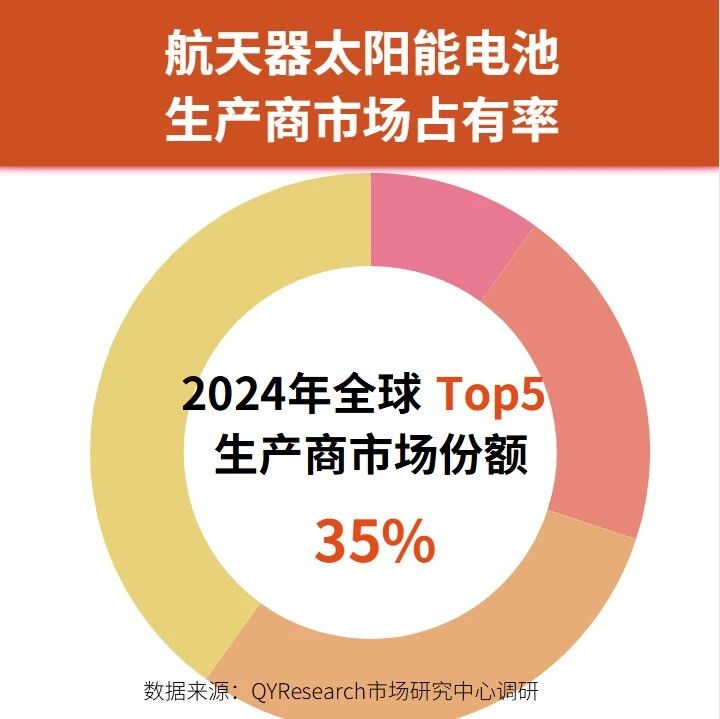
Core Viewpoint - The spacecraft solar cell market is projected to reach $3.1 billion by 2031, with a compound annual growth rate (CAGR) of 12% in the coming years [3]. Market Overview - The global spacecraft solar cell market is expected to grow significantly, driven by advancements in technology and increasing demand for reliable power sources in space applications [3]. - The market is characterized by a few key players, with the top five manufacturers holding approximately 35% of the market share in 2024 [6]. Key Manufacturers - Major manufacturers in the spacecraft solar cell industry include Boeing (Spectrolab), AZUR SPACE Solar Power GmbH, CESI SpA, Rocket Lab (SolAero Technologies), and Sharp Corporation [5][6]. - Spectrolab is recognized for its high-performance solar cells, achieving over 30% efficiency and providing power for critical space missions [7]. - AZUR SPACE specializes in multi-junction solar cells and has been involved in significant European space projects, ensuring high efficiency and radiation resistance [9]. Industry Chain Analysis - The upstream segment focuses on the supply of high-purity semiconductor materials and essential components for solar cell production [11]. - The midstream involves the manufacturing and integration of solar cells, utilizing advanced micro-nano processing techniques to create efficient solar panels [12]. - The downstream segment includes the application of solar cell arrays in various spacecraft, providing essential power for satellites, space stations, and deep-space probes [13]. Industry Trends and Opportunities - Rapid technological advancements are leading to the emergence of perovskite solar cells, which offer lightweight and flexible solutions with efficiencies exceeding 26% [14]. - The commercial space market is expanding, with increasing demand for low Earth orbit satellite constellations and the rise of small spacecraft utilizing flexible solar cells [15]. - Policy support and funding initiatives, such as China's strategic focus on space energy systems and the EU's Horizon Europe program, are fostering industry growth [15]. Challenges and Barriers - Technical challenges include the need for advanced manufacturing processes and the stability of new solar cell technologies, which may limit their application in long-term missions [16]. - High production costs and supply chain risks related to rare metals like gallium and indium pose significant challenges for manufacturers [17]. - The industry has high entry barriers due to the complex technical requirements and long development cycles needed to achieve competitive capabilities [18].