
行星形成机制

Search documents
云南天文台发现500余颗磁活动年轻恒星
Huan Qiu Wang Zi Xun· 2025-12-30 01:15
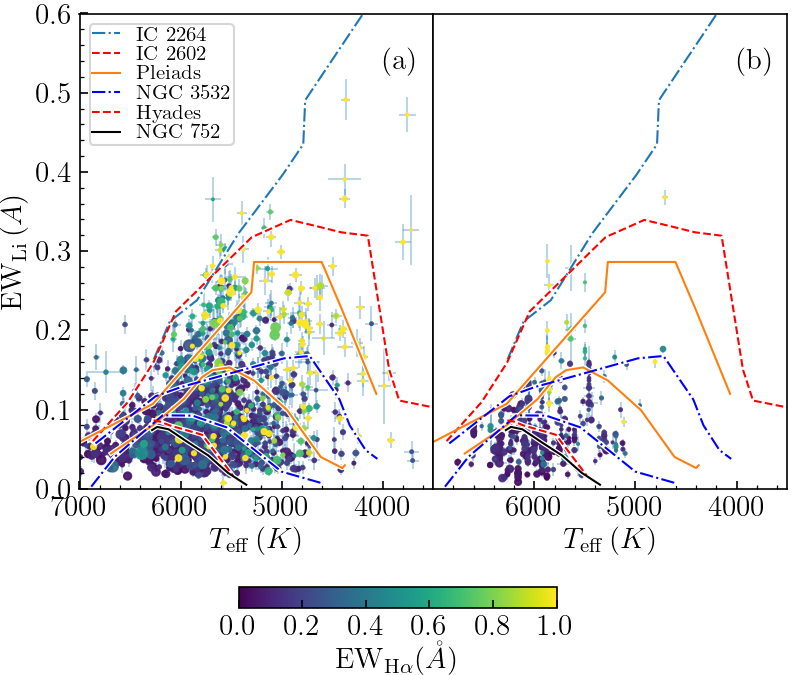
Core Insights - The research team at the Yunnan Astronomical Observatory has discovered a significant number of magnetically active young stars, which are crucial for studying the origins and evolution of stellar magnetic fields and planetary formation mechanisms [2][4]. Group 1: Research Findings - The study utilized spectral survey big data and machine learning techniques to identify over 500 magnetically active young stars, including various types such as T Tauri stars and magnetically active super-saturated stars [4][5]. - The research highlights the differences in magnetic field generation processes between young stars and the Sun, emphasizing the need for more observational samples and near-ultraviolet data to understand these phenomena [4]. Group 2: Methodology - The team employed a simulation of future survey space telescope spectra by lowering spectral resolution, using data from the Guo Shoujing Telescope, and applied a variational autoencoder algorithm for systematic analysis [4]. - Key indicators of stellar magnetic activity, such as hydrogen alpha emission intensity and lithium absorption strength, were analyzed to assess the activity levels and ages of the identified stars [4][5]. Group 3: Future Research Directions - The detailed catalog of newly discovered stars will facilitate further observations, which are expected to provide critical insights into the characteristics and evolutionary patterns of fully convective stellar magnetic fields [5]. - This research aims to deepen the understanding of the role of magnetic fields in stellar early evolution and planetary formation processes [5].

“哈勃”观测到罕见“宇宙撞击”
Ke Ji Ri Bao· 2025-12-24 01:02
Core Findings - An international study led by Northwestern University utilized the Hubble Space Telescope to observe a rare "cosmic collision" in a nearby planetary system, revealing that dust clouds may masquerade as planets for years [1][2] - This discovery aids in understanding planetary formation mechanisms and the structural characteristics of asteroids, which is significant for planetary defense initiatives like the Double Asteroid Redirection Test (DART) [1] Research Process - Since 1993, scientists have been observing the star Beta Pictoris, located 25 light-years from Earth, which has a large and complex debris disk, making it an ideal research target [1] - In 2008, a bright point in the debris disk was mistakenly identified as a planet and named "Beta Pictoris b" [1] - In 2023, follow-up observations revealed that this bright point had disappeared, leading to the discovery of a new bright spot, "Beta Pictoris cs2," which showed a 30% increase in brightness [1] Findings on Dust Clouds - The disappearance of "Beta Pictoris b" supports the hypothesis that it was a transient dust cloud generated by a collision, while the new bright spot "Beta Pictoris cs2" further confirms that both are not planets but rather dust clouds formed from the collision of small rocky bodies similar to asteroids [2] - For several years, signals from such dust clouds may closely resemble those from planets, making it crucial to accurately distinguish between transient collision dust clouds and actual exoplanets with the advent of next-generation observational equipment like the Giant Magellan Telescope [2]