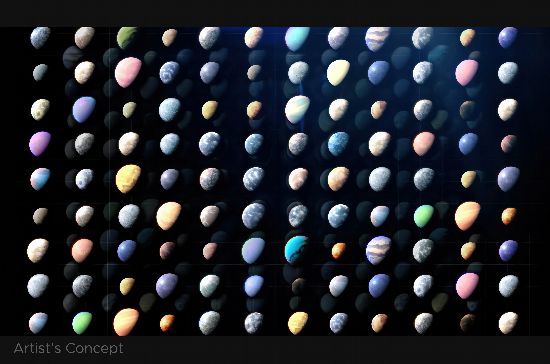
系外行星

Search documents
穿越到2050年,世界将变成什么样
Ke Ji Ri Bao· 2026-01-20 03:02
Group 1 - The year 2050 is seen as a significant milestone for transformative changes in technology and space exploration, with global space agencies focusing on this timeline for their missions [2][3] - NASA aims to achieve manned missions to Mars by 2050, while SpaceX plans to launch unmanned missions as early as 2026 to pave the way for human exploration [3] - Challenges related to biological factors, such as space radiation and psychological isolation, are highlighted as significant hurdles for Mars missions [3] Group 2 - Artificial Intelligence (AI) is predicted to play a central role in scientific research by 2050, potentially becoming the main driver of scientific discovery [4] - The concept of General Artificial Intelligence (AGI) is expected to materialize, enabling AI to autonomously design experiments and analyze data [4] - Current advancements in AI-driven laboratories are already demonstrating the potential for automated scientific research without human intervention [4] Group 3 - New technologies are expected to lead to significant scientific breakthroughs, such as the development of ultra-sensitive quantum sensors that could enhance gravitational wave detection [4][5] - Nuclear fusion energy is anticipated to become a reality by 2050, providing clean and limitless energy to households [6] - Emerging technologies like "clay electronics," which can transform into various forms, may revolutionize medical applications, including the creation of artificial organs [6] Group 4 - The discovery of exoplanets is projected to accelerate, with estimates suggesting that by 2050, humans may confirm the existence of one billion exoplanets, some of which may harbor conditions suitable for life [6] - There is speculation that scientists may discover extraterrestrial life by 2050, potentially leading to significant recognition such as a Nobel Prize [6] - The future is shaped by current investments, policies, and ethical decisions, emphasizing the importance of technology serving humanity [7]
“哈勃”观测到罕见“宇宙撞击”
Ke Ji Ri Bao· 2025-12-24 01:02
Core Findings - An international study led by Northwestern University utilized the Hubble Space Telescope to observe a rare "cosmic collision" in a nearby planetary system, revealing that dust clouds may masquerade as planets for years [1][2] - This discovery aids in understanding planetary formation mechanisms and the structural characteristics of asteroids, which is significant for planetary defense initiatives like the Double Asteroid Redirection Test (DART) [1] Research Process - Since 1993, scientists have been observing the star Beta Pictoris, located 25 light-years from Earth, which has a large and complex debris disk, making it an ideal research target [1] - In 2008, a bright point in the debris disk was mistakenly identified as a planet and named "Beta Pictoris b" [1] - In 2023, follow-up observations revealed that this bright point had disappeared, leading to the discovery of a new bright spot, "Beta Pictoris cs2," which showed a 30% increase in brightness [1] Findings on Dust Clouds - The disappearance of "Beta Pictoris b" supports the hypothesis that it was a transient dust cloud generated by a collision, while the new bright spot "Beta Pictoris cs2" further confirms that both are not planets but rather dust clouds formed from the collision of small rocky bodies similar to asteroids [2] - For several years, signals from such dust clouds may closely resemble those from planets, making it crucial to accurately distinguish between transient collision dust clouds and actual exoplanets with the advent of next-generation observational equipment like the Giant Magellan Telescope [2]
柠檬形状系外行星大气中富含碳分子
Ke Ji Ri Bao· 2025-12-23 01:13
Core Findings - A unique exoplanet named PSR J2322-2650b has been discovered by scientists at the University of Chicago using the James Webb Space Telescope, characterized by its lemon-like shape and high carbon content in its atmosphere [1][2] - This exoplanet is located approximately 4000 light-years from Earth and orbits a rapidly rotating pulsar, which is a rare occurrence in the known universe [1] - The atmosphere of PSR J2322-2650b contains significant amounts of carbon molecules (C3, C2) and exhibits extreme conditions that challenge existing theories of planetary formation [1] Atmospheric and Physical Characteristics - The planet's proximity to its host star and the massive size of the pulsar have resulted in its lemon-shaped, oblate form, with a "year" lasting about 7.8 hours and surface temperatures reaching up to 650°C [2] - Unlike most gas giants, the atmospheric wind direction on PSR J2322-2650b is opposite to the planet's rotation [2] - The planet appears deep red with clouds of graphite floating in its atmosphere, earning it the description of "an evil lemon" and marking it as one of the most peculiar exoplanets known to date [2]
诺贝尔物理学奖得主:相信有外星人的存在
第一财经· 2025-11-17 13:12
Core Viewpoint - Didier Queloz, the 2019 Nobel Prize winner in Physics, asserts that extraterrestrial life likely exists beyond Earth, given the vast number of planets in the universe [3][5]. Group 1: Discovery and Research - Queloz, along with his mentor Michel Mayor, discovered the first exoplanet orbiting a sun-like star in 1995, which revolutionized existing theories of planet formation and migration [5]. - The discovery of the exoplanet 51 Pegasi b marked the beginning of the "exoplanet era," leading to significant advancements in the field of astrobiology [5][6]. Group 2: Exploration of Extraterrestrial Life - Queloz emphasizes that the search for extraterrestrial life is not aimed at finding a new home for humanity but rather to understand and appreciate life on Earth [5][6]. - He discusses the potential for finding traces of extraterrestrial life on Mars, although it may only be remnants like bacteria [6]. Group 3: Technological Advancements - The advancement of observational technology and data accumulation allows astronomers to explore the conditions necessary for life across a broader sample of planets [6]. - AI technology is seen as a crucial tool for future space exploration, with the potential for AI-equipped robots to manage operations in space environments like lunar bases [7].


诺贝尔物理学奖得主:相信有外星人的存在
Di Yi Cai Jing Zi Xun· 2025-11-17 11:57
Core Viewpoint - Didier Queloz, the 2019 Nobel Prize winner in Physics, asserts that extraterrestrial life likely exists beyond Earth, emphasizing the abundance of planets in the universe [1][4]. Group 1: Discovery and Impact - Queloz, along with his mentor Michel Mayor, discovered the first exoplanet orbiting a sun-like star, 51 Pegasi b, in 1995, which revolutionized existing theories of planet formation and migration [3]. - This groundbreaking discovery marked the beginning of the "exoplanet era," leading to their joint Nobel Prize award in 2019 [3]. Group 2: Research Focus - Queloz's recent work focuses on the fundamental question of whether life exists elsewhere in the universe, with an emphasis on understanding the conditions necessary for life [4]. - The exploration of exoplanets aims not to find a new home for humanity but to enhance peaceful living on Earth, highlighting the importance of our planet [4]. Group 3: Future Prospects - Queloz suggests that the likelihood of confirming extraterrestrial life is higher for the younger generation, although it will take time to achieve [5]. - The integration of AI technology in space exploration is seen as a significant advancement, enabling the handling of big data and potentially deploying AI-equipped robots for future missions [5].

星空有约|热木星“搬家”不是为了“取暖”
Xin Hua She· 2025-10-31 10:13
Core Insights - The discovery of hot Jupiters and their formation and evolution patterns indicate that their migration closer to host stars is a result of long-term interactions with other celestial bodies rather than a quest for warmth [1][3]. Group 1: Research Findings - The research team utilized data from the Guo Shoujing Telescope and the European Space Agency's Gaia spacecraft to quantitatively analyze the relationship between 123 hot Jupiters and the ages of their host stars [3]. - The results show a declining trend in the number of hot Jupiters as the age of the host stars increases, with a significant inflection point at around 2 billion years, where the decrease accelerates [3]. - Hot Jupiters are categorized into "early migrants" and "late migrants," with approximately 60% being early migrants that moved inward within the first few million years of their host stars' formation [3][4]. Group 2: Historical Context - The first hot Jupiter, 51 Pegasi b, was discovered 30 years ago, marking the beginning of the identification of this type of exoplanet, with over 6,000 exoplanets now known [4]. - The mainstream theory posits that hot Jupiters initially form in colder regions far from their host stars before migrating inward, although previous models have not fully aligned with observational data [1][3]. Group 3: Future Research Directions - The research team plans to expand their studies to include other types of exoplanets, particularly Earth-like planets, to enhance understanding of Earth and the solar system [4].
距地不到二十光年的“超级地球”发现
Ke Ji Ri Bao· 2025-10-27 01:20
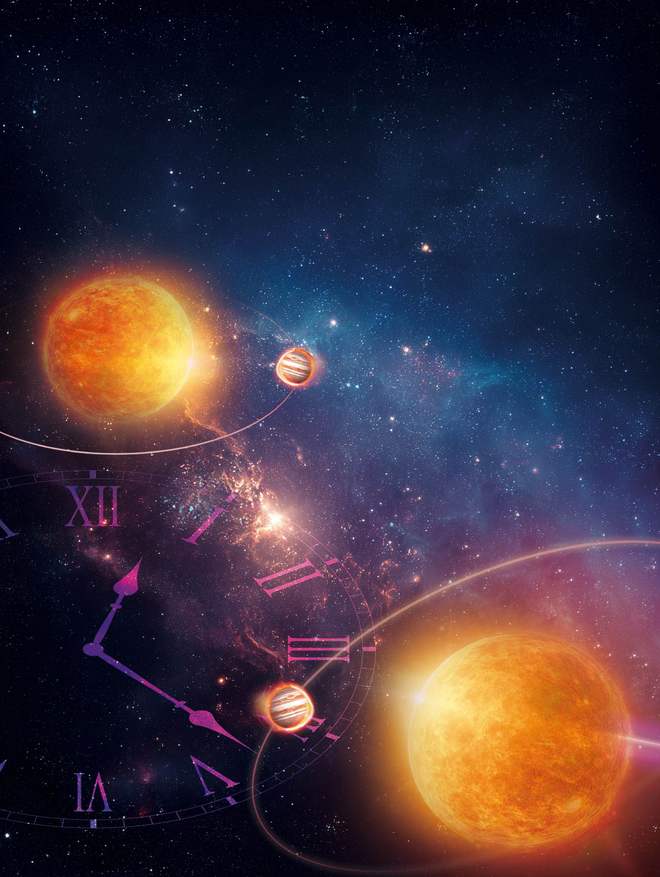
Core Insights - An international team, including researchers from Penn State University, has discovered a new exoplanet named GJ 251 c, located less than 20 light-years from Earth, which is classified as a "super-Earth" [1][2] - GJ 251 c orbits a red dwarf star, GJ 251, situated 18.2 light-years away, and has a mass nearly four times that of Earth, suggesting it is likely a rocky planet [1] - The discovery was made possible through 20 years of observational data, focusing on the star's minute "wobble" caused by the planet's gravitational influence [1] Discovery Process - The confirmation of GJ 251 c involved complex processes to filter out noise from the star's surface activity, utilizing data modeling and signal analysis techniques to ensure the detected signals originated from the planet [2] - Although GJ 251 c cannot be directly imaged yet, future ground-based telescopes and planned giant space telescopes are expected to analyze its atmosphere for signs of life [2] Significance of Super-Earths - Super-Earths, like GJ 251 c, are located in the "habitable zone" of their stars, where conditions may allow for stable liquid water, which is essential for life [3] - These planets are considered prime candidates for the search for extraterrestrial life and may also serve as potential future habitats for humanity [3]
距地不到二十光年的“超级地球”发现 为寻找外星生命带来新希望
Ke Ji Ri Bao· 2025-10-26 23:41
Core Insights - An international team, including researchers from Pennsylvania State University, has discovered a new exoplanet named GJ 251 c, located less than 20 light-years from Earth, which is classified as a "super-Earth" and lies within the habitable zone of its star, raising hopes for the search for extraterrestrial life [1][2] Group 1 - GJ 251 c orbits a red dwarf star named GJ 251, situated 18.2 light-years away, and has a mass nearly four times that of Earth, suggesting it is likely a rocky planet [1] - The discovery was made possible through 20 years of observational data, focusing on the star's minute "wobble" caused by the gravitational influence of the planet [1] - Another planet, GJ 251 b, was previously discovered in 2020, which has an orbital period of 14 days around the same star [1] Group 2 - The confirmation process for GJ 251 c was complex due to noise from the star's surface activity, requiring advanced data modeling and signal analysis techniques to isolate the planetary signal [2] - Direct imaging of GJ 251 c is currently not possible, but future ground-based telescopes and planned giant space telescopes are expected to analyze its atmosphere for signs of life [2]

人类可能根本没有机会收到外星文明发出的信号
Sou Hu Cai Jing· 2025-10-20 08:59
Core Viewpoint - The article discusses the "Dead Internet Theory," which posits that most online content is generated by AI and robots rather than humans, leading to a lack of genuine human interaction on the internet [2] Group 1: Theories on Extraterrestrial Civilizations - Various theories have been proposed to explain the lack of contact with extraterrestrial civilizations, including the idea that life may not find a way to evolve, Earth being a zoo, or civilizations self-destructing upon reaching advanced capabilities [3] - Carl Sagan suggested that as extraterrestrial civilizations advance, their technology may become too sophisticated for us to communicate with, leading to a "communication horizon" [3] Group 2: Technological Acceleration and Its Implications - Sagan predicted that a civilization could reach a level of technological advancement beyond our observational capabilities in about 1,000 years [4] - The rapid development of artificial intelligence (AI) is highlighted as a significant change in human society, with the potential for AI to evolve into a superintelligence that could surpass human capabilities [4] Group 3: Implications for the Search for Extraterrestrial Intelligence (SETI) - Research indicates that considering the exponential growth of technology and the potential prevalence of non-biological intelligence, the window for detecting extraterrestrial signals may be significantly reduced to just 10 to 20 years [5] - This reduction in the detection window suggests that the probability of discovering extraterrestrial civilizations is essentially zero, which may explain the "Great Silence" described in the Fermi Paradox [5]

NASA确认的系外行星突破6000颗
Ke Ji Ri Bao· 2025-09-23 01:40
Core Insights - NASA has confirmed that the number of exoplanets detected has surpassed 6000, with over 8000 additional candidates awaiting confirmation [2][3] - The discovery of exoplanets is accelerating, with the number increasing significantly from just over 5000 three years ago [3] Group 1: Exoplanet Discovery - The majority of exoplanets are studied indirectly due to their faint light being overshadowed by their parent stars [3] - Direct imaging of exoplanets remains rare, with fewer than 100 successfully captured [3] Group 2: Characteristics of Exoplanets - Exoplanets exhibit a wide variety of characteristics, including rocky planets, gas giants, and water-rich planets, as well as those with extreme conditions [2] - Unique types of exoplanets have been identified, such as those resembling Jupiter but orbiting closer to their stars, and planets with surfaces covered in lava or with densities similar to foam [2] Group 3: Scientific Collaboration - Collaboration within the scientific community is essential for converting candidate exoplanets into confirmed ones [3] - The ongoing increase in confirmed exoplanets provides valuable insights into planetary formation conditions and the potential distribution of Earth-like planets, which is crucial for the search for extraterrestrial life [2]