西大距

Search documents
别错过!这是今年最后一次观测水星的窗口期
Xin Hua She· 2025-12-06 04:29
Core Points - Mercury will reach its western elongation on December 8, providing a rare opportunity for astronomy enthusiasts to observe and photograph the planet in the southeastern sky before dawn [1][3] - Mercury is the hardest planet to observe due to its proximity to the Sun, which often obscures it in sunlight [3][4] - The term "greatest elongation" refers to the maximum angular distance of an inferior planet (Mercury and Venus) from the Sun as viewed from Earth, with western elongation occurring when the planet is positioned west of the Sun [3] Observation Conditions - This year, Mercury has three western elongations, with favorable observation conditions in August and December [4] - Around December 8, Mercury will be approximately 17 degrees above the horizon at sunrise, with a brightness of about magnitude 0, marking the last opportunity to observe it until February 2026 [4] - Ideal observation conditions include selecting locations away from obstructions like buildings and trees, preferably in open areas or elevated sites [4] - The best time for observation is about one hour before sunrise during the week surrounding December 8, when the sky is beginning to brighten but Mercury remains visible [4] - While Mercury is visible to the naked eye, using binoculars can significantly enhance the chances of successful observation [4]


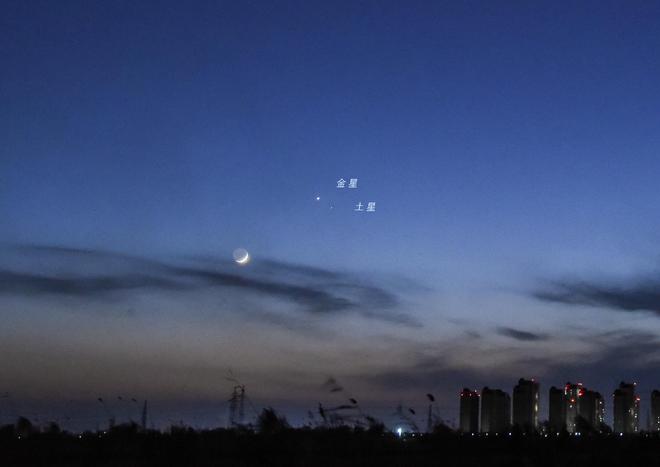
4月25日拂晓金星和土星将上演“双星拱月”
Xin Hua She· 2025-04-23 03:20
Core Points - The astronomical event of "double stars surrounding the moon" featuring Venus and Saturn will occur on April 25, providing a unique viewing opportunity for the public if the weather is clear [1][5][6] - Venus, known as "Tai Bai" in ancient China, will transition between the roles of "Evening Star" and "Morning Star" from late 2024 to the end of 2025 [2] Summary by Sections - **Astronomical Event Details** - On April 25, Venus and Saturn will appear close together in the eastern sky before sunrise, accompanied by a thin crescent moon, forming a triangular arrangement [5] - The visibility of Saturn may be challenging in urban areas due to light pollution, but Venus and the crescent moon are easier to observe [5][6] - The optimal viewing location is suggested to be areas with less light pollution, such as the countryside [5] - **Viewing Recommendations** - The viewing window for this event is limited to about half an hour before sunrise, making it essential for interested observers to be prepared [6] - If the event is missed on April 25, there will be an opportunity to observe a "triple star" event on April 26, where the moon will be positioned closer to Mercury, making it easier to spot [7]