证券期货仲裁

Search documents
金改前沿|“专业、效率、成本”三个关键词解读上海证券期货仲裁新规
Xin Lang Cai Jing· 2025-12-27 06:21
Core Viewpoint - The establishment of the new securities and futures arbitration rules in Shanghai aims to enhance the dispute resolution mechanism in China's capital market, aligning with its transition to a high-quality development phase [1][3]. Group 1: New Arbitration Rules - The newly released arbitration rules will be implemented on March 1, 2026, and are designed to address the shortcomings in the current dispute resolution mechanisms within the capital market [1][4]. - The rules aim to create a "professional, efficient, flexible, and economical" arbitration system for securities and futures [2]. Group 2: Focus on Investor Protection - The rules include a 50% fee reduction for companies listed on the Sci-Tech Innovation Board, specifically aimed at easing the financial burden on small and medium investors [2]. - Special fee reduction policies are also established for certain types of cases involving the protection of small and medium investors' rights [2]. Group 3: Professionalism and Efficiency - The rules will introduce a list of specialized arbitrators to ensure high professional standards in handling increasingly complex financial products [2]. - The arbitration process will be optimized with the introduction of a unique arbitration investigation order system and the acceptance of administrative penalties and judicial documents as evidence [2]. Group 4: Achievements of the Arbitration Center - In its first year, the Shanghai Securities and Futures Arbitration Center handled 1,328 financial cases with a total dispute amount of 17.778 billion, of which 645 cases were related to securities and futures, accounting for 48.6% of the total [4]. - The center achieved a "zero revocation" rate in handling complex cases, including those involving listed companies and financial derivatives [4].


设快速通道、降低费用,沪版证券期货仲裁新规正式发布
Di Yi Cai Jing· 2025-12-26 09:57
Core Viewpoint - The newly released "Securities and Futures Arbitration Rules" aims to enhance the scientific, rational, and operational aspects of securities and futures arbitration in China, marking a new phase for the Shanghai Securities and Futures Arbitration Center [1][2]. Group 1: Purpose and Background - The establishment of specialized arbitration rules for the securities and futures sector responds to the increasing complexity and urgency of disputes in China's capital market, which is entering a new stage of high-quality development [1][2]. - The rules are designed to provide a more accessible and efficient pathway for rights protection, particularly for small and medium investors facing high professional barriers and costs in legal proceedings [2]. Group 2: Key Features of the Rules - The rules define the arbitration scope through a "business category + typical disputes" approach, enhancing clarity for parties involved [2][3]. - A professional arbitrator recommendation list and team formation mechanism will be established, ensuring high standards in case hearings [2][3]. Group 3: Efficiency and Flexibility - The rules optimize case handling processes, encouraging the use of expedited procedures and embracing digital solutions for evidence submission and online hearings [3]. - A "mediation-arbitration connection" mechanism is introduced to facilitate seamless transitions between mediation and arbitration, particularly for disputes involving multiple investors [3]. Group 4: Economic Considerations - The rules lower the cost barriers for arbitration, including a 50% fee reduction for companies listed on the Sci-Tech Innovation Board, aimed at supporting national technology innovation strategies [4][5]. - Specific fee reduction policies are established for cases involving the protection of small and medium investors' rights, thereby reducing their cost of seeking justice [4][5].
上海版证券期货仲裁规则即将出台,纠纷化解能级有望持续提升
Di Yi Cai Jing· 2025-11-04 10:54
Core Viewpoint - The China (Shanghai) Securities and Futures Arbitration Center will soon launch arbitration rules and related guidelines to enhance the efficiency and effectiveness of dispute resolution in the securities and futures sector [1][2]. Group 1: Arbitration Center Development - The Shanghai Arbitration Committee is responding to policy requirements and market demands by establishing the China (Shanghai) Securities and Futures Arbitration Center by the end of 2024, building on the Shanghai Financial Arbitration Institute [1]. - The arbitration center has already published its first list of recommended professional arbitrators and has signed cooperation memorandums with major exchanges to integrate arbitration theory and practice [1][2]. Group 2: Case Statistics - In the past five years, the Shanghai Financial Arbitration Institute has handled nearly 8,000 financial cases with a dispute amount close to 1,000 billion, including over 3,000 securities and futures cases amounting to nearly 600 billion [1]. - Since its establishment, the arbitration center has accepted nearly 1,200 financial cases, with around 600 related to securities and futures [1]. Group 3: Characteristics of Securities Arbitration - The arbitration process is characterized by six features: autonomy of parties, finality of decisions, confidentiality, professional adjudicators, procedural flexibility, and enhanced preservation and enforcement effectiveness [2]. - The arbitration philosophy emphasizes respect for contractual spirit and commercial practices, ensuring equal protection for both parties and focusing on the legal and social effects of decisions [2]. Group 4: Benefits of Arbitration - Arbitration offers several advantages for resolving securities and futures disputes, including confidentiality, efficiency through finality of decisions, professional adjudication, and a supportive judicial environment in Shanghai [3]. - The increasing complexity and specialization of securities and futures disputes necessitate a higher quality and efficiency from arbitration institutions [3]. Group 5: Risk Prevention Suggestions - Market participants are advised to verify the legal identity and qualifications of counterparties, adhere to legal obligations, clearly define responsibilities in contracts, maintain evidence throughout the transaction process, and be proactive in exercising rights [4].
打造国际证券期货争议解决新高地
Jin Rong Shi Bao· 2025-09-30 01:49
Core Viewpoint - The establishment of the China (Beijing) Securities and Futures Arbitration Center marks a significant step in enhancing the legal framework of the capital market and improving the dispute resolution mechanism in the securities and futures sector in China [1][3]. Group 1: Establishment and Purpose - The China (Beijing) Securities and Futures Arbitration Center was launched on September 25, initiated by the Beijing Arbitration Commission and the Beijing International Arbitration Center [1]. - The center aims to provide a professional arbitration platform to resolve disputes in the securities and futures industry, thereby enhancing the legal environment for capital markets [3]. - The establishment aligns with the recent amendments to the arbitration law, indicating a new phase in the development of arbitration systems in China [1][2]. Group 2: Regulatory Support and Collaboration - The China Securities Regulatory Commission (CSRC) emphasizes the importance of arbitration as a legal tool for protecting investor rights and facilitating economic development [2]. - The center has signed cooperation agreements with various financial institutions and associations to promote high-standard operations and collaborative efforts in dispute resolution [3]. Group 3: Arbitration Rules and Innovations - The newly released Securities and Futures Arbitration Rules consist of 17 articles focusing on the characteristics of securities disputes, emphasizing professionalism, efficiency, and intelligence [4][5]. - Key innovations in the rules include expanding applicable scenarios, promoting digital arbitration, and enhancing mediation mechanisms to better protect investor rights [5]. Group 4: Market Context and Future Outlook - The development of securities arbitration is timely, aligning with the growing scale of China's capital market, which is approximately $15 trillion, making it the second largest globally [6]. - The center aims to address the needs of a broader range of investors, particularly small and medium-sized investors, who currently have limited access to arbitration services [7][8]. - Future efforts will focus on integrating international arbitration standards and enhancing China's influence in the global financial arbitration landscape [8].
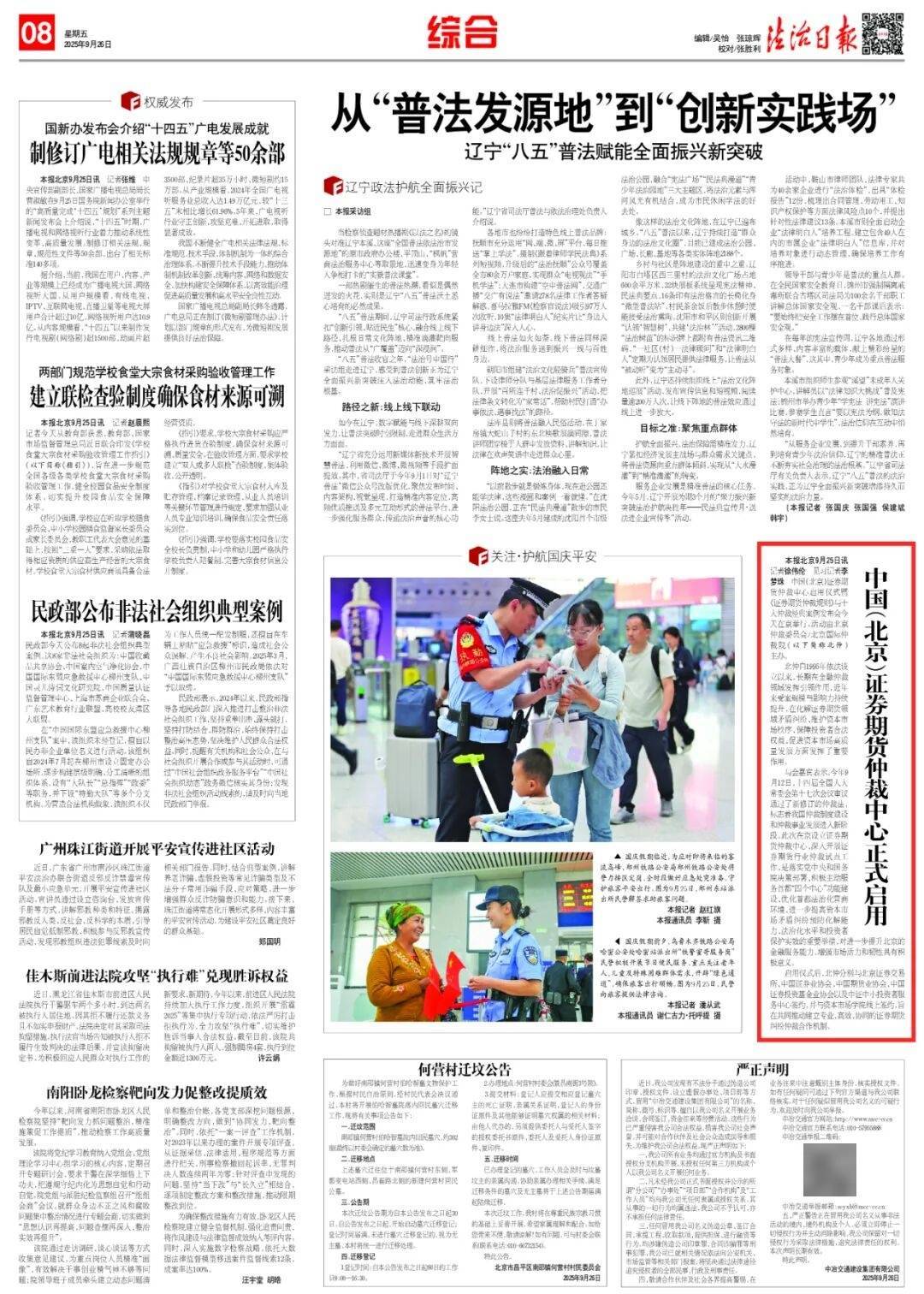
法治日报 | 中国(北京)证券期货仲裁中心正式启用
Sou Hu Cai Jing· 2025-09-29 13:23
Group 1 - The Ministry of Civil Affairs announced eight typical cases of illegal social organizations, highlighting the need for regulation and oversight in the sector [3] - The organizations listed include the China Collection Public Welfare Association and the China Indoor Air Purification Association, which were operating without proper registration [3] - The Ministry emphasized the importance of legal compliance and the consequences for organizations that fail to adhere to regulations [3] Group 2 - The establishment of the Securities and Futures Arbitration Center in Beijing aims to enhance the resolution of disputes in the capital market and protect investors' rights [17] - The center's launch follows the recent revision of the arbitration law, indicating a new phase in the development of arbitration systems in China [17] - The initiative is part of broader efforts to improve the legal environment for business and enhance the capital market's operational efficiency [17] Group 3 - The Education Ministry and the State Administration for Market Regulation issued guidelines to improve food safety in school canteens, focusing on the procurement and inspection of food materials [2] - The guidelines aim to establish a comprehensive food safety system in schools, ensuring transparency and accountability in food sourcing [2] - Schools are required to implement strict verification processes for food supplies to enhance safety standards [2] Group 4 - The Guangdong provincial government is conducting community safety campaigns to raise awareness about anti-drug and anti-cult activities [4] - These initiatives involve setting up consultation booths and distributing informational materials to educate the public on the dangers of illegal activities [4] - The campaign aims to foster community engagement and encourage citizens to report suspicious activities [4] Group 5 - The Ministry of Justice in Liaoning Province is leveraging new media to promote legal awareness and education among the public [6] - Various platforms, including social media and video channels, are being utilized to disseminate legal knowledge and engage with citizens [6] - The initiative aims to make legal information more accessible and relevant to everyday life [6] Group 6 - The establishment of law-themed parks and cultural spaces in Liaoning is part of a broader strategy to integrate legal education into community life [7] - These spaces serve as venues for public legal education and aim to foster a culture of lawfulness among residents [7] - The initiative reflects a commitment to making legal knowledge more approachable and engaging for the general public [7] Group 7 - The focus on youth in legal education initiatives highlights the importance of cultivating a law-abiding culture among younger generations [9] - Programs targeting students include legal knowledge competitions and interactive learning experiences to enhance understanding of legal principles [9] - The goal is to instill a sense of legal awareness and responsibility in young people [9] Group 8 - The recent activities in various sectors indicate a concerted effort to enhance regulatory frameworks and improve compliance across industries [17][2][3] - These initiatives reflect a growing recognition of the importance of legal and regulatory adherence in fostering a safe and efficient business environment [17][2][3] - The emphasis on community engagement and public education underscores the role of citizens in maintaining legal standards and reporting violations [4][6][7]