
谈判策略

Search documents
市场对特朗普关税威胁“免疫”?经济学家:仅约四分之一真正实施
智通财经网· 2026-01-27 15:04
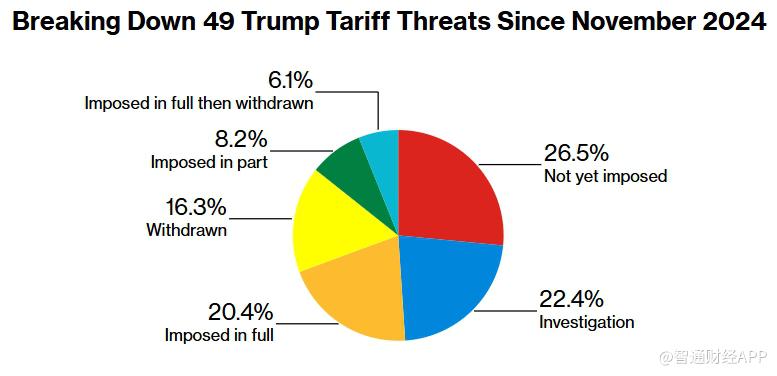
Core Viewpoint - The recent tariff threats issued by President Trump are perceived by the financial markets and corporate sectors as negotiation tactics rather than actual policy actions, leading to a relatively muted response from investors and executives [1][4]. Group 1: Tariff Threats and Market Reaction - Trump has issued four significant tariff threats in less than three weeks, which typically would cause investor volatility and corporate anxiety, but the current market response has been relatively calm [1]. - Approximately 25% of Trump's tariff threats have been implemented, while around 43% have been retracted, indicating a low execution rate of his threats [1]. - The market views these threats as tools for negotiation rather than definitive policy changes, reflecting a decrease in sensitivity among investors to Trump's tariff rhetoric [4]. Group 2: Analysis of Tariff Threats - Economists Nicole Gorton-Caratelli and Chris Kennedy reviewed 49 tariff threats or new trade investigations proposed by Trump since the November 2024 election, finding that over half were not fully executed [4]. - The actual implementation of threats or investigations has been concentrated between February and September, with a noticeable reduction in threats towards the end of the year, suggesting a correlation with public sentiment regarding domestic cost pressures [4]. - The pattern of Trump's tariff threats shows that he tends to retract the most eye-catching and impactful threats, particularly those that could significantly raise actual tariffs or disrupt the trade truce with China [4].

美国财长贝森特:欧盟的报复准备措施是一种谈判策略。
news flash· 2025-07-23 11:12
Core Viewpoint - The U.S. Treasury Secretary, Janet Yellen, stated that the European Union's preparation for retaliatory measures is a negotiation strategy [1] Group 1 - The EU's potential retaliatory measures are seen as a tactic to strengthen their position in negotiations [1] - Yellen emphasized that such actions are common in international trade discussions [1] - The comments reflect ongoing tensions between the U.S. and EU regarding trade policies [1]
美媒:中美会谈让部分国家转变谈判策略,中国“不卑不亢”作风可能会被学习借鉴
Huan Qiu Shi Bao· 2025-05-20 00:05
Core Insights - The recent trade talks between China and the U.S. in Geneva have positively impacted the global economy, leading to a significant rollback of high tariffs imposed by the U.S. on China, providing a potential negotiation strategy for other countries facing similar tariff pressures [1] - The calm and composed demeanor exhibited by China during the negotiations may serve as a model for other nations in their dealings with the U.S. [1] Group 1 - The trade talks have prompted a shift in negotiation strategies among countries facing U.S. tariffs, encouraging them to adopt a more composed approach [3] - South Korea's leading presidential candidate, Lee Jae-myung, has suggested a steady approach in trade negotiations with the U.S., advising the current interim government against rushing [3] - India has indicated a preference for a cautious negotiation style with the U.S., urging the media not to make premature judgments [3] Group 2 - Japanese decision-makers are likely to reconsider their timeline for reaching an agreement with the U.S., allowing more time for negotiations to secure better outcomes [3] - U.S. officials have also signaled that negotiations may require more time, reflecting a broader understanding of the need for patience in trade discussions [3] - The ability of a country to maintain composure in negotiations with the U.S. is often linked to its own bargaining power, which is indicative of its overall strength [3]
美国财长贝森特:战略上的不确定性是美国总统特朗普的谈判策略。
news flash· 2025-05-01 11:30
Core Viewpoint - The U.S. Treasury Secretary, Mnuchin, stated that strategic uncertainty is part of President Trump's negotiation strategy [1] Group 1 - The statement highlights the role of strategic uncertainty in negotiations, suggesting it is a deliberate tactic employed by the Trump administration [1]