关税威胁

Search documents
特朗普:如果加拿大推进与中国磋商达成的贸易协议,美国将采取重磅措施,我们不希望中国掌控加拿大
Xin Lang Cai Jing· 2026-02-01 17:16
Core Viewpoint - The article highlights President Trump's warning to Canada regarding its potential trade agreement with China, indicating that the U.S. will respond significantly if Canada proceeds with the deal [2][4]. Group 1: U.S. Response to Canada-China Trade Agreement - President Trump stated that if Canada finalizes a trade agreement with China, the U.S. will take "heavy measures" [4]. - Trump previously threatened to impose a 100% tariff on Canadian goods if the trade agreement with China is implemented [4]. Group 2: Canadian Government's Reaction - Canadian Prime Minister Mark Carney responded strongly to Trump's tariff threat, emphasizing his focus on empowering Canadian citizens to control their economic destiny amid foreign threats [4].

特朗普威胁对加拿大采取“重磅措施”
Xin Lang Cai Jing· 2026-02-01 13:07
Core Viewpoint - The article highlights President Trump's warning to Canada regarding its potential trade agreement with China, indicating that the U.S. will respond significantly if Canada proceeds with the deal [1]. Group 1: U.S. Response - President Trump stated that if Canada finalizes a trade agreement with China, the U.S. will take "heavy measures" [1]. - Trump previously threatened to impose a 100% tariff on Canada if the trade deal with China is realized [1]. Group 2: Canada's Position - Canadian Prime Minister Mark Carney responded strongly to Trump's tariff threats, emphasizing his focus on empowering Canadian citizens against "foreign threats" to their economic future [1].
特朗普威胁对加采取“重磅措施”
Xin Lang Cai Jing· 2026-02-01 12:32
Core Viewpoint - The article discusses U.S. President Trump's warning to Canada regarding its potential trade agreement with China, indicating that significant repercussions will follow if Canada proceeds with the deal [1][2]. Group 1: U.S. Response to Canada-China Trade Agreement - President Trump stated that if Canada finalizes a trade agreement with China, the U.S. will take "heavy measures" [1][2]. - Trump previously threatened to impose a 100% tariff on Canada if the trade agreement with China is realized [1][2]. Group 2: Canadian Government's Reaction - Canadian Prime Minister Mark Carney responded strongly to Trump's tariff threat, emphasizing his efforts to empower Canadian citizens against foreign economic threats [1][2].
关税突发!特朗普再威胁征税,宣布国家紧急状态
Sou Hu Cai Jing· 2026-01-30 01:42
Group 1 - The core viewpoint of the article highlights President Trump's threats to impose tariffs on goods from countries supplying oil to Cuba and on Canadian aircraft due to certification disputes [1][4] - Trump signed an executive order declaring a national emergency regarding the tariffs on goods from countries providing oil to Cuba [1] - The U.S. will suspend the certification of Bombardier's Global Express series and all Canadian-made aircraft until the Gulfstream aircraft receive full certification [1] Group 2 - Trump warned that if the certification issues are not resolved immediately, a 50% tariff will be imposed on all Canadian aircraft exported to the U.S. [1] - International gold and silver prices rose during the Asian trading session, following a day when they reached historical highs [1][2] - The London gold price was reported at 5435.895, reflecting a 1.09% increase, while the London silver price was at 117.585, up by 1.48% [2]

瑞达期货贵金属期货日报-20260129
Rui Da Qi Huo· 2026-01-29 09:26
1. Report Industry Investment Rating There is no information about the report industry investment rating provided in the content. 2. Report's Core View - The precious metals market continued to experience an accelerating upward trend, with gold prices hitting new all - time highs. The Fed maintained the interest rate as expected at the FOMC meeting. The market may price in a more hawkish Fed stance. Under the assumption of stable inflation and employment data, the market expects the Fed to cut interest rates 2 - 3 times in the second half of the year. The overall bullish logic for precious metals remains intact in the medium - to - long - term, and investors should consider buying on dips, while being cautious of short - term corrections. The London gold is expected to face resistance at $5500 per ounce and find support at $5000 per ounce, and London silver at $120 per ounce and $100 per ounce respectively [2]. 3. Summary by Relevant Catalogs 3.1 Futures Market - **Prices**: The closing price of the Shanghai gold main contract was 1249.120 yuan/gram, up 62.9 yuan; the Shanghai silver main contract was 30891 yuan/kilogram, up 1672 yuan [2]. - **Positions**: The main contract positions of Shanghai gold decreased by 10653 hands to 211,820 hands, and those of Shanghai silver decreased by 4376 hands to 13,190 hands [2]. - **Volumes**: The trading volume of the Shanghai gold main contract increased by 90641 to 521,258 hands, while that of Shanghai silver decreased by 325925 to 759,570 hands [2]. - **Warehouse Receipts**: The warehouse receipt quantity of Shanghai gold remained unchanged at 103029 kilograms, and that of Shanghai silver decreased by 26360 kilograms to 482,008 kilograms [2]. 3.2现货市场 - **Spot Prices**: The spot price of gold on the Shanghai Gold Exchange was 1243.02 yuan, up 58.06 yuan; the spot price of Huatong No.1 silver was 30,094 yuan, up 1105 yuan [2]. - **Basis**: The basis of the Shanghai gold main contract was - 6.10 yuan/gram, down 4.86 yuan; the basis of the Shanghai silver main contract was - 797 yuan/gram, down 567 yuan [2]. - **ETF Holdings**: The SPDR gold ETF holdings increased by 2.58 tons to 1089.96 tons, and the SLV silver ETF holdings decreased by 211.42 tons to 15,636.12 tons [2]. 3.3 Supply and Demand - **CFTC Non - commercial Net Positions**: The non - commercial net positions of gold in CFTC decreased by 6468 to 244770 contracts, and those of silver decreased by 6846 to 25,214 contracts [2]. - **Supply**: The total quarterly supply of gold increased by 86.24 tons to 1313.07 tons, and the total annual supply of silver increased by 482 tons to 32,056 tons [2]. - **Demand**: The total quarterly demand for gold increased by 174.15 tons to 1257.90 tons, and the total annual demand for silver decreased by 491 tons to 35,716 tons [2]. 3.4 Macro Data - **Dollar Index**: The dollar index was 96.35, up 0.59 [2]. - **Yield and Volatility**: The 10 - year US Treasury real yield was 1.90%, unchanged; the VIX volatility index was 16.35, unchanged; the CBOE gold volatility index was 39.67, up 6.54 [2]. - **Ratios**: The S&P 500/gold price ratio was 1.31, down 0.06; the gold - silver ratio was 47.05, up 1.66 [2]. 3.5 Industry News - **Fed Policy**: The Fed maintained the benchmark interest rate at 3.50% - 3.75%, pausing after three consecutive 25 - basis - point cuts. Fed Chair candidate Waller supported a 25 - basis - point cut. The Fed noted that the unemployment rate showed initial signs of stabilization, inflation remained relatively high, and economic uncertainty was still high. Fed Chair Powell said that raising interest rates was not the basic assumption for the next move, and he believed the Fed would maintain its independence [2]. - **Geopolitical Tensions**: US President Trump threatened Iran again, saying the next strike would be more intense and a large fleet was heading to Iran [2]. - **BOJ Policy**: The Bank of Japan's meeting minutes showed that if the outlook met expectations, it was advisable to continue raising interest rates, and the monetary policy environment would remain loose even after a rate hike [2]. - **Rate Cut Probability**: According to CME "FedWatch", the probability of a 25 - basis - point rate cut by the Fed in March was 13.5%, and the probability of keeping the rate unchanged was 86.5%. By April, the probability of a 25 - basis - point cumulative cut was 24.1%, the probability of keeping the rate unchanged was 74%, and the probability of a 50 - basis - point cumulative cut was 2.0% [2].
3 European Stocks Built to Shrug Off Tariffs
Yahoo Finance· 2026-01-28 14:18
Core Insights - The current market focus is heavily on tariffs, particularly under the second Trump administration, with threats to increase tariffs on Canada, Mexico, Europe, and Asia causing market volatility [2][3] - U.S. trading partners, especially India and China, are adapting to the unpredictable tariff landscape, leading to a shift in international trade dynamics [3][4] - European stocks have been outperforming U.S. stocks, with the S&P 500 showing less than 1.5% growth over the last three months, indicating a potential investment opportunity in European markets [3][5] Tariff Threats and Market Impact - The Trump administration's renewed tariff threats in January, particularly regarding the Greenland purchase, have created an environment of uncertainty for U.S. trading partners [4][6] - The ongoing tariff discussions may lead to a preference for European companies that generate revenue outside the U.S. or those whose products are likely exempt from tariffs [6] Investment Opportunities - There is a growing trend towards international diversification, with significant reallocations of funds by major investment firms like BlackRock and Vanguard towards global markets [5] - Three European stocks are identified as minimally affected by tariffs, presenting potential safe havens for capital amidst ongoing tariff threats [6]
加税动机引诸多猜测!特朗普“关税突袭”,韩国强烈不安
Huan Qiu Shi Bao· 2026-01-27 22:57
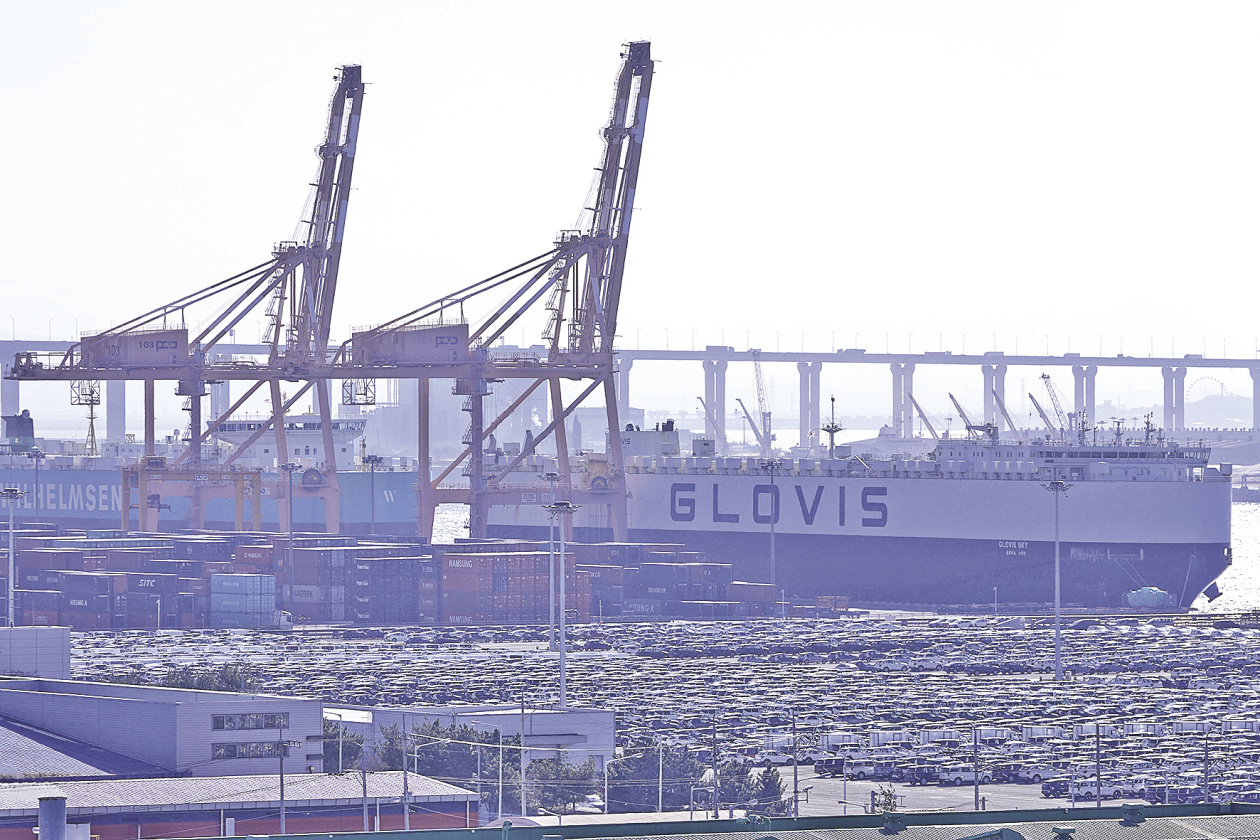
Group 1 - The core point of the article is that President Trump announced an increase in tariffs on South Korean goods, including automobiles, from 15% to 25%, citing the South Korean National Assembly's failure to approve a trade agreement with the U.S. [1][3] - The South Korean government expressed confusion and concern over the lack of formal notification from the U.S. regarding the tariff increase, indicating that they would communicate their intent to fulfill the trade agreement [1][3][5] - Experts believe that the U.S. is using tariff threats as leverage to accelerate South Korea's investment commitments, which were agreed upon last November, where South Korea pledged to invest $350 billion in the U.S. [5][6] Group 2 - The announcement has caused significant anxiety among South Korean businesses, as they had previously settled tariff issues through negotiations, and this sudden increase has created uncertainty in the investment environment [6][7] - Trump's use of tariffs as a diplomatic tool has raised doubts among allies about the stability of U.S. trade policies, with concerns that such unpredictable actions could disrupt global trade [5][8] - The article highlights that Trump's tariff threats are not isolated to South Korea, as he has also threatened other countries, indicating a broader strategy to use tariffs for political leverage ahead of upcoming elections [7][8]
特朗普关税追踪:落地概率不足三成 最引人注目的狠话常被收回
Xin Lang Cai Jing· 2026-01-27 16:43
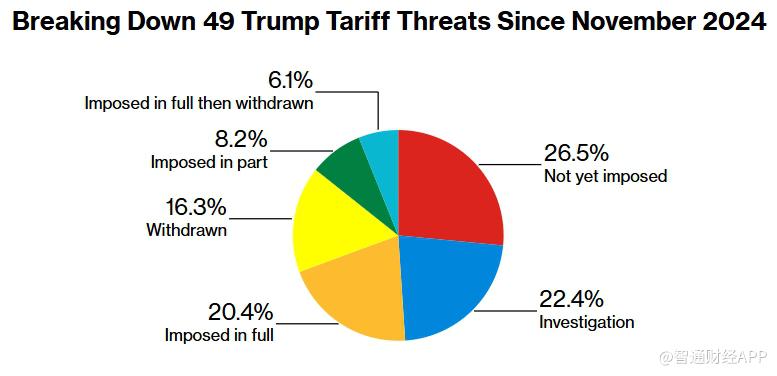
Core Viewpoint - Trump's recent threats regarding tariffs have not significantly unsettled financial markets or corporate executives, as they are perceived as strategic moves rather than serious actions [2][8]. Group 1: Analysis of Tariff Threats - Trump has issued four tariff threats in less than three weeks, typically causing investor anxiety and lowering growth forecasts for targeted countries [2][8]. - A new analysis indicates that Trump follows through on his threats approximately 25% of the time, while about 43% of the threats are either retracted or never formally implemented [9][8]. Group 2: Timeline and Trends - The majority of fully executed or investigated threats occurred between February and September, with a noted decrease in threats towards the end of last year as concerns over living costs affected his approval ratings [11][4]. - The analysis shows that Trump tends to retract his most significant threats, particularly those that would drastically increase U.S. effective tariff rates or jeopardize trade ceasefires [6][13].
市场对特朗普关税威胁“免疫”?经济学家:仅约四分之一真正实施
智通财经网· 2026-01-27 15:04
Core Viewpoint - The recent tariff threats issued by President Trump are perceived by the financial markets and corporate sectors as negotiation tactics rather than actual policy actions, leading to a relatively muted response from investors and executives [1][4]. Group 1: Tariff Threats and Market Reaction - Trump has issued four significant tariff threats in less than three weeks, which typically would cause investor volatility and corporate anxiety, but the current market response has been relatively calm [1]. - Approximately 25% of Trump's tariff threats have been implemented, while around 43% have been retracted, indicating a low execution rate of his threats [1]. - The market views these threats as tools for negotiation rather than definitive policy changes, reflecting a decrease in sensitivity among investors to Trump's tariff rhetoric [4]. Group 2: Analysis of Tariff Threats - Economists Nicole Gorton-Caratelli and Chris Kennedy reviewed 49 tariff threats or new trade investigations proposed by Trump since the November 2024 election, finding that over half were not fully executed [4]. - The actual implementation of threats or investigations has been concentrated between February and September, with a noticeable reduction in threats towards the end of the year, suggesting a correlation with public sentiment regarding domestic cost pressures [4]. - The pattern of Trump's tariff threats shows that he tends to retract the most eye-catching and impactful threats, particularly those that could significantly raise actual tariffs or disrupt the trade truce with China [4].
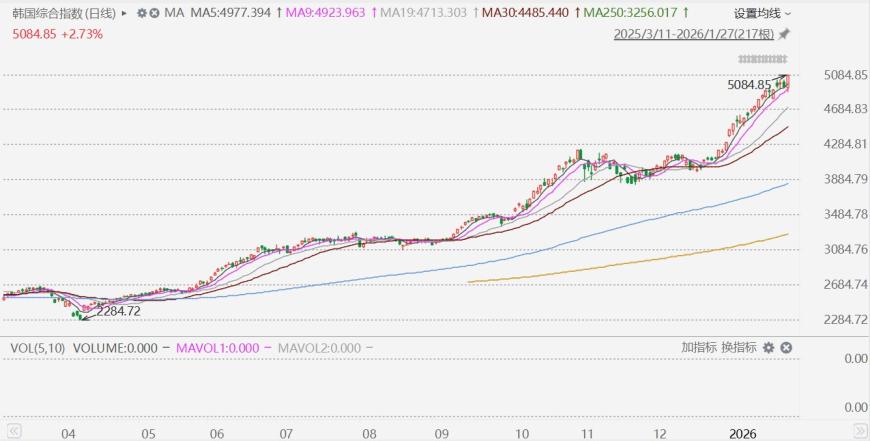
对特朗普关税威胁不为所动?韩股收涨2.73%再创历史新高
Ge Long Hui· 2026-01-27 07:04
Core Viewpoint - The South Korean Composite Index experienced a significant increase, closing at a record high of 5084.85 points, despite initial declines due to trade threats from Trump [1]. Group 1: Market Performance - On January 27, the South Korean Composite Index fell over 1% during the day due to Trump's threat to raise tariffs on South Korean goods from 15% to 25% but ultimately closed up 2.73% [1]. - The index has seen a cumulative increase of 20.66% within the month [1]. Group 2: Analyst Insights - Analysts noted that the low opening and high closing of the South Korean stock market indicate that traders are becoming less responsive to Trump's trade strategies, betting that he will not follow through on severe penalties often used as negotiation tactics [1]. - According to economist Nicole Gordon-Caratelli, only 27% of the tariff threats issued by Trump since his re-election have been realized [1].