账号关联

Search documents
指纹浏览器 vs 无痕模式:选择哪个更适合跨境电商多账号管理?
Sou Hu Cai Jing· 2026-02-10 09:38
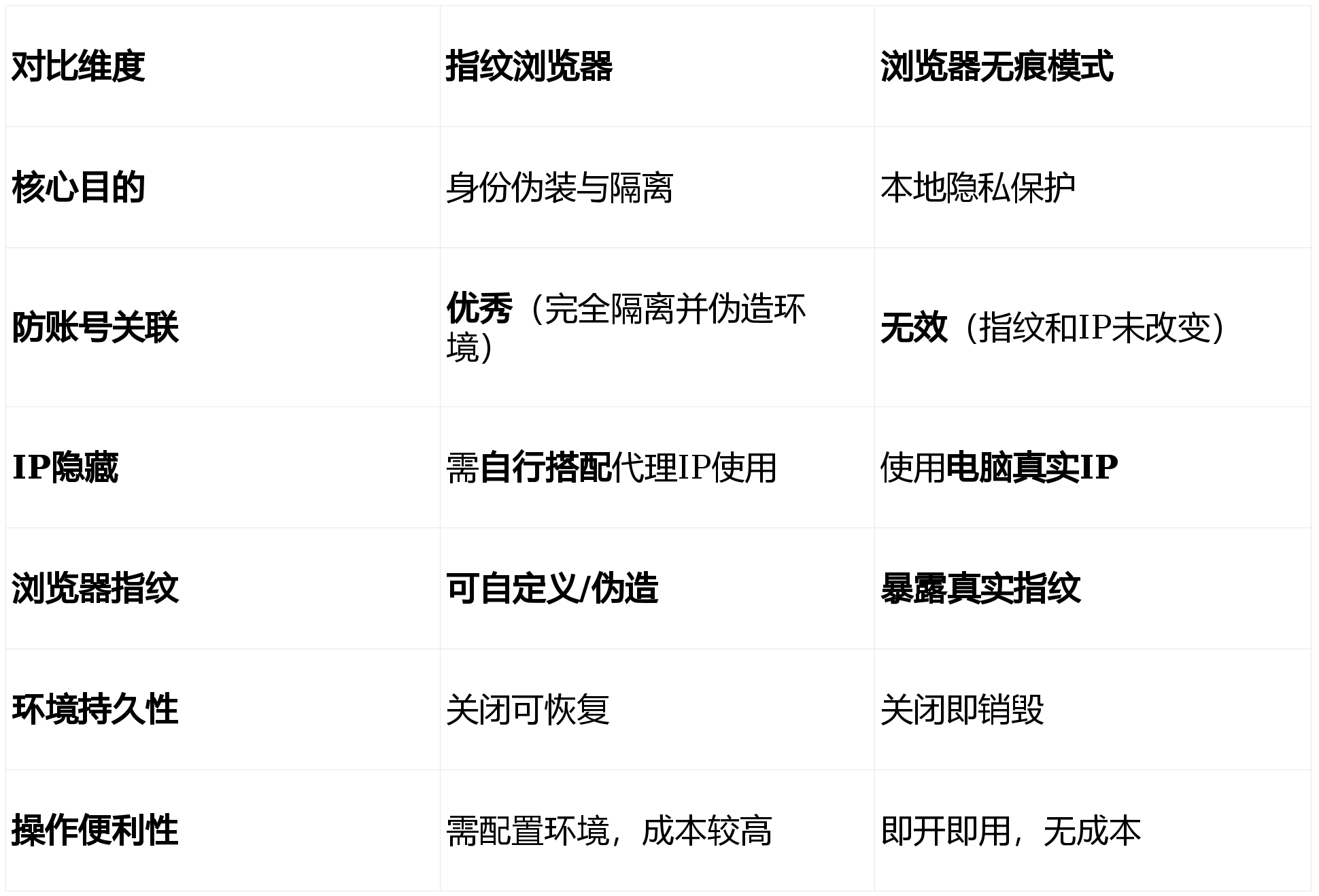
Core Insights - The article discusses the challenges of managing multiple accounts in cross-border e-commerce, emphasizing the importance of account security and the differences between fingerprint browsers and incognito mode [1][3]. Fingerprint Browser - The fingerprint browser actively forges and isolates browser fingerprints, creating a unique and stable virtual browser environment for each account [1]. - It can customize and spoof browser fingerprints, ensuring that each account operates in a completely isolated environment, which is crucial for preventing account bans [3][4]. - Fingerprint browsers are particularly effective for cross-border e-commerce operations, as they simulate multiple independent computers, thus reducing the risk of account association and bans [3][5]. Incognito Mode - Incognito mode focuses on privacy protection rather than identity masking, providing a temporary browsing session that does not leave local traces [2]. - It does not hide or alter the user's real information, meaning the actual IP address and browser fingerprint are still exposed to websites and service providers [3]. Comparison of Use Cases - Fingerprint browsers are suitable for scenarios requiring identity masking and account isolation, such as managing multiple accounts on e-commerce platforms and social media [3][4]. - Incognito mode is appropriate for temporary logins and testing website visitor states, as it clears local data but does not prevent account association [3][4]. Proxy IP Integration - Combining fingerprint browsers with proxy IPs enhances account security by ensuring that each virtual browser environment is linked to a unique IP address, preventing detection of account associations [5][9]. - Different types of proxy IPs (static, dynamic, residential) are suited for various business scenarios, with static residential IPs being advantageous for cross-border e-commerce [4][5]. Security Considerations - While using fingerprint browsers and proxy IPs significantly reduces the risk of detection, complete security is not guaranteed, as operational behaviors also play a critical role in account safety [8][9]. - Each virtual browser environment should ideally be paired with a distinct proxy IP to maintain account isolation [7].

IPv4地址一般是什么格式?IP地址基础知识科普
Sou Hu Cai Jing· 2025-09-26 10:52
Core Concept - The article discusses the structure and significance of IPv4 addresses, highlighting the differences between public and private IP addresses, as well as the importance of IP addresses in various professional contexts [1][7][11]. IPv4 Address Structure - IPv4 addresses are commonly represented in Dotted-Decimal Notation, consisting of four groups of numbers separated by dots, with each number ranging from 0 to 255 [2][3]. - Each IPv4 address is fundamentally a 32-bit binary code, with each decimal group corresponding to an 8-bit binary number [4][5]. Public vs Private IP Addresses - Public IP addresses serve as unique identifiers for devices on the internet, assigned by Internet Service Providers (ISPs), and can be accessed directly from the internet [7][9]. - Private IP addresses are used within local networks (LANs) and allow devices to communicate internally without being exposed to the public internet [7][8]. Dynamic vs Static IP Addresses - Dynamic IP addresses are commonly used by residential broadband users and can change with each network reconnection [10][13]. - Static IP addresses remain constant and are typically used in professional settings where a permanent address is required for consistent access [10][13]. Importance of IP Addresses in Professional Contexts - For industries such as cross-border e-commerce and social media marketing, IP addresses are critical strategic resources that can influence business success [11][12]. - IP addresses are monitored by platforms to prevent account associations, which can lead to multiple accounts being penalized if one is flagged [11][12]. IPFLY's Role in IP Management - IPFLY provides services that help businesses manage their IP addresses effectively, offering solutions for IP isolation and simulating local environments for account management [13][14]. - The service allows users to bypass geographical restrictions and access a wide range of online resources, enhancing operational capabilities [14].