资本充足率下滑

Search documents
东莞农商银行净利三连降!
Shen Zhen Shang Bao· 2026-03-28 13:57
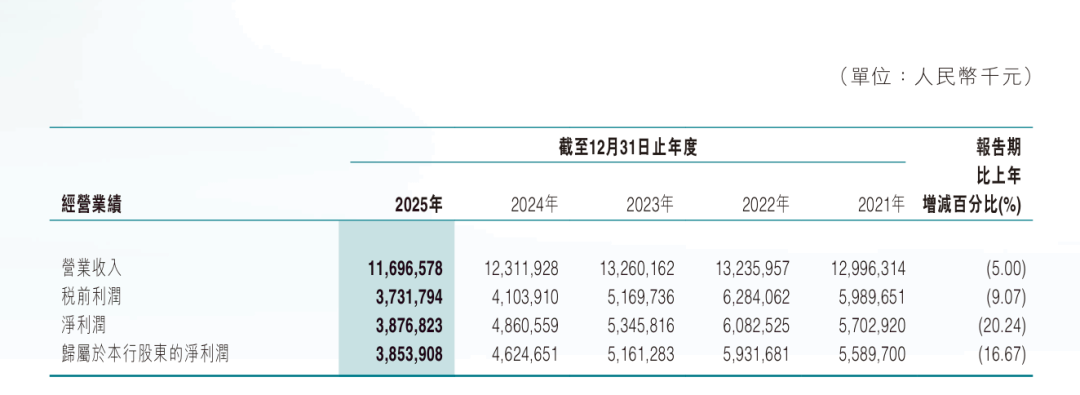
Core Viewpoint - Dongguan Rural Commercial Bank reported a decline in revenue and net profit for the year 2025, marking the third consecutive year of profit decline, raising concerns about its financial health and operational efficiency [2][4]. Financial Performance - The bank achieved a revenue of 11.697 billion yuan in 2025, a decrease of 5% year-on-year [3]. - The net profit attributable to shareholders was 3.854 billion yuan, down 16.67% compared to the previous year [2][3]. - The pre-tax profit also fell to 3.732 billion yuan, reflecting a 9.07% decline [3]. Profitability Indicators - Average return on total assets decreased to 0.50% from 0.67% in 2024, a drop of 0.17 percentage points [5]. - Average return on equity fell to 6.18%, down from 8.10% the previous year, a decrease of 1.92 percentage points [5]. - The net interest margin decreased to 1.19%, down from 1.30% [5]. - The cost-to-income ratio increased to 38.36%, up by 0.92 percentage points year-on-year [5]. Asset and Capital Position - As of the end of 2025, total assets amounted to 796.016 billion yuan, with total deposits at 544.212 billion yuan and total loans at 409.031 billion yuan [4]. - The capital adequacy ratio was reported at 15.41%, down 1.13 percentage points from the previous year [6]. - The core tier 1 capital adequacy ratio decreased to 13.30%, a decline of 1.04 percentage points [6]. Compliance Issues - In November 2025, the bank was fined 2.45 million yuan for inadequate loan management practices, including failure to conduct proper risk assessments [8][9]. - Specific penalties were imposed on responsible individuals within the bank, highlighting compliance challenges [8][9]. Market Performance - As of March 27, the bank's stock price increased by 0.59%, closing at 3.39 HKD per share, with a total market capitalization of 23.35 billion HKD [10].

郑州银行,1.21亿股将被司法拍卖
Shen Zhen Shang Bao· 2025-11-05 13:01
Core Insights - Zhengzhou Bank reported a revenue of 9.395 billion yuan for the first three quarters of 2025, representing a year-on-year increase of 3.91%, and a net profit of 2.279 billion yuan, up 1.56% year-on-year. Despite this growth, the bank's stock has declined by 2% this year [1][2]. Financial Performance - In Q3 2025, Zhengzhou Bank achieved a revenue of 2.705 billion yuan, a 2.15% increase year-on-year, with a net profit of 652 million yuan, up 0.22% year-on-year [2]. - Non-interest income for the first three quarters reached 1.579 billion yuan, showing significant growth, but was heavily influenced by investment income and fair value changes, which are volatile and do not provide stable profit support [2]. - The bank's credit impairment losses rose significantly, reaching 4.359 billion yuan in Q3, an increase of 313 million yuan or 7.74% year-on-year, primarily due to increased losses from loans and advances [2][3]. Capital Adequacy - The bank's capital adequacy ratios have been declining for three consecutive years, with the core tier 1 capital ratio dropping from 9.29% at the end of 2022 to 8.76% by Q3 2025. The tier 1 capital ratio fell from 11.63% to 10.74%, and the total capital ratio decreased from 12.72% to 12.00% [3]. Shareholder Issues - Zhengzhou Bank has faced challenges with executive share reductions, judicial auctions of shares, and severe share pledges. The largest shareholder, Zhengzhou Municipal Finance Bureau, holds 657 million shares, accounting for 7.23% of total shares, with a significant portion pledged [4]. - Henan Guoyuan Trading Co., one of the top ten shareholders, has continuously reduced its holdings, selling 20.8488 million shares in 2023, 9.4066 million shares in 2024, and 88.8012 million shares in the first half of 2025, reducing its stake from 3.53% at the end of 2024 to 1.76% by the end of September 2025 [4]. Market Performance - In the Hong Kong stock market, institutional investors like Yuanta Financial Holdings and Yunnan Energy Investment Group have reduced their holdings in Zhengzhou Bank's H-shares from 11.99% to 10.81% [6]. - As of November 5, 2025, Zhengzhou Bank's A-shares closed at 2.04 yuan per share, down over 50% from their historical peak, while H-shares reached a low of 0.68 HKD, currently trading at 1.28 HKD [6].

营收、净利润双降,东莞银行、南海农商行上市前路几何?
Nan Fang Du Shi Bao· 2025-09-12 12:27
Core Viewpoint - The recent performance data of Dongguan Bank and Nanhai Rural Commercial Bank raises concerns about their prospects for A-share IPOs, as both banks have experienced significant declines in revenue and net profit in the first half of 2025 [2][3]. Financial Performance - In the first half of 2025, Dongguan Bank reported revenue of 4.97 billion yuan, a year-on-year decline of 8.02%, and a net profit of 2.36 billion yuan, down 1.4% [3]. - Nanhai Rural Commercial Bank's revenue was 3.28 billion yuan, a decrease of 8.2%, with a net profit of 1.39 billion yuan, down 14.2% [3]. - Both banks continued the downward trend observed in 2024, with Dongguan Bank's revenue and net profit declining by 3.7% and 8.2% respectively, while Nanhai's revenue fell by 6.3% [3]. Interest Margin and Asset Growth - The net interest margin for Dongguan Bank and Nanhai Rural Commercial Bank has decreased to 1.11% and 1.08% respectively, significantly lower than the industry average of 1.42% [3][4]. - Total assets for Dongguan Bank reached 677 billion yuan, growing by 5% year-on-year, while Nanhai's total assets were 337.71 billion yuan, also up by 5.2% [4]. Investment Income Dependency - Nanhai Rural Commercial Bank's investment net income accounted for 44.1% of its revenue, the highest among all A-share listed city commercial banks, while Dongguan Bank's investment net income represented 29.8% of its revenue [7]. - Both banks have seen increased volatility in non-interest income, with Dongguan Bank's non-interest income showing mixed results, including a significant loss in fair value changes [6][7]. Capital Adequacy and IPO Challenges - Dongguan Bank's core Tier 1 capital adequacy ratio decreased from 9.31% at the beginning of the year to 9.24% by mid-year, while Nanhai's ratio fell from 13.52% to 12.4% [8][9]. - The prolonged wait for an IPO, with Dongguan Bank having submitted its application in 2008 and Nanhai in 2018, highlights the increasing uncertainty surrounding bank listings in the current market environment [8][9].