赛道轮动行情

Search documents
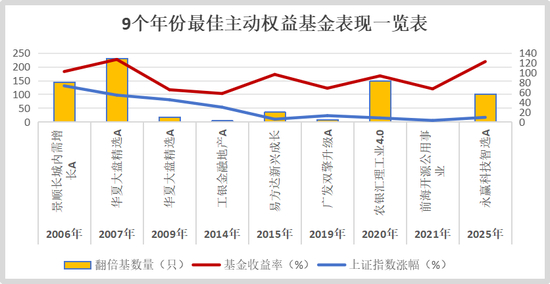
收益率超200%!时隔17年,公募再现“两倍基”
Xin Lang Cai Jing· 2025-12-14 07:25
Core Insights - The active equity funds in the public offering sector have shown remarkable performance in 2025, with nearly 60 funds achieving "doubling" returns and the first fund since 2008 reaching over 200% returns [1][15] - If the leading fund maintains a cumulative return exceeding 7.84% in the remaining trading days of 2025, it will set a record for the highest annual return in public fund history [1][18] - The resurgence of active management capabilities is attributed to both market structural changes and advancements in research capabilities within public funds [1][9] Performance Highlights - As of December 12, 2025, the top-performing fund, Yongying Technology Smart Selection A, achieved a return of 218.40%, significantly outperforming the second-place fund by over 50 percentage points [4][18] - The number of funds with returns exceeding 100% reached 57, with 19 of those exceeding 120% [8][21] - Historical comparisons show that the highest number of "doubling" funds occurred in 2007, with 129 funds, while the current year has seen a resurgence in high-performing funds [21] Market Trends - The performance of active equity funds has been particularly strong in 2025, with a notable concentration in technology, high-end manufacturing, and innovative pharmaceutical sectors [9][22] - The market has shifted towards structural trends, with significant returns linked to concentrated holdings in popular stocks [9][24] - The current market environment is characterized by a longer duration and larger scale of structural trends compared to previous years [25] Industry Dynamics - The active management capabilities of public funds are being reaffirmed, with a shift away from short-term behaviors towards a focus on investor interests and research-driven strategies [13][26] - The talent pool within public funds has improved, ensuring stable output and continuity in research capabilities [11][25] - The industry is experiencing a cultural shift towards prioritizing long-term investment strategies over short-term gains, which has alleviated some pressures on fund managers [13][26]