
结构性行情

Search documents
超4300只个股上涨
第一财经· 2026-03-27 07:41
Market Overview - On March 27, all four major indices closed higher, with the Shanghai Composite Index rising by 0.63% to 3913.72, the Shenzhen Component Index increasing by 1.13% to 13760.37, the ChiNext Index up by 0.71% to 3295.88, and the STAR Market Index gaining 1.54% to 1662.72 [3][4]. Sector Performance - The lithium battery sector experienced a significant surge, with energy metals, chemical pharmaceuticals, and innovative drug sectors leading the gains. Conversely, the electricity, insurance, and banking sectors saw declines [4]. - Notable gainers in the lithium sector included companies like Yongshan Liye (+10.05% to 11.72), Shengxin Lithium Energy (+10.00% to 42.23), and Rongjie Co. (+10.00% to 78.00) [5]. - The electricity sector faced adjustments, with companies such as Guangdong Power A (-7.34% to 6.94) and Hunan Development (-7.22% to 16.96) experiencing significant losses [6]. Capital Flow - There was a net inflow of capital into sectors such as non-ferrous metals, electronics, and biomedicine, while public utilities, banking, and transportation sectors saw net outflows [7]. - Specific stocks with notable net inflows included Ganfeng Lithium (15.32 billion), Shenjian Co. (8.36 billion), and Dongfang New Energy (8.02 billion) [7]. Institutional Insights - According to Caixin Securities, the market may exhibit a structural differentiation in thematic sectors in the near term [9]. - CITIC Securities forecasts that oil transportation companies are expected to achieve record profits in 2026 [10]. - Huatai Securities anticipates that the global supply-demand balance for lithium carbonate will remain tight [11].



首发规模超58亿元!主动权益基金再现爆款
券商中国· 2026-03-11 15:00
Core Viewpoint - The article highlights the emergence of "explosive" actively managed equity funds in the market, with a notable example being the Yongying Rui Jian Growth Mixed Fund, which raised over 5.8 billion yuan during its initial offering period, indicating a strong demand for new equity products in a favorable macroeconomic environment [1][2][7]. Fundraising Highlights - The Yongying Rui Jian Growth Mixed Fund had a net subscription amount of 5.867 billion yuan and attracted over 230,000 investors during its fundraising period from February 26 to March 6 [2][5]. - As of March 11, 2023, a total of 251 new funds have been established this year, raising a cumulative amount of 232.145 billion yuan, with actively managed equity funds showing particularly strong performance [1][7]. Market Trends - The article notes that the fundraising success of new equity funds is driven by several factors, including the ongoing profitability of the equity market, favorable macro policies, and improved liquidity conditions [7][10]. - The performance of equity funds in 2025, which saw a rise of over 30%, has bolstered investor confidence, leading to increased willingness to invest in the stock market [7]. Investment Outlook - Looking ahead to 2026, the market is expected to witness a more diverse structural market, supported by a friendly macro environment, ample liquidity, and continuous inflow of new capital [6][10]. - Key investment areas identified for 2026 include artificial intelligence, military technology, innovative pharmaceuticals, high-end manufacturing, controllable nuclear fusion, commercial aerospace, and differentiated competition in cyclical products [6].
申万期货品种策略日报——股指-20260304
Shen Yin Wan Guo Qi Huo· 2026-03-04 03:47
Report Summary 1. Report Industry Investment Rating - No industry investment rating is provided in the report [1][2] 2. Core View of the Report - Affected by geopolitical factors, US stocks continued to decline significantly, and A - shares fell again in the previous trading day. The defense and military industry sector led the decline, while the petroleum and petrochemical sector led the rise, with a market turnover of 3.16 trillion yuan. From March onwards, as listed companies gradually disclose their annual and first - quarter reports, industry leaders with strong performance certainty will attract funds, driving the market from "expectation - driven" to "profit - driven". The market will enter the "alpha selection" stage, with pure concept stocks and small - cap stocks without performance support likely to remain weak, while policy - beneficiary and performance - improving sectors may have sustainable opportunities. In the short term, due to geopolitical disturbances, the risk - aversion sentiment has increased, and the risk preference has declined. In the long run, the stock index trend will return to the domestic fundamentals, focusing on the resonance effect of policy implementation and industry catalysis, and funds are likely to continue to focus on high - growth sectors to consolidate the market's structural trend [2] 3. Summary by Relevant Catalogs 3.1 Stock Index Futures Market - **IF Contracts**: The previous day's closing prices of IF contracts (current month, next month, next quarter, and far - quarter) were 4651.40, 4639.40, 4606.60, and 4541.20 respectively, with declines of 60.60, 64.40, 59.40, and 61.20, and decline rates of 1.29%, 1.37%, 1.27%, and 1.33% respectively. The trading volumes were 107068.00, 7207.00, 37297.00, and 15057.00, and the open interests were 145903.00, 7122.00, 94886.00, and 40016.00, with changes of - 4542.00, 1534.00, 2246.00, and 1146.00 respectively [1] - **IH Contracts**: The previous day's closing prices of IH contracts (current month, next month, next quarter, and far - quarter) were 3019.00, 3016.40, 3010.20, and 2972.80 respectively, with declines of 25.20, 28.40, 27.80, and 30.60, and decline rates of 0.83%, 0.93%, 0.92%, and 1.02% respectively. The trading volumes were 52257.00, 3366.00, 16224.00, and 7126.00, and the open interests were 62121.00, 4171.00, 31817.00, and 16433.00, with changes of 580.00, 525.00, - 121.00, and 694.00 respectively [1] - **IC Contracts**: The previous day's closing prices of IC contracts (current month, next month, next quarter, and far - quarter) were 8266.20, 8214.80, 8136.20, and 7993.20 respectively, with declines of 366.40, 393.60, 374.20, and 368.20, and decline rates of 4.24%, 4.57%, 4.40%, and 4.40% respectively. The trading volumes were 150232.00, 11368.00, 72049.00, and 27683.00, and the open interests were 148457.00, 11245.00, 116607.00, and 55794.00, with changes of 5416.00, 2770.00, 7095.00, and 5201.00 respectively [1] - **IM Contracts**: The previous day's closing prices of IM contracts (current month, next month, next quarter, and far - quarter) were 8129.40, 8089.00, 7949.40, and 7766.80 respectively, with declines of 300.60, 297.20, 286.80, and 271.40, and decline rates of 3.57%, 3.54%, 3.48%, and 3.38% respectively. The trading volumes were 179978.00, 15339.00, 68726.00, and 29646.00, and the open interests were 185852.00, 16170.00, 125408.00, and 74477.00, with changes of 4833.00, 5535.00, 4766.00, and 3778.00 respectively [1] - **Inter - month Spreads**: The current values of inter - month spreads for IF, IH, IC, and IM contracts were - 12.00, - 2.60, - 51.40, and - 40.40 respectively, compared with the previous values of - 8.60, - 2.00, - 24.00, and - 43.60 [1] 3.2 Stock Index Spot Market - **CSI 300 Index**: The previous day's index value was 4655.90, with a trading volume of 370.62 billion lots and a total trading value of 8016.59 billion yuan, a decline of 1.54% compared to the previous two - day value [1] - **SSE 50 Index**: The previous day's index value was 3014.27, with a trading volume of 104.83 billion lots and a total trading value of 2217.06 billion yuan, a decline of 1.06% compared to the previous two - day value [1] - **CSI 500 Index**: The previous day's index value was 8281.61, with a trading volume of 346.15 billion lots and a total trading value of 6346.60 billion yuan, a decline of 4.35% compared to the previous two - day value [1] - **CSI 1000 Index**: The previous day's index value was 8142.45, with a trading volume of 390.19 billion lots and a total trading value of 6648.64 billion yuan, a decline of 3.95% compared to the previous two - day value [1] - **CSI 300 Industry Index**: The decline rates of major consumer, pharmaceutical and healthcare, real estate and finance, and information technology sectors were - 0.47%, - 1.45%, 0.42%, and - 4.30% respectively. The decline rates of telecommunications services and public utilities sectors were - 1.88% and 1.03% respectively [1] 3.3 Futures - Spot Basis - **CSI 300**: The previous day's values of the basis for IF contracts (current month, next month, next quarter, and far - quarter) were - 4.50, - 16.50, - 49.30, and - 114.70 respectively [1] - **SSE 50**: The previous day's values of the basis for IH contracts (current month, next month, next quarter, and far - quarter) were 4.73, 2.13, - 4.07, etc. [1] - **CSI 500**: The previous day's values of the basis for IC contracts (current month, next month, next quarter, and far - quarter) were - 15.41, - 66.81, - 145.41, etc. [1] - **CSI 1000**: The previous day's values of the basis for IM contracts (current month, next month, next quarter, and far - quarter) were - 13.05, - 53.45, - 193.05, - 375.65 respectively [1] 3.4 Other Domestic and Overseas Major Indices - **Domestic Indices**: The decline rates of the Shanghai Composite Index, Shenzhen Component Index, Small and Medium - Sized Board Index, and ChiNext Index were - 1.43%, - 3.07%, - 3.16%, and - 2.57% respectively [1] - **Overseas Indices**: The decline rates of the Hang Seng Index, Nikkei 225, S&P Index, and DAX Index were - 1.12%, - 3.06%, - 0.94%, and - 3.57% respectively [1] 3.5 Macro Information - The 2026 National Two Sessions are about to start. The Fourth Session of the 14th National Committee of the Chinese People's Political Consultative Conference will be held from March 4th to 11th, and the Fourth Session of the 14th National People's Congress will open on March 5th [2] - The spokesperson of the National Committee of the Chinese People's Political Consultative Conference said that China's economy has a stable foundation, many advantages, strong resilience, and great potential, and the long - term positive support conditions and basic trends remain unchanged [2] - China's foreign ministry and foreign minister expressed their positions on the Middle East issue, urging all parties to stop military actions and maintain energy security [2] - US President Trump made a series of tough statements during his meeting with the German Chancellor, including on the Iran situation, European ally relations, and oil prices [2] 3.6 Industry Information - Six departments including the Ministry of Industry and Information Technology jointly issued a guidance on promoting the comprehensive utilization of photovoltaic modules [2] - The National Energy Administration emphasized ensuring power supply in the "15th Five - Year Plan", promoting energy transformation, and building a unified power market [2] - In 2025, China's primary energy production exceeded 500 million tons of standard coal, and non - fossil energy became the main source of new power generation [2] - Due to the tense situation in the Middle East, the traffic volume in the Strait of Hormuz has dropped sharply, and logistics in the region has come to a standstill [2]
不出意外,周四,A股可能见证10年新高了
Sou Hu Cai Jing· 2026-02-25 12:45
Group 1 - The A-share market is likely to witness a new 10-year high, with the Shanghai Composite Index approaching the 4190-point mark, indicating a potential upward trend rather than a peak for the year [1][5] - The real estate sector has seen significant gains, particularly among stocks with an average price exceeding 30,000, primarily in the Hong Kong market, suggesting a divergence in investment opportunities based on market perception [3] - Key sectors contributing to the index's rise include liquor, securities, and semiconductors, with energy prices also playing a role in lifting the index temporarily [5][7] Group 2 - The current market environment is characterized by structural trends and sector rotation, indicating that the market is in a mid-to-late phase rather than at the end of a bull market [5] - The prolonged consolidation around the 4200-point level may be beneficial for a future breakout, as the average holding cost has increased, suggesting that a significant upward movement could be imminent [7] - Investors are advised to remain patient and not to be overly concerned about short-term fluctuations, as long as major market players do not trigger a downturn [7]

ETF市场“冷热不均” 港股主题ETF受青睐
Zheng Quan Ri Bao· 2026-02-24 15:44
Group 1 - The ETF market has shown a "mixed" trend this year, with broad-based ETFs experiencing net outflows while Hong Kong-themed ETFs have gained traction, indicating a structural allocation logic in the market [1] - Specific data shows that as of February 24, the Hang Seng Tech ETF saw a net inflow of 29.6 billion, the Hong Kong Stock Connect Internet ETF had a net inflow of 11.3 billion, and the Hong Kong Stock Connect Innovative Drug ETF recorded a net inflow of 3.015 billion [1] - The overall trend reflects investors' heightened attention and inclination towards investment opportunities in the Hong Kong market, with a focus on low valuations and core assets in technology, innovative drugs, and internet platforms [2] Group 2 - The current valuation levels in the Hong Kong market are becoming increasingly attractive, with expectations of marginal improvements in corporate earnings and liquidity factors [2] - Investment strategies are focused on low-position layouts, sector concentration, and liquidity-driven approaches, with investors actively using ETFs to capture market opportunities [2] - The outlook for the Hong Kong market remains positive, with expectations of a "structural market" driven by substantial corporate earnings recovery rather than mere valuation expansion [2]
春季行情能否掀起,看节后抉择
2 1 Shi Ji Jing Ji Bao Dao· 2026-02-13 23:04
Core Viewpoint - The market is currently cautious, with a tendency for structural opportunities to emerge, particularly in sectors experiencing price increases, such as resource and innovative growth industries [5][14]. Market Trends - The A-share market typically exhibits a pattern of "weak before the holiday, strong after" based on historical trends [5][14]. - The Shanghai Composite Index has formed a significant upward channel since January 2025, with upper resistance levels identified at 3359 points (February 13, 2025), 3439 points (March 19, 2025), 3883 points (August 25, 2025), and 4025 points (October 30, 2025) [5][14]. - The lower boundary of this upward channel aligns with the 60-day moving average and the half-year line, currently situated between 3940 and 4000 points, which may provide strong support [5][14]. Future Projections - An important cyclical period is anticipated in August 2026, coinciding with various historical market milestones, which may influence market dynamics [6][15]. - The Shanghai Composite Index has recently broken above a long-term resistance level of 3730 points, establishing a bullish foundation for the market [6][15]. - The upward channel's lower boundary is expected to rise, potentially leading the index to approach historical gap levels from June 2015, specifically between 4456 and 4483 points [7][16]. Technical Analysis - The Shanghai Composite Index has formed a triangular consolidation pattern since December 16, 2025, with upper resistance around 4150 points and lower support near 4060 points [8][17]. - The Shenzhen Component Index has established a large converging upward channel since October 2024, with significant resistance and support levels identified [8][17]. - The long-term outlook for the Shenzhen Component Index suggests a potential breakout, driven by economic transformation and the growth of new industries, indicating a possible "transformation bull market" [9][18].

节前资金“加仓过年”,创业板、卫星产业ETF成“香饽饽”
Zhong Guo Jing Ji Wang· 2026-02-12 08:45
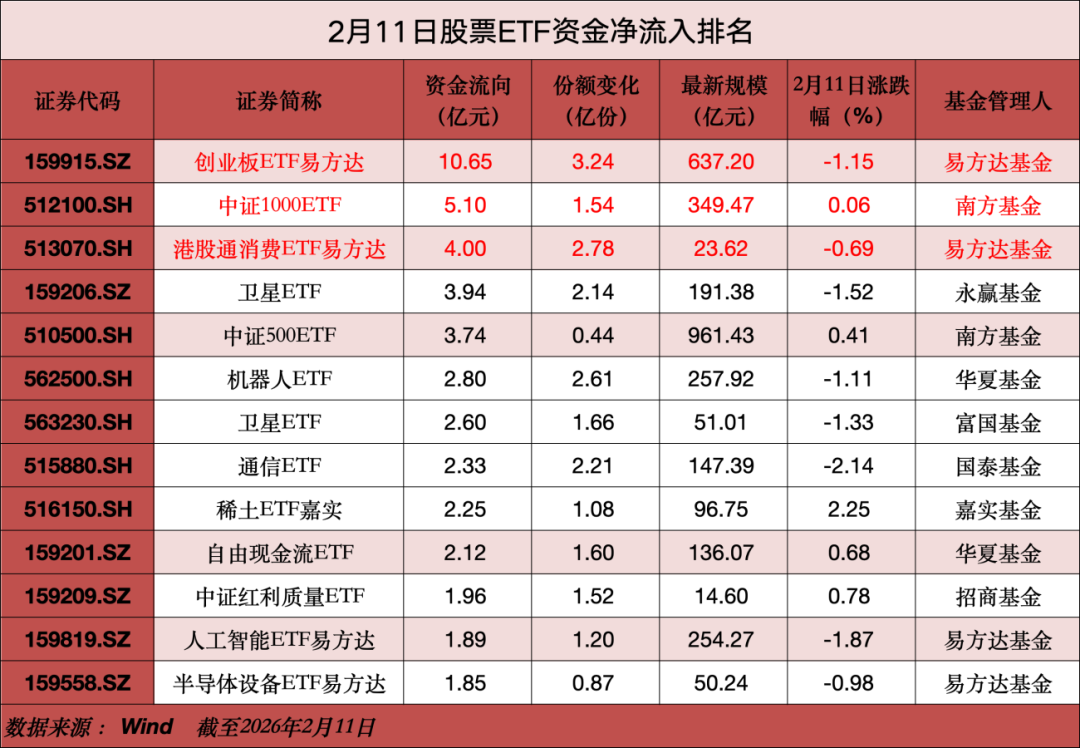
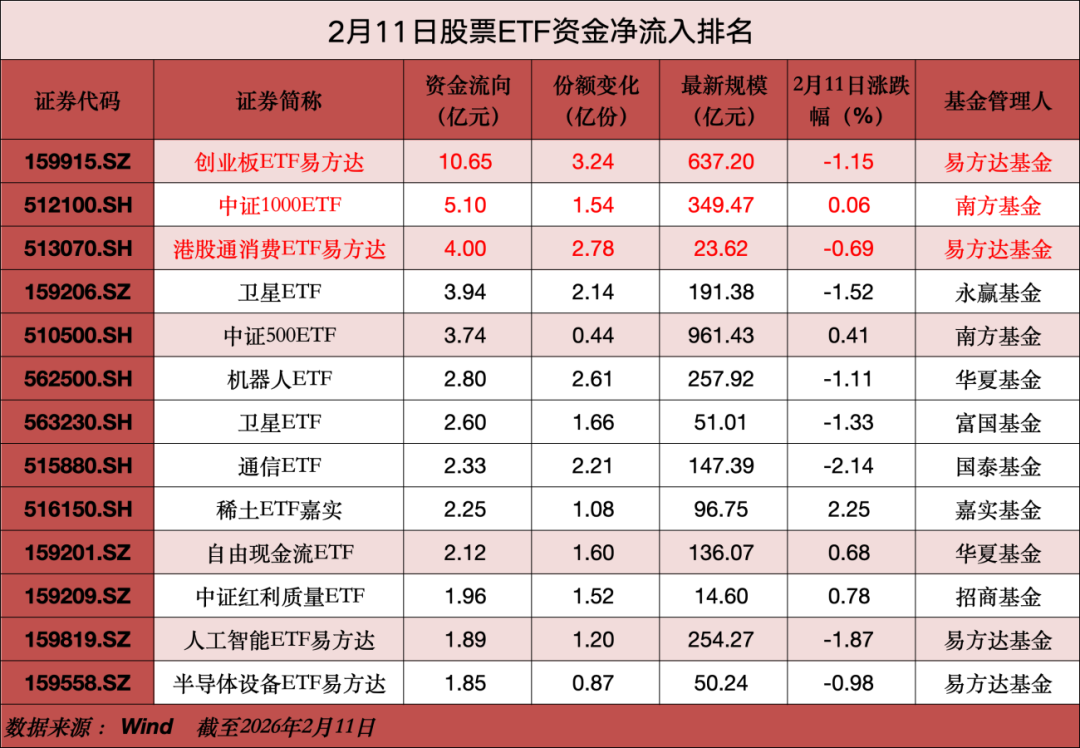
Group 1 - The A-share market showed mixed performance on February 11, with the three major indices fluctuating, and a slight net outflow of 236 million yuan from stock ETFs [1][2] - The ChiNext index saw significant net inflow of 1.14 billion yuan, while the CSI A500 index experienced net outflow [1][2] - The satellite industry and robotics sectors attracted notable capital inflows, while the new energy and dividend sectors faced outflows [1][2] Group 2 - As of February 11, the total scale of stock ETFs in the market reached 4.19 trillion yuan, with an overall net outflow of 236 million yuan for the day [2] - The ChiNext ETF led the inflows with a net inflow of 1.14 billion yuan, primarily driven by E Fund's ChiNext ETF, which saw inflows of 1.065 billion yuan [2][4] - The satellite industry also showed strong inflows, with a net inflow of 890 million yuan, including 394 million yuan into E Fund's satellite ETF [2][4] Group 3 - Over the past five days, the Hang Seng Technology Index ETF received over 6 billion yuan in inflows, while the SGE Gold 9999 Index ETF saw inflows exceeding 4.2 billion yuan [3] - The wide-based ETFs experienced a net outflow of 755 million yuan, with the CSI A500 ETF leading the outflows at 1.605 billion yuan [6][8] - The new energy sector had the highest outflow among thematic sectors, with a net outflow of 820 million yuan [7] Group 4 - The latest scale of E Fund's ETFs reached 661.02 billion yuan, with a total net inflow of 1.53 billion yuan on the previous trading day [4][5] - The robotics ETF and free cash flow ETF from Huaxia Fund saw significant inflows of 280 million yuan and 212 million yuan, respectively [5] - The market outlook suggests a focus on core growth assets, with stable earnings expectations and a potential return of foreign capital, indicating strong allocation properties in a volatile environment [9]

热门赛道,获加仓
Zhong Guo Ji Jin Bao· 2026-02-12 05:49
Core Viewpoint - The A-share market is experiencing mixed performance with significant inflows into the ChiNext and satellite industry ETFs, indicating a shift in investor sentiment towards these sectors as the market prepares for the upcoming holiday season [1][2]. ETF Fund Flows - As of February 11, the total scale of 1,339 stock ETFs in the market reached 4.19 trillion yuan, with an overall net outflow of 236 million yuan on that day [2]. - The ChiNext index ETF saw the most significant net inflow of 1.14 billion yuan, while the CSI A500 index ETF experienced a notable net outflow [3]. - The satellite industry also attracted substantial investment, with a net inflow of 890 million yuan on February 11 [3]. Notable ETF Performances - The top-performing ETFs included: - E Fund ChiNext ETF with a net inflow of 1.065 billion yuan [4]. - Southern CSI 1000 ETF with a net inflow of 510 million yuan [5]. - Yongying Satellite ETF with a net inflow of 394 million yuan [4]. - In the past five days, the Hang Seng Technology Index ETF saw inflows exceeding 6 billion yuan, and the SGE Gold 9999 Index ETF attracted over 4.2 billion yuan [3]. Outflows in Broader Market - The broad-based ETFs experienced a net outflow of 755 million yuan, with the CSI A500 ETF leading the outflows at 1.605 billion yuan [6][7]. - The new energy sector also faced significant outflows, totaling 820 million yuan [8]. Market Outlook - The market is expected to focus on macroeconomic data and industry trends post-holiday, with a potential shift towards structural changes in trading logic [9]. - Analysts suggest that the core growth assets are currently at historical median valuations, providing a potential for valuation recovery, while the technology sector remains strong amid ongoing innovations [10].
按兵不动?
第一财经· 2026-02-06 11:09
Market Overview - The three major A-share indices experienced a slight decline with reduced trading volume, where the Shanghai Composite Index showed relative stability due to the strength of cyclical sectors like oil, chemicals, and electricity, providing support to the index [3] - The Shenzhen Component Index and the ChiNext Index were primarily dragged down by adjustments in the technology growth sector [3] Market Performance - A total of 2,748 stocks rose while 2,549 stocks fell, indicating a structural market where more stocks increased than decreased [4] - The market showed significant sector differentiation, with rising sectors concentrated in resource products (oil, petrochemicals, chemicals, energy metals) and new energy growth tracks (humanoid robots, solid-state batteries), while declining sectors included consumer goods (liquor, retail, tourism) and defense industry [5] Trading Volume - The total trading volume of the two markets was approximately 2 trillion yuan, reflecting a mild decrease of 1.39%, yet overall market liquidity remains ample [6] - The Shanghai market saw a reduction in trading volume, while the Shenzhen market experienced a counter-trend increase, driven by profit-taking in previously high-performing blue-chip stocks and increased interest in lower-priced small and mid-cap growth stocks, indicating a structural rotation [6] Fund Flow - There was a net outflow of funds from institutional investors, while retail investors saw a net inflow [7] - Institutions shifted their focus from previously high-performing consumer and military sectors to oil, petrochemicals, electrical equipment, humanoid robots, and energy metals, while retail investors favored small and mid-cap growth stocks, showing a trend of continuous net inflow and accelerated buying towards the end of trading [8] Investor Sentiment - Retail investor sentiment was reported at 75.85%, indicating a generally optimistic outlook among individual investors [9] - The sentiment analysis showed that 21% of investors increased their positions, while 19.64% reduced their holdings, with 59.36% remaining unchanged [12] Positioning and Profitability - The average position of investors was reported at 67.95%, with 47.22% fully invested, 28.67% holding less than half, and 6.48% in cash [18] - In terms of profitability, 4.54% of investors reported gains exceeding 50%, while 41.32% were within a loss of 20% [20]

摩根士丹利基金2026年度投资策略会顺利举办
Zheng Quan Ri Bao Wang· 2026-02-06 09:43
Group 1: Core Insights - The 2026 investment strategy conference by Morgan Stanley Fund highlighted significant opportunities in the technology sector, particularly in AI computing, AI applications, and high-end manufacturing, driven by policy and engineering dividends [1] - The bond market in 2026 is expected to revolve around the "temperature difference" between "strong expectations" and "weak realities," leading to a market characterized by dual fluctuations [1] - Emphasis on timing over directional judgment is crucial for 2026, with a focus on short-term trading opportunities and risk control while considering medium to long-term trends [1] Group 2: Commodity Market Insights - Current data does not support widespread inflation, indicating a likely structural market in 2026 [2] - Precious metals are expected to retain their safe-haven function in the first and second quarters of 2026 [2] - Base metals, particularly minor metals, are projected to benefit from moderate global economic growth, resilient demand, and constrained supply, enhancing their strategic value and allocation appeal [2]