超硬材料产业升级

Search documents
超硬材料概念股集体异动 产业链加速向高端迈进
Zheng Quan Ri Bao Wang· 2025-10-15 12:45
Core Viewpoint - Recent stock price fluctuations in superhard material companies are driven by upgraded export policies and industry value reassessment, alongside breakthroughs in diamond applications and expectations of industry consolidation [1] Industry Outlook - The superhard materials sector, including synthetic diamonds and cubic boron nitride, is crucial for high-end manufacturing and national technological advancement, with demand surging due to semiconductor localization, renewable energy, and high-end manufacturing upgrades [2] - The market for superhard materials is projected to reach approximately 75 billion yuan by 2025, with a compound annual growth rate of about 5.9% until 2030, and China's market share expected to grow to 22.8% of the global market by 2025 [3] Company Developments - Companies in the superhard materials industry are transitioning from scale expansion to quality enhancement, focusing on key technological breakthroughs and new applications [4] - LiLiang Diamond has achieved a breakthrough in large particle diamond single crystal growth technology, producing a diamond weighing 156.47 carats, setting a world record [5] - Companies are increasing R&D investments in functional diamonds for applications in optical windows, chip heat sinks, and semiconductor devices, indicating a shift from "tool materials" to "strategic materials" [5][6]


超硬材料产业招商清单:中兵红箭、力量钻石、四方达等最新投资动向【附关键企业名录】
Qian Zhan Wang· 2025-07-25 06:23
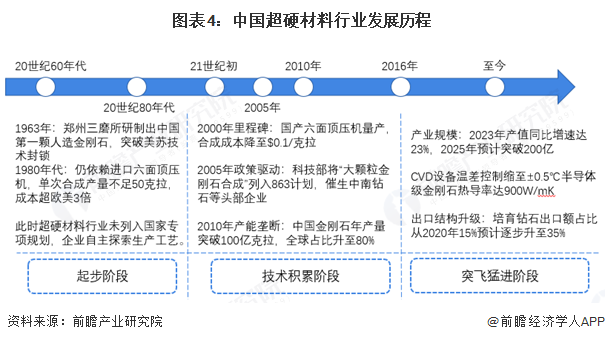
Core Insights - The superhard materials industry is crucial for modern manufacturing, involving the research, production, and application of synthetic diamonds and cubic boron nitride (CBN) [1][3] - China's superhard materials industry has evolved from breaking technological barriers to dominating the mid-to-low-end market, with industrial diamond production accounting for over 95% of global output in 2023 [1][4] - The industry is strategically important for national high-end manufacturing and technology independence, with goals set for 2025 to maintain a 95% global production share of basic materials and achieve over 30% localization of high-end products [3][4] Industry Development - The superhard materials industry in China has formed a closed-loop ecosystem from upstream domestic substitution to midstream monopoly and downstream application explosion [4] - Upstream: High-purity graphite and catalyst agents are supplied at scale, with 100% localization of six-sided press machines, while semiconductor-grade CVD equipment remains reliant on imports [4] - Midstream: China has achieved a global monopoly in industrial diamonds, cultivated diamonds, and cutting tools, with cultivated diamonds expected to penetrate new markets worth hundreds of billions by 2025 [4] - Downstream: Applications have expanded from traditional machining to high-end fields like semiconductor wafer cutting and quantum computing [4] Government Support and Market Dynamics - Local governments are prioritizing the superhard materials industry for investment attraction, offering incentives, land resources, and establishing industrial parks [5] - Collaboration with universities and research institutions is emphasized to promote integrated development and provide technical support [5] - The industry has seen the emergence of competitive leading enterprises, supported by favorable policies and market dynamics [5] Key Enterprises - Notable companies in the superhard materials sector include: - Zhongbing Hongjian Co., Ltd. with a registered capital of 139,255.89 million RMB, focusing on smart ammunition and superhard materials technology [9][11] - Henan Huanghe Whirlwind Co., Ltd. with a registered capital of 144,218.45 million RMB, recognized for its technological innovation [5] - Henan Sifangda Superhard Materials Co., Ltd. with a registered capital of 48,590.883 million RMB, known for its industry standards [5] Challenges and Future Outlook - Despite its global dominance, the industry faces structural challenges, including a low capacity utilization rate of 60% and a talent gap exceeding 30,000 in high-end fields [13][15] - The reliance on imports for core equipment, particularly in semiconductor-grade CVD technology, is a critical issue that needs addressing [15] - Initiatives are underway to establish talent training bases and enhance domestic production capabilities, aiming for a 30% localization rate in high-end CVD equipment by 2025 [15]