
车-路-云一体化

Search documents
从封闭场景到全域覆盖,主线科技如何讲好“高阶智驾”故事?
Zhi Tong Cai Jing· 2025-12-18 02:27
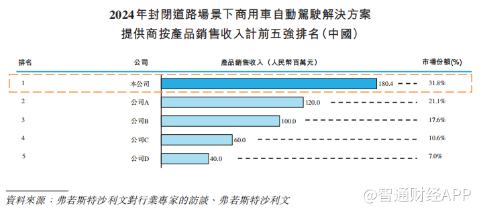
Core Viewpoint - The company, Mainline Technology, is seeking to accelerate its commercialization process in the L4 autonomous truck sector through a public listing on the Hong Kong Stock Exchange, leveraging its first-mover advantage and technological accumulation in closed scenarios [1][2]. Company Overview - Mainline Technology, established in 2017, is a leading provider of L4 autonomous trucks and solutions in China, with a market share of 31.8% in closed road scenarios, significantly surpassing the second-largest competitor at 21.1% [2]. - The company has developed an integrated product ecosystem covering logistics hubs, highway logistics, and urban traffic, with a total delivery of 830 AiTruck smart trucks and 349 AiBox smart terminals as of the last feasible date [2][4]. Financial Performance - Revenue is projected to grow from RMB 112.36 million in 2022 to RMB 254.09 million in 2024, reflecting a compound annual growth rate (CAGR) of over 50% [7]. - The company reported a significant revenue increase of over 1700% in the first half of 2025 compared to the previous year, driven by large projects in highway logistics [7]. - The gross profit margin is expected to improve from 3.7% in 2022 to 22.7% in 2024, reaching 30.3% in the first half of 2025, indicating a positive trend in profitability [8]. Business Structure - The core product matrix includes AiTruck (smart trucks), AiBox (smart terminals), and AiCloud (smart cloud services), corresponding to three main application scenarios: TrunkPort (logistics hubs), TrunkPilot (highway logistics), and TrunkCity (urban traffic) [4]. - Revenue contributions from different segments show that logistics hubs are expected to generate RMB 1.82 billion in 2024, accounting for 71.6% of total revenue, while highway logistics is projected to contribute RMB 421 million, or 16.6% [4]. Market Opportunity - The autonomous commercial vehicle market is experiencing explosive growth, with the closed road scenario market projected to grow from RMB 400 million in 2021 to RMB 1.3 billion in 2024, and the open road scenario market expected to increase from RMB 100 million to RMB 2.3 billion in the same period [14][16]. - Government policies and technological advancements are creating a favorable environment for the development of autonomous driving technologies, with significant support from national and local regulations [17][18]. Challenges - The company is currently in a phase of rapid revenue growth but has not yet achieved profitability, with net losses of RMB 278 million in 2022, RMB 213 million in 2023, and RMB 187 million in 2024 [9][10]. - High customer and supplier concentration poses risks, with the top five customers accounting for 67.9% of revenue in 2024, which could impact negotiation power and operational stability [12]. - The company has a high dependency on external financing, with negative cash flow from operating activities totaling approximately RMB 416 million from 2022 to 2024 [12][13].

新股前瞻|从封闭场景到全域覆盖,主线科技如何讲好“高阶智驾”故事?
智通财经网· 2025-12-18 02:12
Core Viewpoint - The company, Mainline Technology, is poised to become a significant player in the L4 autonomous driving truck sector in China, leveraging its early advantages in closed scenarios and technological accumulation to accelerate commercialization through capital market empowerment [1][2]. Company Overview - Mainline Technology, established in 2017, is a leading provider of L4 autonomous trucks and solutions in China, with a comprehensive "vehicle-edge-cloud" integrated product ecosystem covering logistics hubs, highway logistics, and urban traffic [2][4]. - The company holds a market share of 31.8% in the closed-road scenario for L4 autonomous trucks, significantly surpassing the second-place competitor's 21.1% [2]. Business Structure - The core product matrix includes AiTruck (smart trucks), AiBox (smart terminals), and AiCloud (smart cloud services), corresponding to three main application scenarios: TrunkPort (logistics hubs), TrunkPilot (highway logistics), and TrunkCity (urban traffic) [4]. - Revenue contributions for 2024 are projected at 1.82 billion RMB from logistics hubs (71.6% of total revenue), 421 million RMB from highway logistics (16.6%), and approximately 566 million RMB from urban traffic, which is still in the early commercialization stage [4]. Financial Performance - The company is experiencing rapid revenue growth but has not yet achieved profitability, with revenues increasing from 112 million RMB in 2022 to 254 million RMB in 2024, reflecting a compound annual growth rate (CAGR) of over 50% [5][6]. - The gross profit margin is expected to rise from 3.7% in 2022 to 22.7% in 2024 and reach 30.3% in the first half of 2025, driven by increased adoption of its solutions [6][7]. Investment and Financial Structure - Research and development expenditures totaled 382 million RMB from 2022 to 2024, with 60.9% of the first half of 2025's revenue allocated to R&D [8]. - As of June 30, 2025, the company had total liabilities exceeding 1.3 billion RMB, with net liabilities around 1.08 billion RMB, indicating a high reliance on external financing [9][10]. Market Opportunities - The commercial vehicle autonomous driving industry is entering a golden development period, with the closed-road market projected to grow from 400 million RMB in 2021 to 1.3 billion RMB in 2024, and the open-road market expected to expand from 100 million RMB to 2.3 billion RMB in the same period [12][15]. - Government policies are increasingly supportive of autonomous driving technology, facilitating testing and deployment, which is expected to enhance market growth [15][16]. Challenges - The industry faces challenges such as the complexity of open-road scenarios, varying customer acceptance of new technologies, and ongoing regulatory developments regarding liability and data security [16]. - The company must navigate high customer and supplier concentration risks, with the top five customers accounting for 67.9% of revenue in 2024, which could impact negotiation power and operational stability [10].