
近零碳建筑

Search documents
“三维降碳”技术助力建造高海拔“近零碳”医院
Xin Lang Cai Jing· 2026-01-25 13:03
Core Insights - The construction of the Sichuan University West China Second Hospital in Tibet aims to create a modern healthcare facility focused on the health of women and children in the high-altitude region, overcoming extreme weather challenges [1][4] - The project has developed a "three-dimensional carbon reduction technology" to achieve near-zero carbon emissions, significantly reducing carbon output by 65% [3] Group 1: Project Challenges - The construction site faces extreme cold and oxygen-deficient conditions, with temperatures dropping to minus 10 degrees Celsius [1] - Key challenges identified include rapid heat loss in cold conditions, difficulty in balancing insulation and natural light, and low energy recovery efficiency due to continuous ventilation [1] Group 2: Innovative Solutions - The project employs passive heating strategies by utilizing large, high-performance windows to capture sunlight and thick insulation on the north side to retain heat [3] - Active efficiency improvements include the introduction of air-source heat pumps and a fresh air heat recovery system, enhancing internal heat circulation [3] - Renewable energy sources are harnessed through extensive installation of solar photovoltaic panels and solar water heating systems, converting abundant sunlight into sustainable energy [3] Group 3: Project Status and Future Outlook - The hospital's main structure is expected to be completed by the eve of the 2026 Spring Festival, marking a significant milestone in its development [4] - The facility is positioned to serve as a critical healthcare resource for women and children in Tibet while exemplifying the integration of green technology in high-altitude construction [4]
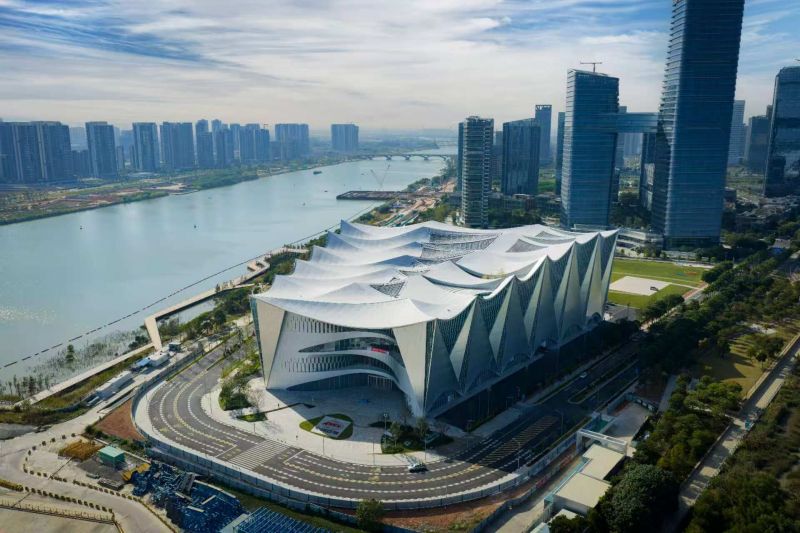
大湾区科学会堂全面亮相 珠三角再添科技新地标
Zhong Guo Fa Zhan Wang· 2025-12-12 06:15
Core Viewpoint - The Greater Bay Area Science Hall, a landmark for scientific exchange, has officially opened, showcasing international standards in Guangzhou's Nansha district [1][3]. Group 1: Project Overview - The Greater Bay Area Science Hall covers an area of approximately 92,600 square meters and integrates an academic center, science museum, and supporting functions [1][3]. - The design concept "Sailing with a Thousand Sails, Technology at Sea" features the largest wave-shaped continuous welded stainless steel roof in the country, with dimensions of 170 meters in length and 150 meters in width, and a maximum height difference of 21 meters [3][4]. Group 2: Construction and Materials - The project utilized 7,000 tons of steel, with the roof's maximum span reaching 75 meters, divided into 38 triangular grid units to create a fluid wave-like structure [3][4]. - Advanced construction techniques, including 3D laser scanning and intelligent welding robots, were employed to ensure precision in the welding seams, maintaining accuracy within millimeters over a total length exceeding 40,000 meters [3][4]. Group 3: Sustainability and Technology - The building aims to be a "near-zero carbon building," utilizing fluorocarbon-coated aluminum panels and anodized aluminum plates that are resistant to corrosion and require minimal maintenance [4][5]. - The installation of 1,200 square meters of photovoltaic glass on the roof is expected to generate 96,000 kilowatt-hours annually, fulfilling the indoor lighting needs [4][5]. - The cooling system in the underground machine room employs a high-efficiency technology developed by China Railway Construction, improving the energy efficiency ratio from 6.15 to nearly zero carbon standard of 6.8, achieving an overall energy-saving rate exceeding 50% [4][5]. Group 4: Future Implications - The Greater Bay Area Science Hall is positioned as a crucial platform for deepening cooperation in the Guangdong-Hong Kong-Macau Greater Bay Area and is expected to enhance regional collaborative innovation and support the development of an open and integrated technological ecosystem [5].


龙华双馆展示深圳绿色建造实力 秀绿色科技 亮“低碳底牌”
Shen Zhen Shang Bao· 2025-08-11 22:46
Core Insights - The upcoming 15th National Games is approaching, with a focus on the green construction capabilities showcased by the Longhua Sports Center and the Jian Shang Sports Complex in Longhua District [1][3] Group 1: Longhua Sports Center - The Longhua Sports Center is the largest sports venue in Longhua District and has received a "three-star green building design label," the highest level for green construction in China [1] - The venue features a natural lighting system with large windows and terraces, maximizing the use of natural light indoors [1] - A distributed photovoltaic system combined with an energy storage station creates a self-sufficient energy loop, with 16.90% of construction materials being reusable or recyclable [1] Group 2: Jian Shang Sports Complex - The Jian Shang Sports Complex is the first vertically distributed large sports venue in the country, designed to address space limitations through vertical stacking [2] - The complex's exterior features a double-layer skin system that allows for natural light capture and air circulation, reducing material consumption and carbon emissions [2] - The design encourages public use of terraces, gardens, and open spaces, promoting a low-carbon lifestyle and integrating the building with the surrounding urban environment [2] Group 3: Overall Impact - Both venues exemplify near-zero carbon buildings that blend event excitement with community warmth, showcasing Shenzhen's ability to achieve ecological and developmental harmony in a high-density urban setting [3]