智慧建造

Search documents
新疆交建:公司子公司中新数科聚焦“交通”领域
Zheng Quan Ri Bao Wang· 2026-02-12 11:44
Core Viewpoint - Xinjiang Jiaojian (002941) is engaged in various transportation infrastructure services, including surveying, design, construction, and operation, as well as manufacturing and logistics related to construction materials [1] Group 1: Business Overview - The company's main business includes roads, bridges, water conservancy, railways, tunnels, and municipal infrastructure [1] - A subsidiary, Zhongxin Shuke, focuses on smart construction, intelligent management, and digital services in the transportation sector [1] Group 2: Project Development - The "Zhudao" series collaboration projects are currently in the research and testing phase and have not yet achieved large-scale commercialization [1] - These projects are not expected to significantly impact the company's current operating performance [1] Group 3: Future Outlook - The company will continue to monitor the development of related technologies while cautioning investors about the uncertainties in research and market risks [1]

宏润建设(002062):首次覆盖报告:基建底盘稳固,新兴业务打开第二成长曲线
EBSCN· 2026-01-07 12:23
Investment Rating - The report gives the company an "Accumulate" rating for the first time [5]. Core Viewpoints - The company is one of the earliest private enterprises to enter shield tunneling construction in China, with over 300 kilometers of cumulative tunneling and a strong presence in key cities like Shanghai, Hangzhou, and Ningbo. The company is expanding its business from traditional infrastructure to include photovoltaic energy storage, distributed energy, and intelligent construction, creating a more balanced growth structure [1][14]. - The company's new energy business is entering a high-growth phase, projected to grow by 298% year-on-year in 2024 and 94% in the first half of 2025, contributing significantly to profit. This shift from "construction contracting" to "engineering + energy" is beginning to show results [1][3]. - The construction industry is under pressure, with new contracts declining for two consecutive years. However, policies aimed at improving cash flow are expected to gradually enhance the financial environment for the industry [2][38]. Summary by Sections Company Overview - The company has evolved from a focus on rail transit construction to becoming a leading integrated construction group in urban infrastructure and new energy. It has a strong foothold in the Yangtze River Delta region and has diversified its business to include various sectors such as municipal engineering and renewable energy [14][16]. Industry Analysis - The construction industry is currently facing a contraction due to a downturn in the real estate sector and tightening local finances. New contract amounts have decreased significantly, but ongoing debt resolution policies are expected to improve cash flow conditions [2][38]. Business Transformation - The company is actively seeking new growth avenues in response to the pressures on traditional construction. It is focusing on new energy and intelligent construction, with significant investments in these areas. The new energy business is expected to provide a second growth curve, while the AI robotics sector is also being developed through strategic partnerships [54][65]. Financial Projections - The company forecasts a decline in revenue for 2024, with a projected revenue of 5.923 billion yuan, down 7.82% year-on-year. However, net profit is expected to stabilize and grow in subsequent years, with predictions of 287 million yuan in 2025 and 350 million yuan in 2027 [4][3].

【我在大国工程当工匠】比三峡大坝高出62米!他们在戈壁挑战“世界之最”
Xin Lang Cai Jing· 2026-01-04 20:04
Core Viewpoint - The construction of the Dashi Gorge Water Conservancy Hub in Xinjiang, which is the world's highest concrete-faced rockfill dam at 247 meters, represents a significant achievement in modern water conservancy engineering, addressing flood control, irrigation, power generation, and ecological regulation [1]. Group 1: Project Overview - The Dashi Gorge Water Conservancy Hub is taller than the Three Gorges Dam by 62 meters and is designed to handle complex geological and climatic conditions [1]. - The project is a collaboration led by China Energy Engineering Group Gezhouba Company, showcasing the dedication and expertise of its builders over five years [1]. Group 2: Key Personnel and Their Contributions - Xu Shumei, the deputy manager of the project, emphasizes quality control, implementing a three-tier quality inspection network and optimizing material usage, saving 2,240 tons of fly ash and over 20 million yuan in costs [2][4]. - Li Dongfei, the project manager, has transformed traditional construction methods by integrating technology, leading to the development of a smart management cloud platform with an investment of over 80 million yuan [4]. - Mei Lin, a renowned hoisting engineer, successfully completed the precise installation of a 367-ton generator rotor, overcoming challenges posed by strong winds and complex canyon conditions [5][7]. Group 3: Technological Innovations - The project utilizes a smart management system with 2,300 monitoring points for real-time tracking of dam conditions, enhancing safety and efficiency [4]. - Innovations such as the "joint-type" chute design were inspired by ancient armor, addressing deformation issues caused by high winds during construction [4]. Group 4: Project Timeline and Future Outlook - The Dashi Gorge project is on track to have its first generator operational by July 2026, which will significantly benefit the irrigation of 8 million acres of farmland and local communities [8].
国家“十四五”规划重大工程叶巴滩水电站首批机组投产
Zhong Guo Xin Wen Wang· 2025-12-27 11:09
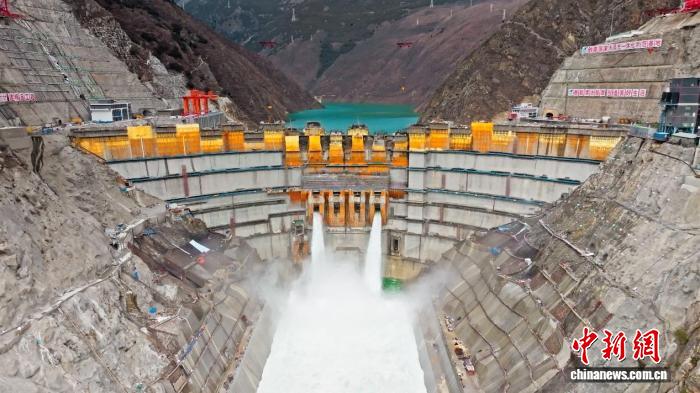
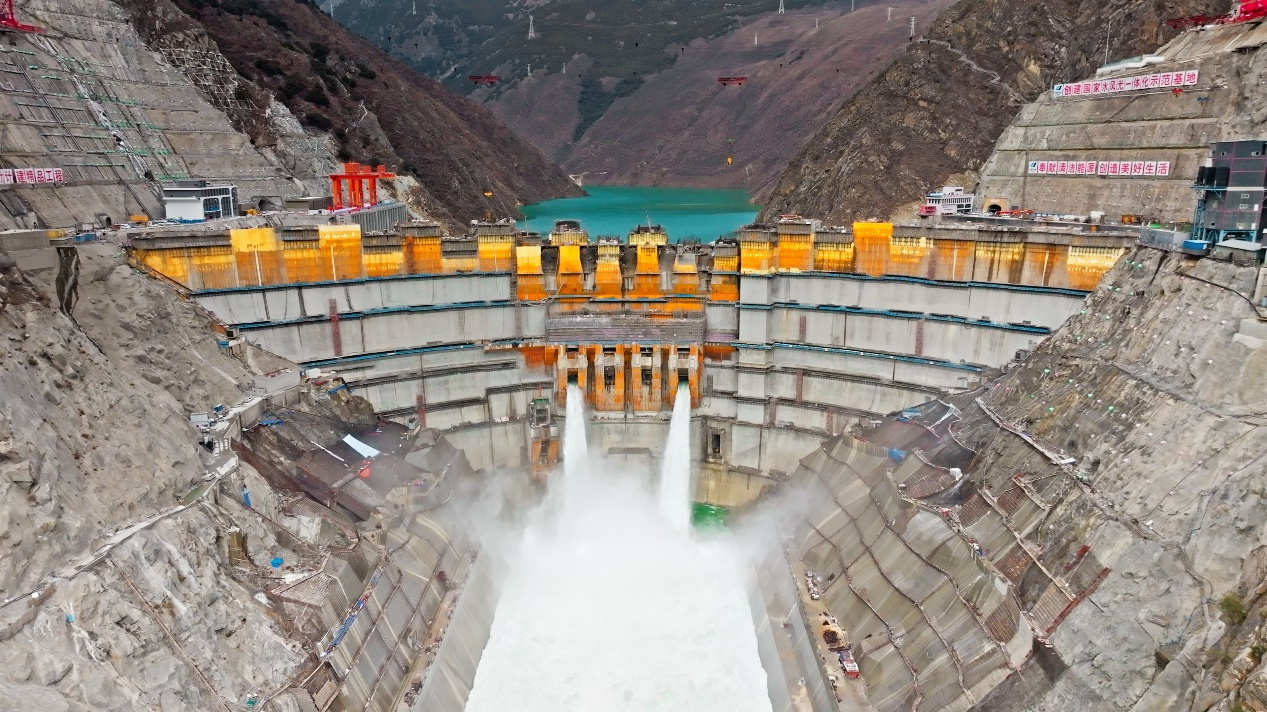
Core Insights - The Yebatang Hydropower Station, the largest installed capacity project in the upper reaches of the Jinsha River, has officially commenced power generation, marking a significant breakthrough in high-altitude dam construction and clean energy development in China [1][3][6] Group 1: Project Overview - The Yebatang Hydropower Station has a total installed capacity of 2.24 million kilowatts and a reservoir capacity of 1.08 billion cubic meters, with an average annual power generation design of 10.2 billion kilowatt-hours [1] - Once fully operational, the project is expected to save over 3 million tons of standard coal annually and reduce carbon dioxide emissions by more than 7 million tons [1] Group 2: Technical Achievements - The project has achieved several industry breakthroughs, including the highest dam height of 217 meters for a double-arch dam under construction in China and the first winter continuous pouring in a cold region [3][5] - It features a maximum discharge capacity of over 10,000 cubic meters per second and is the first to adopt a full dam body flood discharge layout [5] - The underground powerhouse is buried to a depth of 480 meters, and the tailrace tunnel is 3,172 meters long, both records for similar projects in China [5] Group 3: Innovation and Digitalization - The project has implemented smart construction practices, creating the "Yedian Cloud" digital platform that utilizes IoT, BIM, and AI technologies for intelligent temperature control and digital management throughout the construction process [5] Group 4: Energy Transmission - The electricity generated by the Yebatang Hydropower Station will be transmitted to Central China through the "Jinshang-Hubei" ±800 kV UHVDC project, significantly enhancing regional power supply capabilities and contributing to high-quality economic and social development [6]

实现多项世界级突破 我国在建海拔最高双曲拱坝电站叶巴滩首批机组投产
Xin Lang Cai Jing· 2025-12-27 04:15
Core Viewpoint - The successful commissioning of the first batch of units at the Yebatang Hydropower Station marks a significant breakthrough in the construction of high-altitude arch dams and clean energy development in China [1][7]. Group 1: Project Overview - The Yebatang Hydropower Station, located on the upper reaches of the Jinsha River in the Tibet region, is the seventh hydropower station in a planned series of 13, with a total installed capacity of 2.24 million kilowatts and a reservoir capacity of 1.08 billion cubic meters [3]. - The design annual power generation capacity is 10.2 billion kilowatt-hours, which will save over 3 million tons of standard coal and reduce carbon dioxide emissions by more than 7 million tons annually once fully operational [3]. Group 2: Construction Challenges and Innovations - The construction of the Yebatang Hydropower Station faced multiple challenges, including complex geological structures, high geostress (up to 37.6 MPa), and natural disasters during the construction period [5]. - The project team overcame key technical challenges related to foundation construction, temperature control, and continuous winter construction in high-altitude conditions, achieving several industry breakthroughs [6]. Group 3: Technological Advancements - The Yebatang Hydropower Station features the highest arch dam in construction in China at 217 meters and is the first to achieve continuous pouring in cold regions [6]. - It includes the largest underground powerhouse depth of 480 meters and the longest tailrace tunnel of 3,172 meters among similar projects in China [6]. - The project has implemented a digital platform called "Yedian Cloud," utilizing IoT, BIM, and AI technologies for smart temperature control and digital management throughout the construction process [6]. Group 4: Economic and Environmental Impact - The electricity generated will be transmitted through the "Jinshang-Hubei" ±800 kV UHVDC project to central China, enhancing regional power supply security and contributing to high-quality economic development [7]. - The completion of the Yebatang Hydropower Station is a key measure in promoting energy green transition and achieving carbon neutrality goals, contributing significantly to national energy security [7].
永州建材业新风口,互联网平台助力转型升级!
Sou Hu Cai Jing· 2025-12-24 03:49
Core Insights - The construction materials industry is experiencing unprecedented market opportunities due to accelerated urbanization, with increasing demand for high-quality materials across various projects [1] - The Yongzhou Construction Materials Public Platform was established to embrace internet technology and promote industry upgrades, driven by the founder's extensive experience and insights into market trends and user pain points [1] Group 1: Industry Trends - The demand for construction materials is growing due to infrastructure projects, residential construction, rural revitalization, and urban renewal [1] - The industry is moving towards digitalization and intelligence, integrating efficiency, service, information, and resources [1] Group 2: Platform Features - The Yongzhou Construction Materials Public Platform integrates online channels with offline supply chain resources, breaking time and geographical limitations for efficient supply-demand matching [2] - The platform offers a one-stop procurement solution, significantly reducing communication costs and improving transaction efficiency for both developers and individual users [2] Group 3: Operational Efficiency - The platform incorporates various digital tools such as real-time inventory management, dynamic pricing notifications, online customer service, and order tracking systems to enhance merchant operations and customer satisfaction [4] - Merchants can better grasp market trends and adjust product structures and marketing strategies based on data-driven insights, leading to steady business growth [4] Group 4: Partnership Opportunities - The platform is actively recruiting local suppliers to join its online ecosystem, offering exclusive benefits such as homepage promotion, customized marketing support, and logistics financial services [4] - This initiative aims to provide a broader stage for individuals and small businesses while promoting resource integration and collaboration within the region [4] Group 5: Future Outlook - The platform is positioned to become a mainstream model for construction material transactions, driven by data and centered on service, fostering a win-win ecosystem for all participants [4] - The company aims to continuously optimize system functions and user experience while expanding product categories and collaboration forms to inject more possibilities into industry development [5]

全长119.5公里!皖北这条高速今日正式通车
Xin Lang Cai Jing· 2025-12-20 01:35
Core Viewpoint - The Wuhou to Mengcheng Expressway, the first fully self-invested, constructed, and operated highway in Bengbu City, will officially open on December 20, enhancing regional transportation and economic development [1] Group 1: Project Overview - The Wuhou to Mengcheng Expressway is the largest and longest highway project in northern Anhui, with a total length of 119.5 kilometers, starting from Shuangzhongmiao Town in Wuhou County and connecting to the ongoing Sihong to Bengbu Expressway [1] - The expressway will form a "golden triangle" with Ningluo and Xuming highways, effectively alleviating traffic pressure and solidifying Bengbu's status as a national comprehensive transportation hub [1] Group 2: Economic and Social Impact - The project connects industrial parks and agricultural production areas along the route, supporting county-level industrial revitalization and establishing a rapid development corridor for the collaboration of Henan, Anhui, and Jiangsu provinces [1] - It serves national strategies such as the "Huaihe Ecological Economic Belt" and "Yangtze River Delta Integration," promoting the integration of transportation and tourism, and benefiting local livelihoods [1] Group 3: Construction Innovations - The project utilized a "minute-level construction organization" model for the construction of the box girder over the Beijing-Shanghai Railway and pioneered underwater soil extraction technology, reducing land occupation by 1,285.9 acres [2] - Advanced construction techniques such as BIM technology and 3D intelligent paving were applied, resulting in 25 patents for inventions and utility models [2] - Green construction measures included optimizing the route, building 34 kilometers of sound barriers, and employing special processes to protect the Tuo Lake ecology, achieving a win-win for ecological protection and engineering construction [2] Group 4: Future Developments - The extension line of the Sihong to Bengbu Expressway has completed all main bridge works, with an expected completion date by the end of 2026 [3]
这条城市主干道有望春节前通车
Chang Sha Wan Bao· 2025-12-18 10:33
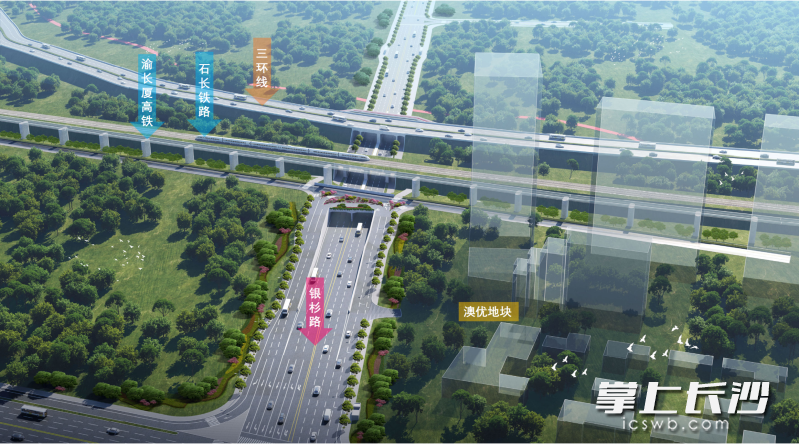
Core Viewpoint - The construction of the Yinsong Road extension in Changsha is progressing steadily and is expected to be completed before the 2026 Spring Festival, significantly improving traffic flow in the area [1][7]. Group 1: Project Overview - The Yinsong Road project, located in the core area of the Banshui New City in Wangcheng District, has a total length of 720 meters and is being built to high urban arterial road standards, with a design speed of 50 km/h and six lanes in both directions [3][5]. - The project serves as a crucial traffic artery connecting major nodes, specifically linking Puyuan Avenue and Qixian Road [7]. Group 2: Construction Challenges - The construction involves complex engineering challenges, including the need to tunnel under the Yuchang-Xia High-speed Railway and the Shichang Railway, as well as to build three underpasses [5][6]. - The project team has implemented innovative smart construction techniques to ensure that the railway operations are not disrupted and that construction progresses steadily [5][6]. Group 3: Project Progress and Impact - Key construction milestones have been achieved, including the completion of several underpasses and the relocation of high-voltage power lines, with the project on track to complete railway tunneling by January 2026 [7]. - Once completed, travel time between Puyuan Avenue and Qixian Road will be reduced from 20 minutes to just 5 minutes, enhancing north-south traffic flow and stimulating economic activity along the route [7].
大湾区科学会堂亮相
Zhong Guo Zhi Liang Xin Wen Wang· 2025-12-17 07:03
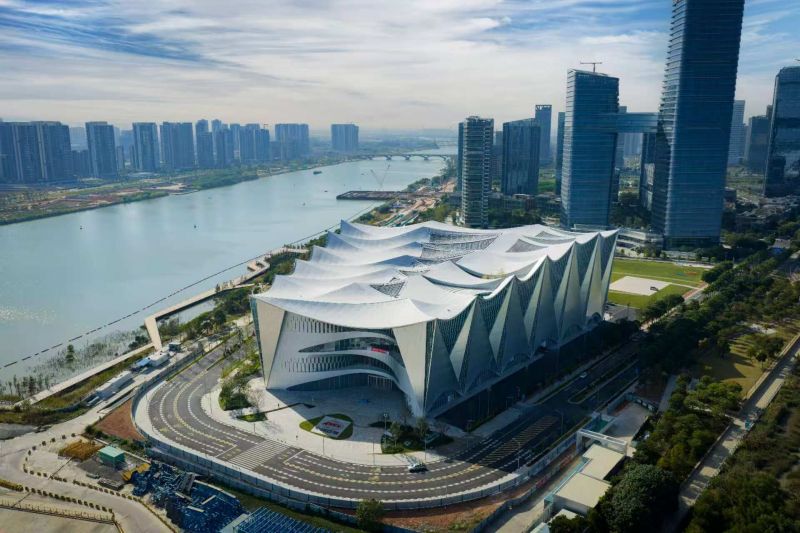
Core Insights - The Greater Bay Area Science Hall, a new landmark for scientific exchange, has been officially unveiled, enhancing the international stature of the Guangdong-Hong Kong-Macao Greater Bay Area [1] Group 1: Construction and Design - The Greater Bay Area Science Hall is located in Nansha District, Guangzhou, with a total construction area of approximately 92,600 square meters, integrating an academic center, science museum, and supporting functions [1] - The design concept "Sailing with a Thousand Sails, Technology at Sea" features the largest wave-shaped continuous welded stainless steel roof in the country, with a maximum height difference of 21 meters and a total steel usage of 7,000 tons [1] - The roof structure is supported by the first continuous wave-shaped single-layer rigid suspended net shell structure in the country, with a maximum span of 75 meters divided into 38 triangular grid units [1] Group 2: Materials and Sustainability - The building aims to be a "near-zero carbon building," utilizing fluorocarbon-coated aluminum panels and anodized aluminum plates that are resistant to acid rain, salt spray, and UV radiation, significantly reducing maintenance pressure [2] - The installation of 1,200 square meters of photovoltaic glass on the roof is expected to generate 96,000 kWh annually, meeting the indoor lighting electricity needs [3] - The cooling system employs self-developed high-efficiency technology, improving the energy efficiency ratio from 6.15 to nearly zero carbon standard of 6.8, achieving an overall energy saving rate exceeding 50% [3] Group 3: Technological Integration - The project incorporates 68 smart construction technologies, including a project management digital construction platform and AI-controlled systems, ensuring comprehensive and intelligent management throughout the construction process [3] - The main forum hall features a unique ceiling design made of 1,185 ceramic components, utilizing lightweight microcrystalline materials to reduce structural load by over 50% compared to traditional materials [3] Group 4: Strategic Importance - The Greater Bay Area Science Hall is positioned as a key platform for deepening cooperation in the Guangdong-Hong Kong-Macao region, supporting international scientific exchange and collaboration [3]

大湾区科学会堂全面亮相 珠三角再添科技新地标
Zhong Guo Fa Zhan Wang· 2025-12-12 06:15
Core Viewpoint - The Greater Bay Area Science Hall, a landmark for scientific exchange, has officially opened, showcasing international standards in Guangzhou's Nansha district [1][3]. Group 1: Project Overview - The Greater Bay Area Science Hall covers an area of approximately 92,600 square meters and integrates an academic center, science museum, and supporting functions [1][3]. - The design concept "Sailing with a Thousand Sails, Technology at Sea" features the largest wave-shaped continuous welded stainless steel roof in the country, with dimensions of 170 meters in length and 150 meters in width, and a maximum height difference of 21 meters [3][4]. Group 2: Construction and Materials - The project utilized 7,000 tons of steel, with the roof's maximum span reaching 75 meters, divided into 38 triangular grid units to create a fluid wave-like structure [3][4]. - Advanced construction techniques, including 3D laser scanning and intelligent welding robots, were employed to ensure precision in the welding seams, maintaining accuracy within millimeters over a total length exceeding 40,000 meters [3][4]. Group 3: Sustainability and Technology - The building aims to be a "near-zero carbon building," utilizing fluorocarbon-coated aluminum panels and anodized aluminum plates that are resistant to corrosion and require minimal maintenance [4][5]. - The installation of 1,200 square meters of photovoltaic glass on the roof is expected to generate 96,000 kilowatt-hours annually, fulfilling the indoor lighting needs [4][5]. - The cooling system in the underground machine room employs a high-efficiency technology developed by China Railway Construction, improving the energy efficiency ratio from 6.15 to nearly zero carbon standard of 6.8, achieving an overall energy-saving rate exceeding 50% [4][5]. Group 4: Future Implications - The Greater Bay Area Science Hall is positioned as a crucial platform for deepening cooperation in the Guangdong-Hong Kong-Macau Greater Bay Area and is expected to enhance regional collaborative innovation and support the development of an open and integrated technological ecosystem [5].