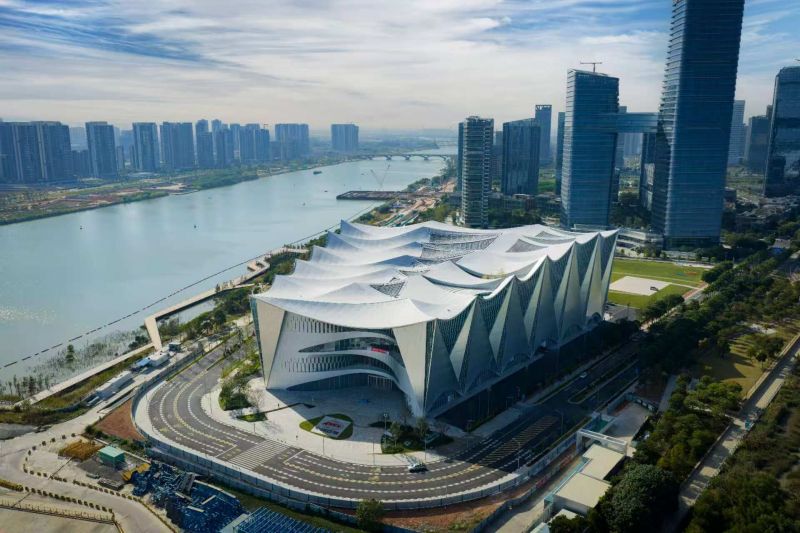
大湾区科学会堂

Search documents
大湾区科学会堂亮相
Zhong Guo Zhi Liang Xin Wen Wang· 2025-12-17 07:03
Core Insights - The Greater Bay Area Science Hall, a new landmark for scientific exchange, has been officially unveiled, enhancing the international stature of the Guangdong-Hong Kong-Macao Greater Bay Area [1] Group 1: Construction and Design - The Greater Bay Area Science Hall is located in Nansha District, Guangzhou, with a total construction area of approximately 92,600 square meters, integrating an academic center, science museum, and supporting functions [1] - The design concept "Sailing with a Thousand Sails, Technology at Sea" features the largest wave-shaped continuous welded stainless steel roof in the country, with a maximum height difference of 21 meters and a total steel usage of 7,000 tons [1] - The roof structure is supported by the first continuous wave-shaped single-layer rigid suspended net shell structure in the country, with a maximum span of 75 meters divided into 38 triangular grid units [1] Group 2: Materials and Sustainability - The building aims to be a "near-zero carbon building," utilizing fluorocarbon-coated aluminum panels and anodized aluminum plates that are resistant to acid rain, salt spray, and UV radiation, significantly reducing maintenance pressure [2] - The installation of 1,200 square meters of photovoltaic glass on the roof is expected to generate 96,000 kWh annually, meeting the indoor lighting electricity needs [3] - The cooling system employs self-developed high-efficiency technology, improving the energy efficiency ratio from 6.15 to nearly zero carbon standard of 6.8, achieving an overall energy saving rate exceeding 50% [3] Group 3: Technological Integration - The project incorporates 68 smart construction technologies, including a project management digital construction platform and AI-controlled systems, ensuring comprehensive and intelligent management throughout the construction process [3] - The main forum hall features a unique ceiling design made of 1,185 ceramic components, utilizing lightweight microcrystalline materials to reduce structural load by over 50% compared to traditional materials [3] Group 4: Strategic Importance - The Greater Bay Area Science Hall is positioned as a key platform for deepening cooperation in the Guangdong-Hong Kong-Macao region, supporting international scientific exchange and collaboration [3]

大湾区科学会堂全面亮相 珠三角再添科技新地标
Zhong Guo Fa Zhan Wang· 2025-12-12 06:15
Core Viewpoint - The Greater Bay Area Science Hall, a landmark for scientific exchange, has officially opened, showcasing international standards in Guangzhou's Nansha district [1][3]. Group 1: Project Overview - The Greater Bay Area Science Hall covers an area of approximately 92,600 square meters and integrates an academic center, science museum, and supporting functions [1][3]. - The design concept "Sailing with a Thousand Sails, Technology at Sea" features the largest wave-shaped continuous welded stainless steel roof in the country, with dimensions of 170 meters in length and 150 meters in width, and a maximum height difference of 21 meters [3][4]. Group 2: Construction and Materials - The project utilized 7,000 tons of steel, with the roof's maximum span reaching 75 meters, divided into 38 triangular grid units to create a fluid wave-like structure [3][4]. - Advanced construction techniques, including 3D laser scanning and intelligent welding robots, were employed to ensure precision in the welding seams, maintaining accuracy within millimeters over a total length exceeding 40,000 meters [3][4]. Group 3: Sustainability and Technology - The building aims to be a "near-zero carbon building," utilizing fluorocarbon-coated aluminum panels and anodized aluminum plates that are resistant to corrosion and require minimal maintenance [4][5]. - The installation of 1,200 square meters of photovoltaic glass on the roof is expected to generate 96,000 kilowatt-hours annually, fulfilling the indoor lighting needs [4][5]. - The cooling system in the underground machine room employs a high-efficiency technology developed by China Railway Construction, improving the energy efficiency ratio from 6.15 to nearly zero carbon standard of 6.8, achieving an overall energy-saving rate exceeding 50% [4][5]. Group 4: Future Implications - The Greater Bay Area Science Hall is positioned as a crucial platform for deepening cooperation in the Guangdong-Hong Kong-Macau Greater Bay Area and is expected to enhance regional collaborative innovation and support the development of an open and integrated technological ecosystem [5].