量子系统预热化

Search documents
【科技日报】我科学家成功调控量子系统预热化持续时间
Ke Ji Ri Bao· 2026-01-30 06:07
Core Viewpoint - The research conducted by scientists from the Chinese Academy of Sciences has successfully discovered and actively controlled the "preheating" phase of a quantum system on a superconducting chip, laying the groundwork for more stable and controllable quantum computing and simulation [1][2]. Group 1: Quantum System Dynamics - Quantum thermalization refers to the process where a quantum system gradually reaches a state of equilibrium, leading to the diffusion of energy and information, which poses a significant challenge for quantum computing that requires long-term information retention [1]. - The preheating phase is an intermediate stage in the thermalization process where the system remains in a relatively stable state before entering complete chaos, akin to ice absorbing heat at 0 degrees Celsius without immediate temperature rise [1]. Group 2: Research Methodology and Findings - Researchers innovatively employed a method called "random multipole driving" to manipulate the quantum system, successfully extending or shortening the duration of the preheating phase through carefully designed non-periodic and self-similar driving sequences [2]. - The study demonstrated that during the platform phase, the growth of chaos in the system was significantly suppressed, while crossing the platform led to a rapid increase in complexity and swift information diffusion throughout the system [2]. Group 3: Implications for Quantum Computing - This research marks the first instance of actively controlling the preheating process beyond periodic driving in a quantum simulator, providing new insights for designing better quantum error correction schemes and extending the coherence time of quantum bits [2]. - The findings validate the unique advantages of quantum simulators in addressing specific complex problems, promoting a synergistic relationship between quantum and classical computing [2].
基于“庄子2.0”芯片实验 中国团队离理解和控制量子世界更近一步
Zhong Guo Xin Wen Wang· 2026-01-29 06:07
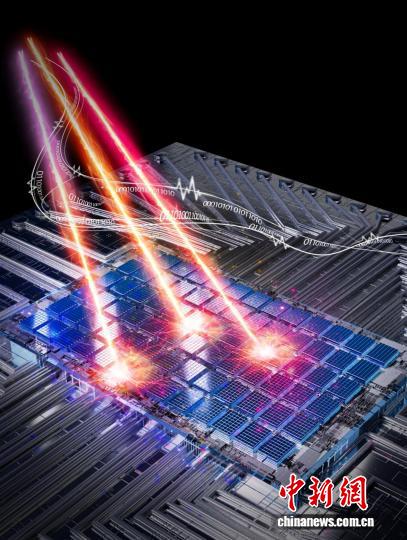
Core Insights - The Chinese research team has made significant progress in understanding and controlling the quantum world through experiments on the "Zhuangzi 2.0" superconducting chip, which contains 78 qubits [1][3] - The findings indicate that quantum computers can simulate complex systems in ways that classical computers cannot, moving closer to practical applications of quantum computing [1][4] Group 1: Experimental Findings - The research revealed the phenomenon of prethermalization, where a quantum system can stabilize at a platform before reaching thermal equilibrium, retaining initial state information [4][5] - Characteristics of the observed prethermalization platform include the retention of initial information, suppressed entropy growth, adjustable platform duration based on driving parameters, and rapid entanglement growth [7][8] - The experiment demonstrated that classical computers struggle to simulate the entanglement growth and information diffusion in systems close to 100 qubits, highlighting the unique capabilities of quantum platforms [7][8] Group 2: Future Development Plans - The successful experiment with the 78-qubit chip was attributed to innovative design, measurement and control technologies, and a systematic approach to research [8][10] - Future plans include developing larger-scale superconducting quantum chips with over 100 qubits, exploring complex quantum systems, and aiming to demonstrate "verifiable practical quantum advantages" [10]