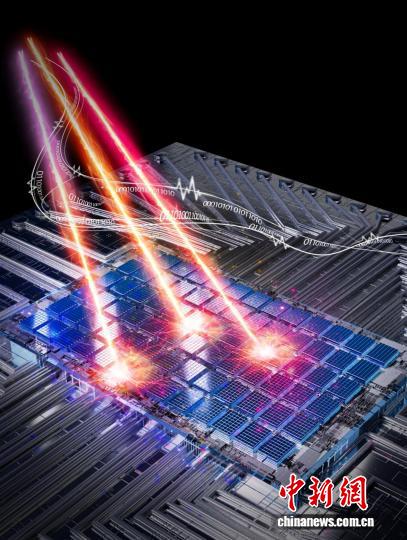
庄子2.0超导芯片

Search documents
基于“庄子2.0”芯片实验 中国团队离理解和控制量子世界更近一步
Zhong Guo Xin Wen Wang· 2026-01-29 06:07
Core Insights - The Chinese research team has made significant progress in understanding and controlling the quantum world through experiments on the "Zhuangzi 2.0" superconducting chip, which contains 78 qubits [1][3] - The findings indicate that quantum computers can simulate complex systems in ways that classical computers cannot, moving closer to practical applications of quantum computing [1][4] Group 1: Experimental Findings - The research revealed the phenomenon of prethermalization, where a quantum system can stabilize at a platform before reaching thermal equilibrium, retaining initial state information [4][5] - Characteristics of the observed prethermalization platform include the retention of initial information, suppressed entropy growth, adjustable platform duration based on driving parameters, and rapid entanglement growth [7][8] - The experiment demonstrated that classical computers struggle to simulate the entanglement growth and information diffusion in systems close to 100 qubits, highlighting the unique capabilities of quantum platforms [7][8] Group 2: Future Development Plans - The successful experiment with the 78-qubit chip was attributed to innovative design, measurement and control technologies, and a systematic approach to research [8][10] - Future plans include developing larger-scale superconducting quantum chips with over 100 qubits, exploring complex quantum systems, and aiming to demonstrate "verifiable practical quantum advantages" [10]