金融控股公司准入管理

Search documents
深圳公示553家未获批“金控”公司,限期3个月内整改
Guo Ji Jin Rong Bao· 2025-11-13 09:09
Core Viewpoint - The Shenzhen Financial Regulatory Bureau, in collaboration with relevant departments, has identified 553 unapproved entities using terms like "financial holding" and "financial group" in their names, as part of efforts to regulate the financial market and prevent illegal financial activities [1][4]. Group 1: Regulatory Actions - The Shenzhen Financial Regulatory Bureau has mandated that the identified entities must apply for cancellation or change of their names and business scope within three months, ensuring that these do not include terms like "financial holding," "financial group," or "financial control" [4]. - Entities that fail to comply with the requirement to cancel or change their names will face further regulatory measures from the Shenzhen Financial Regulatory Bureau and related departments [5]. Group 2: Public Awareness - The Shenzhen Financial Regulatory Bureau has urged the public to be vigilant and verify the qualifications of financial entities to protect their interests [5]. - Entities listed in the public notice have one month to contest their inclusion by contacting the Shenzhen Financial Regulatory Bureau and providing relevant documentation; otherwise, they will be considered to have no objections [5].

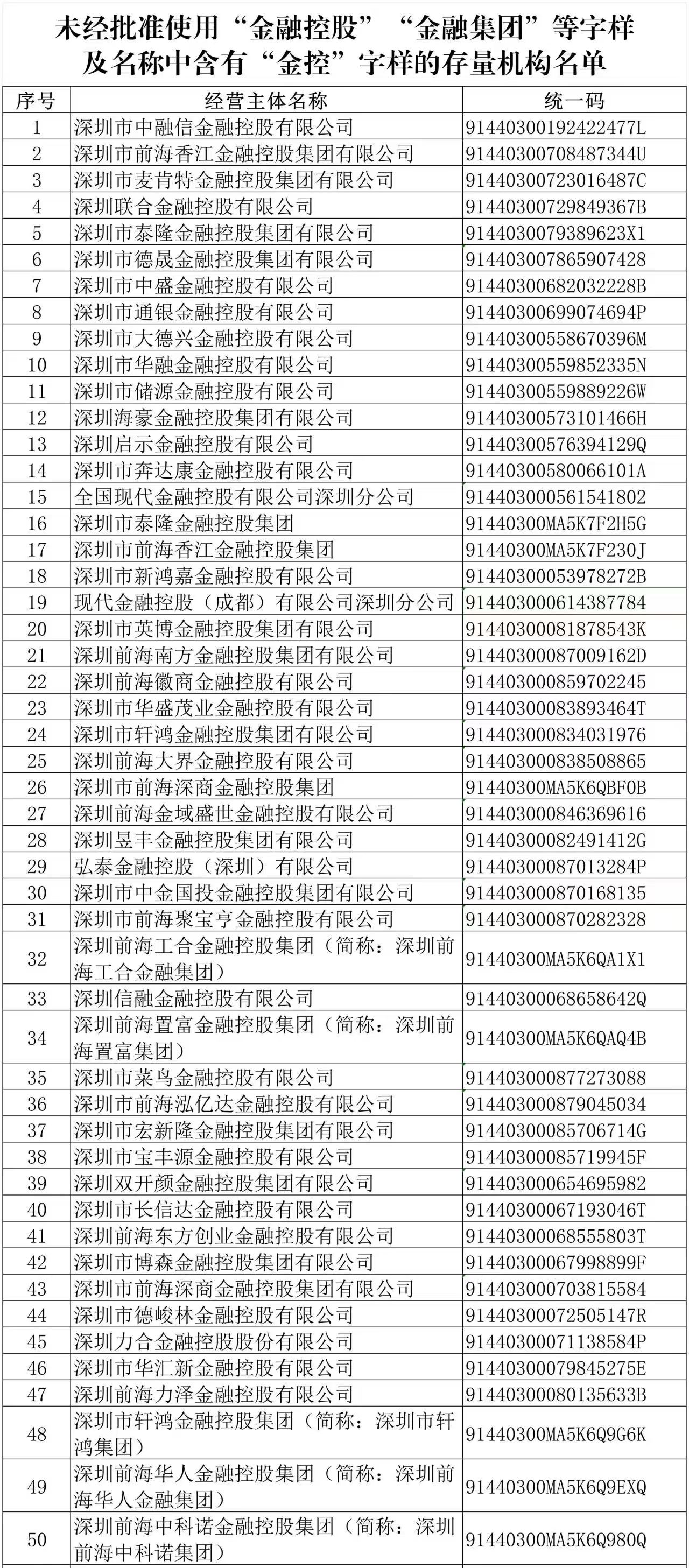
553家企业被点名!深圳金融办:限期3个月内整改
Zheng Quan Shi Bao· 2025-11-13 04:50
Core Points - Shenzhen Municipal Local Financial Management Bureau has publicly announced a list of 553 entities that have improperly used terms like "financial holding" and "financial group" without approval, indicating a crackdown on unlicensed financial operations [1][2] - Notable companies on the list include Shenzhen Lihua Financial Holding Co., Ltd. and TCL Financial Holding (Shenzhen) Group, with a significant number of these entities established between 2013 and 2015 [1] - The announcement follows regulations set forth in 2020 regarding the establishment and supervision of financial holding companies, which require proper licensing for operation [1] Group 1 - The Shenzhen Municipal Local Financial Management Bureau requires the listed entities to apply for name changes or business scope adjustments within three months, ensuring that their names do not include unauthorized financial terms [2] - Failure to comply with these requirements will result in further regulatory actions by the bureau in conjunction with relevant departments [2] Group 2 - The list of entities includes various financial holding companies, indicating a widespread issue of non-compliance within the financial sector in Shenzhen [3][4][5][6][7][8][9][10][11][12][13] - The majority of the companies listed are concentrated in the Qianhai Shenzhen-Hong Kong Cooperation Zone, highlighting a regional focus for the regulatory scrutiny [1]
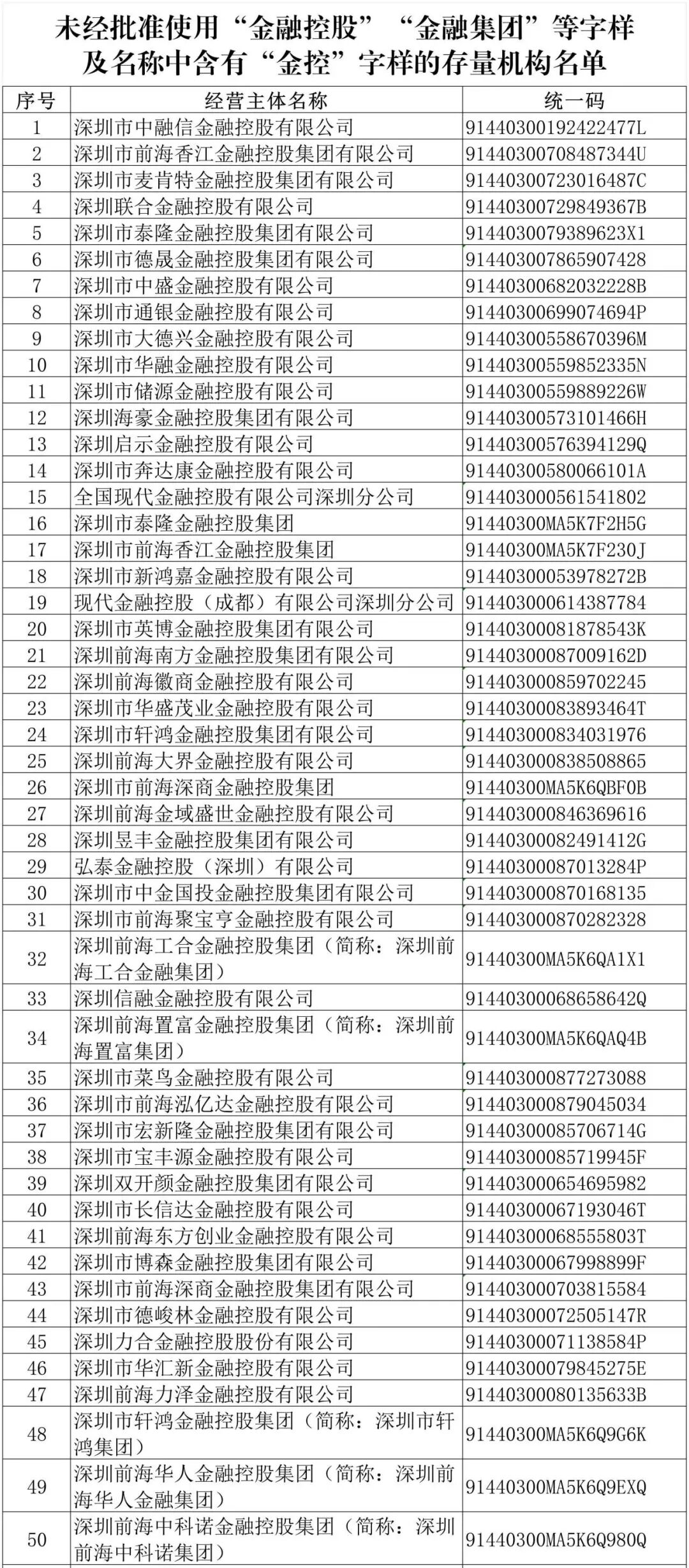
553家企业被点名,深圳金融办:限期3个月内整改
Zheng Quan Shi Bao· 2025-11-13 02:30
Core Viewpoint - Shenzhen's local financial management bureau has publicly announced a list of 553 entities that have improperly used terms like "financial holding" and "financial group" without approval, indicating a crackdown on unlicensed financial operations in the region [1][2]. Group 1: Regulatory Actions - The Shenzhen local financial management bureau requires the listed entities to apply for name changes or business scope adjustments within three months, ensuring that their names do not include unauthorized financial terms [2][3]. - Failure to comply with the rectification requirements will result in further regulatory measures from relevant departments [2]. Group 2: Background and Context - The crackdown follows the issuance of regulations by the Chinese government in September 2020, which established conditions and procedures for the establishment of financial holding companies [1]. - Many of the identified entities were established between 2013 and 2015, primarily located in the Qianhai Shenzhen-Hong Kong Cooperation Zone, indicating a significant presence of non-compliant firms in this area [1]. Group 3: Criteria for Financial Holding Companies - Entities must apply to establish a financial holding company if they meet certain asset thresholds, such as controlling financial institutions with total assets of at least RMB 500 billion or managing assets of at least RMB 5 billion [1]. - The regulations specify that companies without commercial banks must have total assets of at least RMB 100 billion or manage assets of RMB 5 billion to qualify for financial holding status [1].

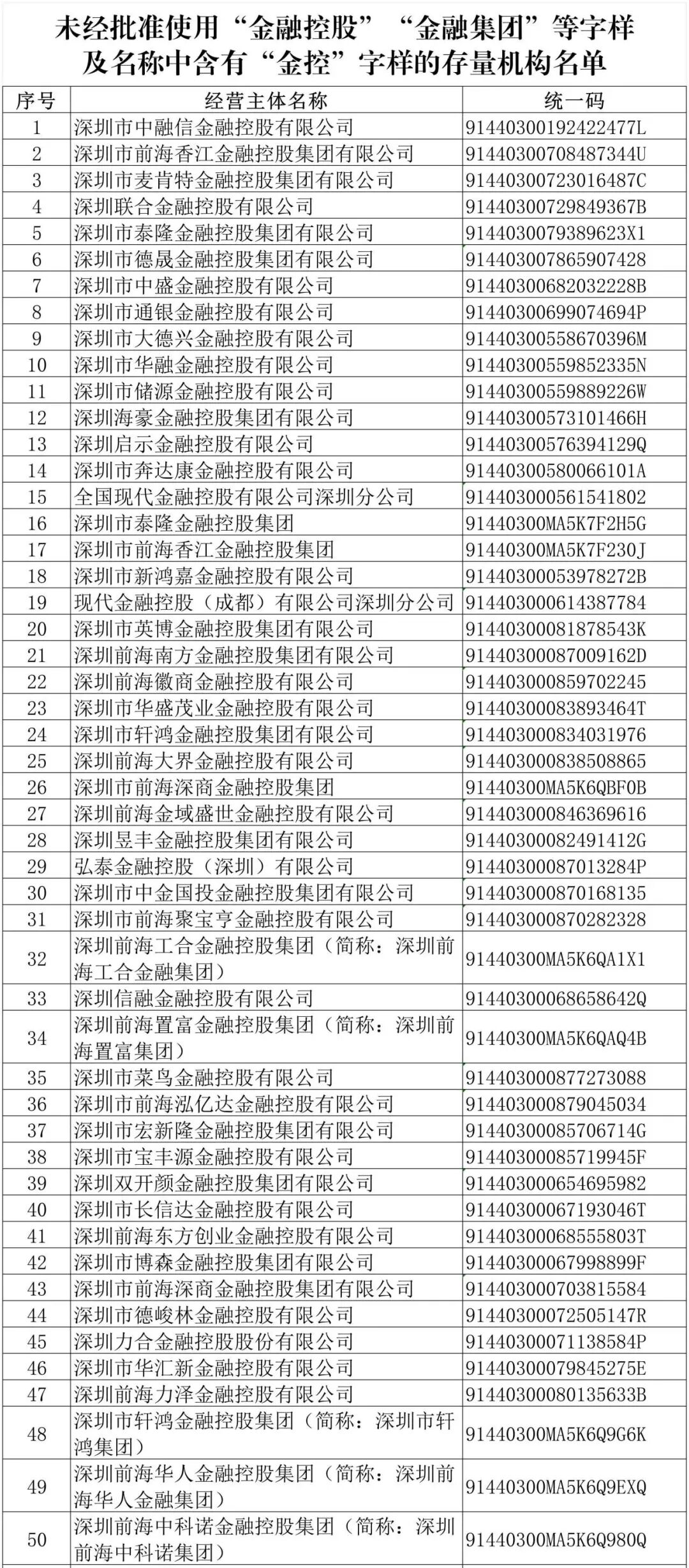
553家企业被点名,深圳金融办:限期3个月内整改
证券时报· 2025-11-13 02:23
Core Viewpoint - The Shenzhen Municipal Local Financial Management Bureau has publicly announced a list of 553 entities that have improperly used terms like "financial holding" and "financial group" without approval, indicating a crackdown on unlicensed financial operations in the region [2][3]. Group 1: Regulatory Background - The announcement follows the release of the "Decision on Implementing Access Management for Financial Holding Companies" by the Chinese government in September 2020, which set clear conditions and procedures for establishing financial holding companies [2][3]. - The regulations state that financial operations are a licensed business, and entities must not register as financial holding companies or use related terms in their names without approval [2][3]. Group 2: Compliance Requirements - Entities listed must apply for name changes or business scope adjustments within three months of the announcement, ensuring that their names do not include unauthorized financial terms [3]. - Failure to comply with these requirements will result in further regulatory actions by the Shenzhen Municipal Local Financial Management Bureau in collaboration with relevant departments [3]. Group 3: Entity List - The list includes notable companies such as Shenzhen Lihua Financial Holding Co., Ltd. and TCL Financial Holding (Shenzhen) Group, with many entities established between 2013 and 2015, primarily located in the Qianhai Shenzhen-Hong Kong Cooperation Zone [2][4]. - The list highlights a significant number of companies that have not adhered to the regulatory framework established since November 2020 [2][3].