
金融控股

Search documents
中航产融:底线思维与右侧机会
GF SECURITIES· 2026-03-18 09:53
1. Report Industry Investment Rating There is no information about the report industry investment rating in the provided content. 2. Core Viewpoints of the Report - Although the yields of AVIC Capital's bonds at various tenors have risen rapidly since January this year, the credit risk may not have changed significantly, and the bonds are still being redeemed normally. The current bond repayment risk of AVIC Capital remains low [3][9]. - The panic - selling of AVIC Capital's bonds is obvious, and the price may deviate from the credit fundamentals. The market panic is mainly triggered by the Vanke event and the weak overall bond market environment [3][27][34]. - With the support of the shareholder, the stability of core assets, and the information - disclosure improvement from the bondholders' meeting, AVIC Capital's credit is expected to be repaired, and the valuation may gradually recover with the resolution of risks, referring to historical cases [3][37][42]. 3. Summary According to the Directory 3.1 Key Event Review - Since 2024, AVIC Capital has faced liquidity pressure, but its bonds have been redeemed normally. In 2024, its subsidiary AVIC Trust was involved in private real - estate defaults, leading to tightened liquidity. In 2025, it delisted, and the interruption of information disclosure and rating downgrades caused market concerns. However, it redeemed a $3 - billion overseas bond in September 2025 and kept normal repayment of domestic bonds [9]. - In 2026, with the smooth settlement of the early - due debts and the establishment of a supplementary information - disclosure mechanism in the bondholders' meeting, the irrational panic caused by information vacuum is expected to subside, and market attention has increased again [9]. 3.2 Three Positive Factors 3.2.1 Shareholder Support and Policy Implementation - The new leadership of AVIC Capital has a background from the AVIC Group, indicating the group's high - level attention to risk management. The group provides liquidity support through equity acquisition and capital lending, and the company optimizes its asset structure and focuses on the financial main business [11][12]. - Since April 2025, AVIC Capital has repaid the principal of RMB 11.6 billion and interest of domestic publicly - issued bonds and debt financing instruments on schedule, showing a strong willingness to repay debts [12][13]. - The State - owned Assets Supervision and Administration Commission of the State Council issued relevant policies in December 2025, increasing the default cost and strengthening the group's support intention [15]. 3.2.2 Core Assets: Profitable for Debt Repayment and Sellable for Survival - As of March 7, 2026, the balance of AVIC Capital's outstanding bonds is RMB 15.67 billion, while the long - term equity investment of the parent company is significantly higher, providing an important asset cushion for bond repayment [17]. - The leasing business is the main source of income. In 2024H1, the leasing business income was RMB 4.8 billion, accounting for 62.06% of the total revenue. In 2024, AVIC Leasing and AVIC Finance achieved net profits of RMB 1.687 billion and RMB 0.864 billion respectively, providing stable support [18]. - AVIC Leasing has high - quality assets and strong business stability. As of June 2025, its leasing assets were mainly concentrated in the aviation and equipment manufacturing industries, with relatively stable asset quality. It can support bond repayment through equity transfer [22]. 3.2.3 Bondholders' Meeting: Information - Disclosure Completion and Expectation Stabilization - On February 25, 2026, the first bondholders' meeting of "23 Chanrong 06" passed five proposals, including establishing a quarterly supplementary information - disclosure mechanism for key financial and debt - repayment information, an investor communication mechanism, advancing the put - option window, and ensuring tracking ratings and information disclosure [23]. 3.3 Valuation Driver Review and Outlook - When the market panics, there is usually a term - structure inversion of bond yields. AVIC Capital's bond yields have shown an obvious term - structure inversion since January, indicating a high level of panic selling and a deviation from the fundamentals [27]. - The valuation of AVIC Capital's bonds has fluctuated. From April to May 2025, the yields rose due to risk events; from August to October 2025, the yields fell because of the company's strong debt - repayment willingness; since November 2025, the yields rose again due to the Vanke event; since mid - February 2026, the yields of "23 Chanrong 05" have recovered to some extent because of the bondholders' meeting [33][34]. - The weak overall bond - market environment is also a factor contributing to the panic selling. Historically, central - state - owned enterprises can obtain strong external support after risk exposure, and their valuations can gradually recover. AVIC Capital's credit is expected to be repaired, and its valuation may recover as risks are resolved, referring to the case of Huarong [34][37][42].
金融控股集团监管研究 ③ | 关于我国金融集团监管改革的观察与思考
清华金融评论· 2026-03-16 06:49
Group 1 - The core viewpoint of the article emphasizes that the reform of financial holding company regulation is crucial for adapting to the new stage of financial system development, providing a regulatory foundation for comprehensive operations and oversight [3][33]. - The establishment of financial holding companies is a key pathway for effectively regulating financial groups and isolating risks, supporting the transition from segmented operations and oversight to comprehensive management and regulation [4][33]. - The article outlines the importance of integrating the control of holding shareholders and parent companies into the regulatory framework to prevent governance risks and promote risk isolation through consolidated supervision [3][4]. Group 2 - The development of financial groups in China has been driven by the need for diversified operations and the integration of financial and industrial capital, leading to a significant increase in the complexity of financial services [10][11]. - Financial groups can be categorized into those with financial institution backgrounds and those with non-financial backgrounds, with the latter often facing more pronounced risks due to less stringent regulatory oversight [7][11]. - The article discusses the historical context of financial regulation in China, highlighting the shift from a separation of finance and industry to a more integrated approach, necessitating reforms in regulatory practices [13][14]. Group 3 - The regulatory reform process has focused on the control relationships within financial groups, particularly following significant risk events, leading to the establishment of guidelines for the governance of financial institutions [14][18]. - The article emphasizes the need for a comprehensive regulatory framework that includes specific guidelines for governance, capital management, and risk isolation to ensure effective oversight of financial holding companies [30][31]. - It is noted that the implementation of financial holding company regulations requires a thorough review and potential revision of existing regulatory frameworks to ensure consistency and effectiveness in managing financial group risks [31][32].

金融控股集团监管研究① | 集团公司控制权风险与法律监管
清华金融评论· 2026-03-14 03:04
Core Viewpoint - The article discusses the rapid rise of corporate groups in China since the reform and opening-up, highlighting the associated risks in sectors like real estate and finance, and emphasizes the need for regulatory reforms to manage control risks within financial holding companies [2][31]. Group 1: Control Rights and Limited Liability - The vitality of modern companies stems from the combination of shareholder control rights and limited liability, which has led to the rise of corporate groups as a dominant organizational form [4][10]. - The article reviews the legal risks associated with corporate group structures, including improper control, regulatory arbitrage, and risk transfer, necessitating reforms in corporate law and regulations [3][10]. - It emphasizes that regulating control rights aims to enhance prudence rather than negate limited liability, which is crucial for preventing systemic risks [4][10]. Group 2: Corporate Group Structures - Corporate groups consist of a parent company and its subsidiaries, where the parent exercises control over strategic decisions, financial budgets, and major transactions [12][14]. - The article notes that the structure of corporate groups often leads to complex control relationships and responsibility allocations, which can obscure accountability and increase legal risks [14][21]. - It highlights that the global trend shows a significant number of large companies are part of corporate groups, reflecting the advantages of coordinated operations and risk management [9][14]. Group 3: Legal and Regulatory Framework - The article outlines the need for a comprehensive legal framework that addresses the control rights and responsibilities within corporate groups, balancing the interests of shareholders, subsidiaries, and creditors [23][24]. - It discusses two main regulatory approaches: top-down control rights penetration and bottom-up shareholder liability attribution, both aimed at ensuring transparency and accountability within corporate structures [23][24]. - The article emphasizes the importance of legal regulations that prevent the abuse of control rights while maintaining the integrity of corporate legal status and limited liability [24][27]. Group 4: Implications for Financial Stability - The article points out that the misuse of control rights can lead to significant risks, particularly in the financial sector, where improper control can threaten financial stability and public interest [21][31]. - It stresses that the new Company Law, effective from July 1, 2024, introduces joint liability for controlling shareholders, addressing key legal risks associated with corporate groups [31][32]. - The article concludes that effective regulation of control rights is essential for mitigating risks in corporate groups, particularly in the real estate and financial sectors, to ensure sustainable economic growth [31][32].
资本界金控(00204.HK)1月末每股综合资产净值1.454港元
Ge Long Hui· 2026-02-15 10:27
Group 1 - The core point of the article is that Capital界金控 (00204.HK) announced its unaudited consolidated net asset value per share to be approximately HKD 1.454 as of January 31, 2026 [1]
金鹰基金大股东的BOSS,终于被拘了
Xin Lang Cai Jing· 2026-02-14 05:40
Core Viewpoint - Li Zhaoting, the former richest man in Shijiazhuang, has been detained by the police, which has significant implications for his companies, particularly Dongxu Group and its subsidiaries [2][3][19]. Group 1: Company Overview - Dongxu Group Limited, the largest shareholder of Jinying Fund with a 66% stake, is controlled by Li Zhaoting [17]. - At his peak, Li Zhaoting controlled three listed companies: Dongxu Optoelectronics, Dongxu Blue Sky, and Jialinjie [20]. Group 2: Financial Misconduct - From 2015 to 2019, under Li Zhaoting's leadership, Dongxu Group engaged in extensive financial fraud, inflating revenues by 47.825 billion yuan and profits by 13.001 billion yuan [21]. - The highest single-year inflation of cash funds reached 44.79 billion yuan, and the group fraudulently issued corporate bonds worth 3.5 billion yuan in 2018 [21]. Group 3: Current Status and Future Implications - Following a series of upheavals, only Jialinjie remains as a listed company under the "Dongxu system" [23]. - Li Zhaoting's control over Jinying Fund is in jeopardy due to a lifetime ban from the securities market imposed by the China Securities Regulatory Commission in June 2025 [25]. - The shares of Jinying Fund held by Dongxu Group have been frozen multiple times by the court due to significant debt disputes [25].

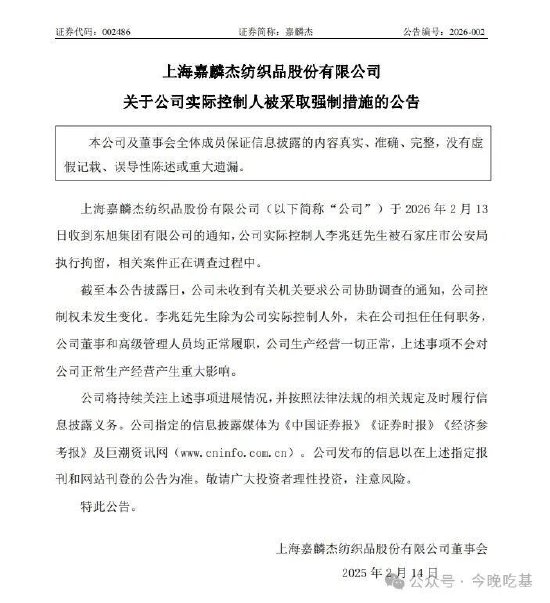
浙江东方股价下跌1.78%,前三季度净利润增长超九成
Jing Ji Guan Cha Wang· 2026-02-11 16:17
Core Viewpoint - Zhejiang Oriental Financial Holding Group Co., Ltd. has experienced a decline in stock price and a net outflow of funds, indicating potential challenges in market performance [1][2]. Stock Performance - On December 11, 2025, the company's stock price fell by 1.78%, with a trading volume of 265 million yuan and a turnover rate of 1.27%, resulting in a total market capitalization of 20.766 billion yuan [1]. - The recent trading activity shows a low turnover rate, reflecting moderate trading activity, with a net outflow of 23.6397 million yuan, which is a small proportion of the total trading volume [2]. Financial Performance - For the first three quarters of 2025, the company reported operating revenue of 5.412 billion yuan, a year-on-year decrease of 22.34%. However, the net profit attributable to shareholders increased by 91.22% to 800 million yuan [3]. - The total assets of the company amounted to 58.217 billion yuan, with equity attributable to shareholders of the parent company at 16.381 billion yuan [3]. Business Development - The company's main business includes trust, futures, insurance, and financial leasing, with sectors such as quantum technology, venture capital, and stakes in securities firms [4]. - In the third quarter of 2025, the company completed the acquisition of Hangzhou United Rural Commercial Bank, which is expected to generate approximately 130 million yuan in non-recurring income for the fiscal year 2025 [4]. Future Outlook - The company has not yet disclosed the specific date for the release of its full-year financial report for 2025, but it is expected to be published in the first quarter of 2026 [5]. - As a financial holding platform backed by state-owned assets in Zhejiang Province, the company is likely to continue adjusting its business in line with policy directions such as technology finance and the integration of the Yangtze River Delta [5].

资本界金控:葛知府辞任非执行董事
Zhi Tong Cai Jing· 2026-02-10 14:44
Group 1 - The company Capital界金控 (00204) announced that Mr. Ge Zhifu has submitted his resignation as a non-executive director, effective from February 10, 2026, to focus more on his other business commitments [1]
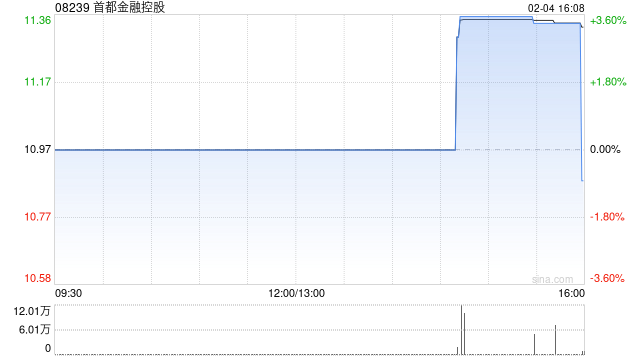
首都金融控股遭周洁减持33万股 每股作价约11.29港元
Xin Lang Cai Jing· 2026-02-05 00:14
Summary of Key Points Core Viewpoint - On February 2, Zhou Jie reduced her stake in Capital Financial Holdings (08239) by selling 330,000 shares at a price of HKD 11.285 per share, totaling approximately HKD 3.7241 million. After the sale, her remaining shareholding is 5.82%, amounting to 5.46 million shares [1]. Group 1 - Zhou Jie sold 330,000 shares of Capital Financial Holdings at HKD 11.285 each [1] - The total amount from the sale was approximately HKD 3.7241 million [1] - After the reduction, Zhou Jie holds 5.46 million shares, representing a 5.82% ownership stake [1]
于宏,被开除党籍、取消待遇!
Zhong Guo Ji Jin Bao· 2026-02-04 09:44
Group 1 - The former Party Secretary and Chairman of Heilongjiang Financial Holding Group, Yu Hong, has been expelled from the Party due to serious violations of discipline and law [2] - Yu Hong was found to have lost his ideals and beliefs, accepted banquets that could influence the impartial execution of duties, and engaged in corrupt practices [2] - The investigation revealed that Yu Hong intervened in market economic activities, violated national laws, and used public power for personal gain, leading to severe disciplinary violations and potential criminal charges [2] Group 2 - Heilongjiang Financial Holding Group, established in December 2018, is a state-owned enterprise with a registered capital of 10.3 billion yuan and a long-term credit rating of AAA [2] - The company fully controls several subsidiaries, including Heilongjiang Dazheng Investment Group and Heilongjiang Xinzhen Financing Guarantee Group, and is a major shareholder in local banks and financial institutions [2] - Yu Hong's previous disciplinary actions included a severe warning in November 2020 for accepting gifts and banquets, highlighting ongoing issues within the company's governance [2]
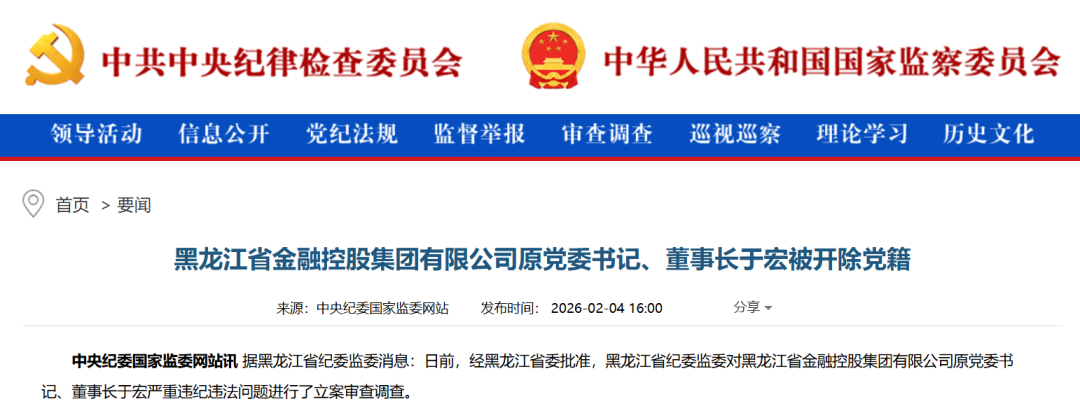
黑龙江省金融控股集团有限公司原党委书记、董事长于宏严重违纪违法被开除党籍
Bei Jing Shang Bao· 2026-02-04 09:13
Group 1 - The investigation into Yu Hong, the former Party Secretary and Chairman of Heilongjiang Financial Holding Group, was approved by the Heilongjiang Provincial Party Committee due to serious violations of discipline and law [1] - Yu Hong is accused of losing ideals and beliefs, violating the spirit of the Central Eight Regulations, and accepting meals that could influence the impartial execution of duties [1] - He allegedly engaged in corrupt practices by seeking benefits for others in employee recruitment and cadre transfers, receiving money in return [1] Group 2 - Yu Hong's actions constitute serious violations of the Party's organizational, integrity, and work disciplines, and he is suspected of bribery, with a severe nature and negative impact [2] - The decision was made to expel Yu Hong from the Party, cancel his benefits, confiscate his illegal gains, and transfer his criminal issues to the prosecution for legal review and prosecution [2]