
银河系研究

Search documents
跟着“郭守敬”追星星
Xin Lang Cai Jing· 2026-02-18 23:26
Core Insights - The Guo Shoujing Telescope, named after the famous Yuan dynasty astronomer, is a significant scientific infrastructure in China, focusing on deep-space observation and analysis of stellar spectra [1][2] Group 1: Telescope Functionality - The Guo Shoujing Telescope is designed to analyze light spectra from stars, providing insights into their temperature, composition, velocity, and age, rather than capturing images of the night sky [2] - It can observe 4,000 stars simultaneously, making it a powerful tool for understanding the formation and evolution of the Milky Way [2] Group 2: Data Collection and Efficiency - Since its official operation began in September 2012, the telescope has released 28.07 million spectral data entries and 11.59 million stellar parameter sets, maintaining the largest data volume globally [2] - The telescope's operational efficiency allows it to observe five to six celestial regions in a single night, creating extensive archives for over 20,000 stars [4] Group 3: Human Element and Commitment - The team behind the telescope, including long-term staff members, has dedicated significant time and effort, often working through holidays, to contribute to astronomical research [3][4] - Each spectral line represents the life of a star, emphasizing the dedication of the team in their pursuit of knowledge about the universe [3]
星空有约丨“银河画卷”,开卷!
Xin Lang Cai Jing· 2025-12-11 10:17
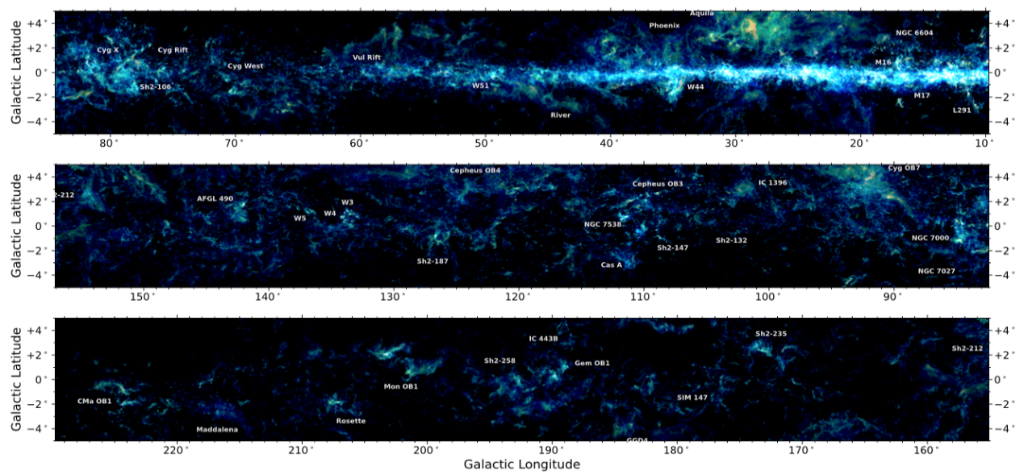
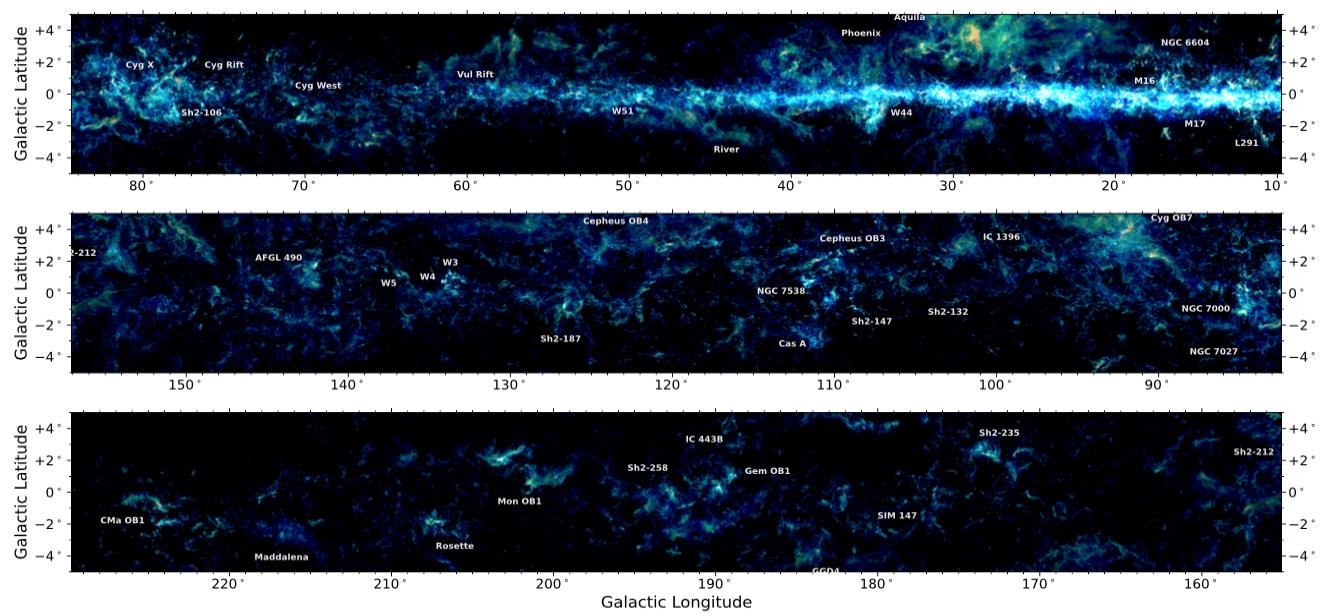
Core Insights - The "Milky Way Painting" (MWISP) survey plan officially released its first batch of millimeter-wave molecular line observation data, showcasing the contributions of Chinese astronomers to global astronomy [1][6] Group 1: Project Overview - The MWISP project, organized by the Purple Mountain Observatory, is a large-scale millimeter-wave molecular line survey that utilizes a 13.7-meter diameter millimeter-wave radio telescope located in Delingha, Qinghai [5][10] - The survey covers approximately 2300 square degrees near the northern galactic plane, specifically in the range of galactic longitude 10 to 230 degrees and latitude ±5 degrees [3][8] Group 2: Data and Findings - The released data includes over 100 million spectral lines, providing a comprehensive millimeter-wave CO molecular line database that offers an unprecedented panoramic view of the distribution and structure of molecular gas in the Milky Way [3][8] - The data reveals both the macroscopic distribution of molecular gas in the Milky Way and the internal details and physical properties of interstellar molecular clouds, aiding in the study of gas circulation and star formation processes [5][10] Group 3: Future Implications - The publicly available data is expected to promote collaborative innovation in multi-band astronomical research, complementing other major scientific facilities like the 500-meter Aperture Spherical Telescope (FAST) and the High Altitude Cosmic Ray Observatory (LHAASO) [5][10] - The MWISP project also accumulates important technical experience for next-generation large aperture millimeter/submillimeter telescopes with hundreds of beams for future surveys [11]

前所未有的全景视角!“银河画卷”开卷
Yang Shi Xin Wen· 2025-12-11 09:14
Core Insights - The "Milky Way Imaging Survey Project" (MWISP) has officially released its first batch of millimeter-wave molecular line observation data to the global community, marking a significant milestone in astronomical research [1][6]. Group 1: Project Overview - The MWISP is a large-scale millimeter-wave molecular line survey covering 2,310 square degrees near the northern galactic plane, specifically from galactic longitude 10 to 230 degrees and latitude ±5.25 degrees [3][6]. - The project has been in development since 2011, culminating in over 100 million spectral line data points, creating the most comprehensive millimeter-wave carbon monoxide molecular line database to date [3][6]. Group 2: Technological Advancements - The survey utilizes a 13.7-meter diameter millimeter-wave radio telescope located at the Qinghai Observation Station, which is currently the only large-scale radio astronomical observation equipment in China operating in the millimeter-wave band [3][6]. - The core backend instrument, a multi-beam superconducting imaging spectrometer, enhances observational efficiency by 60 times compared to traditional methods, allowing for high-sensitivity and high-resolution surveys of molecular gas in the Milky Way [3][6]. Group 3: Scientific Contributions - The MWISP data exhibits significant advantages in sensitivity, dynamic range, multi-line simultaneous observation, and uniform sampling across large areas, surpassing previous international carbon monoxide survey projects [6]. - The data provides a detailed view of the macro distribution structure of molecular gas in the Milky Way and reveals internal details and physical properties of interstellar molecular clouds, supporting research on gas circulation and star formation processes [6]. Group 4: Future Implications - The release of this data is expected to promote collaborative innovation in multi-band astronomical research, aiding domestic and international research teams in studies related to star formation and galaxy evolution [6]. - The success of the MWISP lays the groundwork for future large-aperture millimeter/submillimeter telescopes to conduct surveys with hundreds of beams, highlighting China's growing capabilities in astronomical data support and international collaboration [6].
星空有约|“银河画卷”,开卷!
Xin Hua She· 2025-12-11 04:46
Core Viewpoint - The "Milky Way Scroll" (MWISP) survey plan has officially released its first batch of millimeter-wave molecular line observation data, providing unprecedented insights into the distribution and structure of molecular gas in the Milky Way galaxy [1][2] Group 1: Project Overview - The MWISP survey is a large-scale millimeter-wave molecular line survey organized by the Purple Mountain Observatory, utilizing a 13.7-meter diameter millimeter-wave radio telescope located in Delingha, Qinghai [2] - The data covers approximately 2,300 square degrees of the northern galactic plane, specifically in the range of galactic longitude 10 to 230 degrees and latitude ±5 degrees [1] - The project has been ongoing for over ten years since its inception in 2011, with the first phase of the survey already completed [1] Group 2: Data Significance - The released data includes over 100 million spectral line data points, creating the most comprehensive millimeter-wave CO molecular line database to date [1] - The survey data provides a high-precision, multi-line joint analysis of the molecular gas in the Milky Way, contributing to a three-dimensional star map and census report of the galaxy's gas circulation and star formation processes [2] - The data will facilitate collaborative innovation in multi-band astronomical research, complementing other major domestic scientific facilities such as the 500-meter Aperture Spherical Telescope (FAST) and the High Altitude Cosmic Ray Observatory (LHAASO) [2] Group 3: Accessibility and Future Implications - The first batch of data is stored and published by the "Scientific Data Bank," making it accessible to global astronomical researchers and enthusiasts starting from December 11 [2] - The MWISP project has accumulated important technical experience for future large-aperture millimeter/submillimeter telescopes with multi-beam capabilities [2]