锂电产业链高质量发展

Search documents
订单排到明年,磷酸铁锂的“苦日子”熬出头了?
Zhong Guo Hua Gong Bao· 2025-11-20 09:33
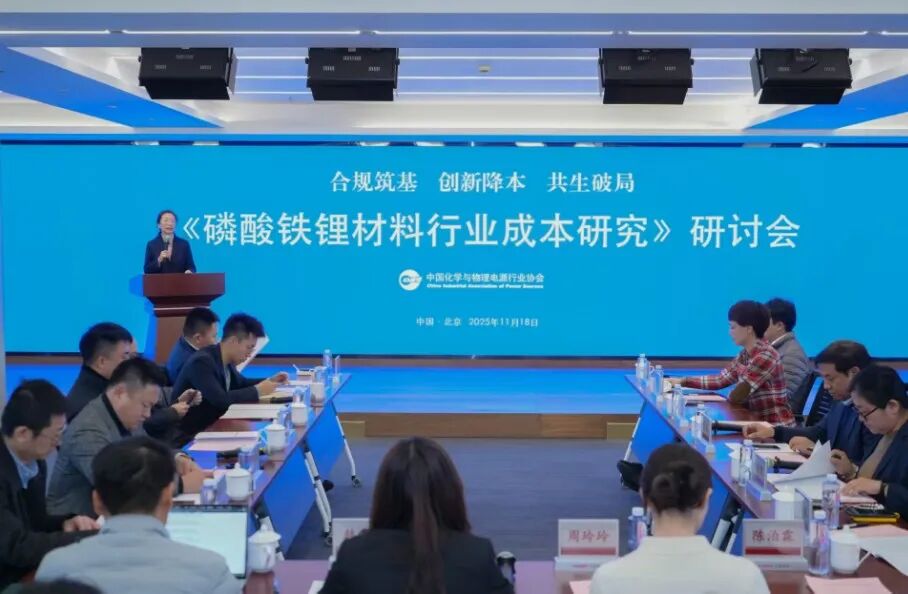
Core Insights - The seminar on "Cost Research of Lithium Iron Phosphate Materials" was held to explore feasible paths for high-quality development in the lithium battery industry chain [1] - Lithium iron phosphate (LFP) is a core material for power and energy storage batteries, supporting the global lithium battery industry with its high safety, long cycle life, and cost advantages [3] - China's lithium-ion battery exports reached $55.38 billion from January to September 2025, a year-on-year increase of 26.75%, with domestic new energy vehicle penetration exceeding 45% and energy storage installations surging by 60% [3] - The industry is expected to exceed 3 trillion yuan in total output value this year, with LFP materials accounting for nearly 74% of cathode material shipments [3] Industry Challenges - The domestic production capacity of LFP cathode materials is expected to approach 4.7 million tons in 2024, while actual production is only around 2.3 million tons, resulting in a capacity utilization rate of about 50% [3] - The price of LFP materials has plummeted from 173,000 yuan per ton at the end of 2022 to 34,000 yuan per ton, a decline of 80.2%, leading to over 36 months of continuous losses in the industry [3] - The average debt-to-asset ratio of six listed companies in the sector is as high as 67.81%, indicating significant financial pressure [3] Market Dynamics - Despite a surge in demand for LFP materials driven by the rapid growth of the downstream new energy vehicle and energy storage markets, cost pressures remain unresolved due to chaotic competition and unreasonable profit distribution within the industry [4] - The cost structure of LFP materials shows that the main material accounts for 35%-40% of costs, with energy costs and direct expenses each around 19%, and auxiliary material costs only 5%-6% [4] - Only 16.7% of companies in the industry are profitable, significantly lower than other lithium battery core material companies, highlighting the urgent need to address profitability and financial risks [4] Strategic Initiatives - The industry is called to action to rebuild market pricing logic using cost indices, curb "involutionary" competition, and shift from "scale competition" to "quality competition" through innovation [5] - A focus on supply-demand balance is emphasized to create a collaborative development ecosystem and guide the orderly release of production capacity [5] - Representatives from LFP companies engaged in discussions on cost reduction, efficiency enhancement, and collaborative development during the seminar [5]