长程地理与时间理解

Search documents
AI能否「圣地巡礼」?多模态大模型全新评估基准VIR-Bench来了
机器之心· 2025-10-15 04:08
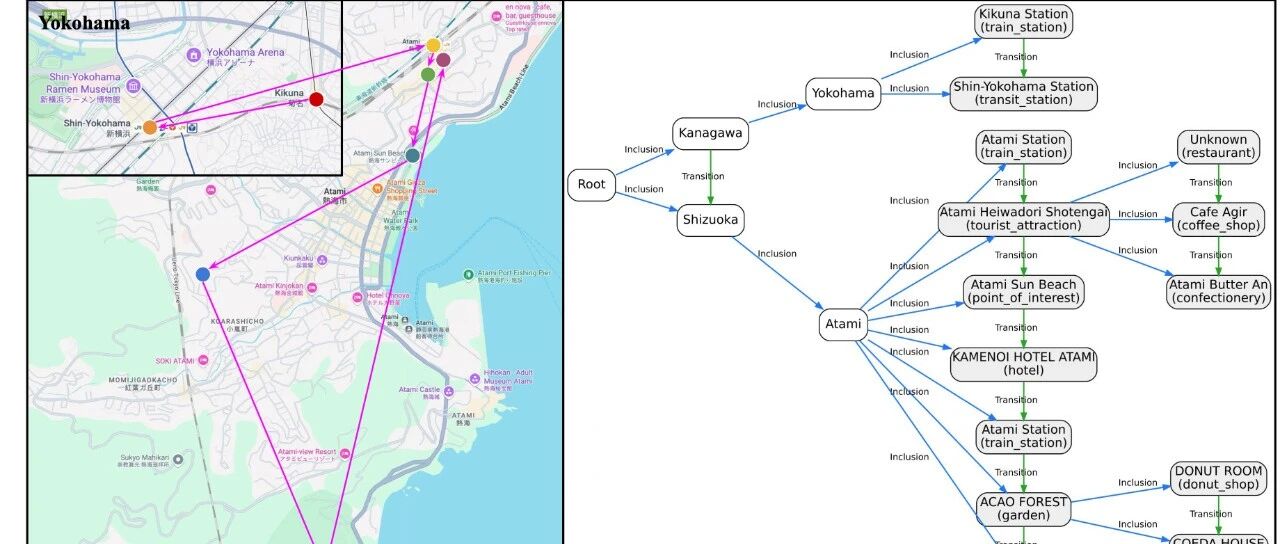
Core Insights - The article discusses the development of a new multimodal large model evaluation benchmark called VIR-Bench, aimed at assessing AI's ability to understand travel videos in terms of geographical locations and temporal sequences [4][20] - The research emphasizes the importance of reconstructing travel itineraries from videos, which requires models to comprehend both geographic and temporal relationships [20] Group 1: VIR-Bench Overview - VIR-Bench is designed to evaluate AI's understanding of travel vlogs by generating a visiting order graph that represents the sequence and relationships of visited locations [6][9] - The visiting order graph consists of nodes representing locations categorized into three levels: Prefecture, City, and Point of Interest (POI) [7][9] Group 2: Task Design and Dataset - The task is divided into two sub-tasks: node prediction, where the model identifies all visited locations, and edge prediction, where it determines the relationships between these locations [10][11] - A dataset of 200 travel videos was constructed, covering 3,689 POIs across 43 prefectures in Japan, with detailed annotations for each video [17][13] Group 3: Experimental Results and Challenges - Current models, particularly open-source ones, lag behind commercial models in POI node recognition and transition edge prediction, with transition edge prediction being notably challenging [16][18] - The performance of models improves significantly with increased scale and the inclusion of geographic pre-training, highlighting the importance of these factors in enhancing accuracy [16][18] Group 4: Future Directions - The research indicates that while current models struggle with long-range reasoning and temporal understanding, there are clear pathways for improvement, such as enhancing spatial awareness and integrating multimodal information [20][18] - The ultimate goal is for AI to not only analyze videos but also to possess the capability to act within the world, aligning with applications in robotics and autonomous systems [20][18]