长臂猿演化研究

Search documents
2026年首期Cell封面论文,来自中国科学院×中山大学
生物世界· 2026-01-10 03:06
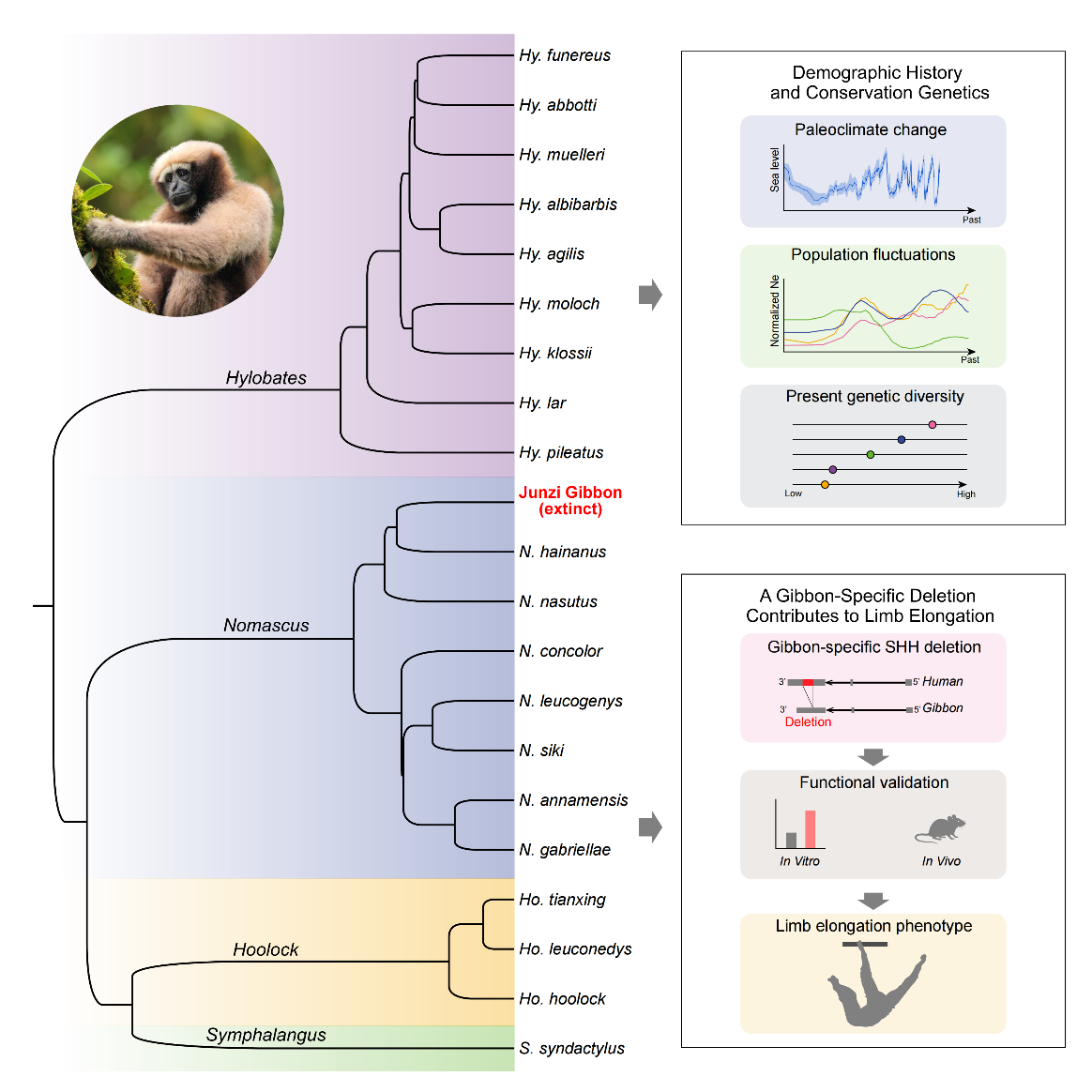
Core Insights - The article discusses a significant research paper published in the journal Cell, focusing on the genome sequences of extant and extinct gibbons, which provides insights into their phylogeny, demographic history, and conservation status [3][7]. Group 1: Research Findings - The research team conducted large-scale genome sequencing and comparative analysis of 18 extant gibbon species and mitochondrial genomes of 3 extinct gibbon samples, including the Junzi gibbon [6][7]. - The study clarified the evolutionary relationships among the four genera of gibbons, resolving a long-standing debate in academia regarding their classification [7]. - The extinct Junzi gibbon was reclassified under the Nomascus genus, negating its previous status as an independent genus [7][9]. Group 2: Genetic Insights - The research identified a deletion of 205 base pairs in the Sonic Hedgehog (SHH) gene, which is linked to the elongated limbs characteristic of gibbons [8][9]. - The historical dynamics of gibbon population sizes and habitat suitability were found to correlate with past climate changes, providing valuable information for conservation efforts [7][9]. Group 3: Implications for Conservation - The findings advance the understanding of gibbon evolution, biology, and conservation efforts, highlighting the importance of genomic studies in informing conservation strategies for threatened gibbon species [11].


【央视新闻】长臂猿为何“长臂”?中国研究团队破解百年难题
Yang Shi Xin Wen· 2025-11-10 03:04
Core Insights - The research led by the Kunming Institute of Zoology, in collaboration with various domestic and international research institutions, has provided new scientific insights into the evolution, population dynamics, and genetic basis of gibbons, aiding global conservation efforts [2][3]. Group 1: Evolutionary Insights - The study constructed the most comprehensive gibbon genome dataset to date, covering 18 extant gibbon species and successfully obtaining mitochondrial genomes from three ancient samples, including the extinct "Gentle Gibbon" [2]. - The research revealed the evolutionary relationships among the four major genera of the gibbon family, addressing a century-old classification issue and providing a framework for understanding their rapid radiation evolution [2]. - The study confirmed the taxonomic status of the Hoolock gibbon as an independent species and reclassified the "Gentle Gibbon" under the genus Hoolock, correcting previous misconceptions about ancient species classification [2]. Group 2: Population Dynamics - The research reconstructed the population dynamics of gibbons over the past several hundred thousand years, identifying a significant population bottleneck during the Late Pleistocene (approximately 100,000 to 200,000 years ago) followed by a synchronous population recovery around 70,000 years ago [3]. - This population dynamic aligns with global climate changes and sea level fluctuations, indicating that historical climate change has been a key driver of gibbon population fluctuations [3]. Group 3: Genetic Mechanisms of Morphological Traits - The research identified a specific deletion in the regulatory region of the Sonic Hedgehog (SHH) gene, which is crucial for limb development in vertebrates, through comparative genomic analysis [4]. - Functional validation using transgenic mouse models showed that mice carrying the gibbon-specific gene deletion exhibited significantly elongated limb bones compared to wild-type mice, suggesting that this structural variation played a critical role in the evolutionary elongation of gibbon limbs [4].
长臂猿为何“长臂”?中国研究团队破解百年难题
Yang Shi Xin Wen Ke Hu Duan· 2025-11-10 02:03
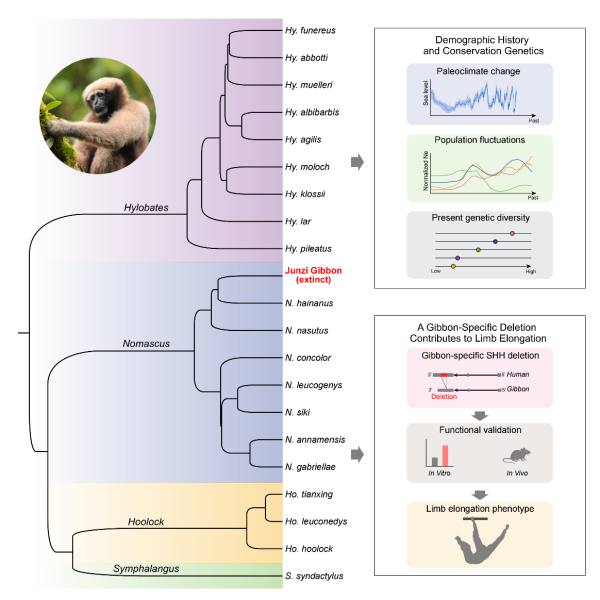
Core Insights - The research led by the Kunming Institute of Zoology, Chinese Academy of Sciences, provides new scientific insights into the evolution, population dynamics, and genetic basis of the gibbon family, aiding global conservation efforts [1][3] Group 1: Research Findings - The study constructed the most comprehensive gibbon genome dataset to date, covering 18 extant gibbon species and successfully obtaining mitochondrial genomes from three ancient samples, including the extinct "Gentle Gibbon" [1] - The research revealed the evolutionary relationships among the four genera of gibbons: Hylobates, Nomascus, Symphalangus, and Bunopithecus, addressing a century-old classification issue [1][3] - The study confirmed the taxonomic status of the Hoolock gibbon as an independent species and reclassified the "Gentle Gibbon" under the Nomascus genus, providing important insights into historical species diversity and geographical distribution [1][3] Group 2: Population Dynamics - The research reconstructed the population dynamics of gibbons over the past several hundred thousand years, identifying a significant population bottleneck during the Late Pleistocene (approximately 100,000 to 200,000 years ago) followed by a synchronous population recovery around 70,000 years ago [3] - This population dynamic aligns with global climate changes and sea-level fluctuations, indicating that historical climate change was a key driver of gibbon population fluctuations [3] Group 3: Genetic Mechanisms - The research identified a specific deletion in the regulatory region of the Sonic Hedgehog (SHH) gene, which is crucial for limb development in vertebrates, through comparative genomics analysis [3][4] - Functional validation using transgenic mouse models showed that mice with the gibbon-specific gene deletion exhibited significant relative growth in limb bones, suggesting that this structural variation played a critical role in the evolutionary elongation of gibbon limbs [4]