零售媒体广告

Search documents
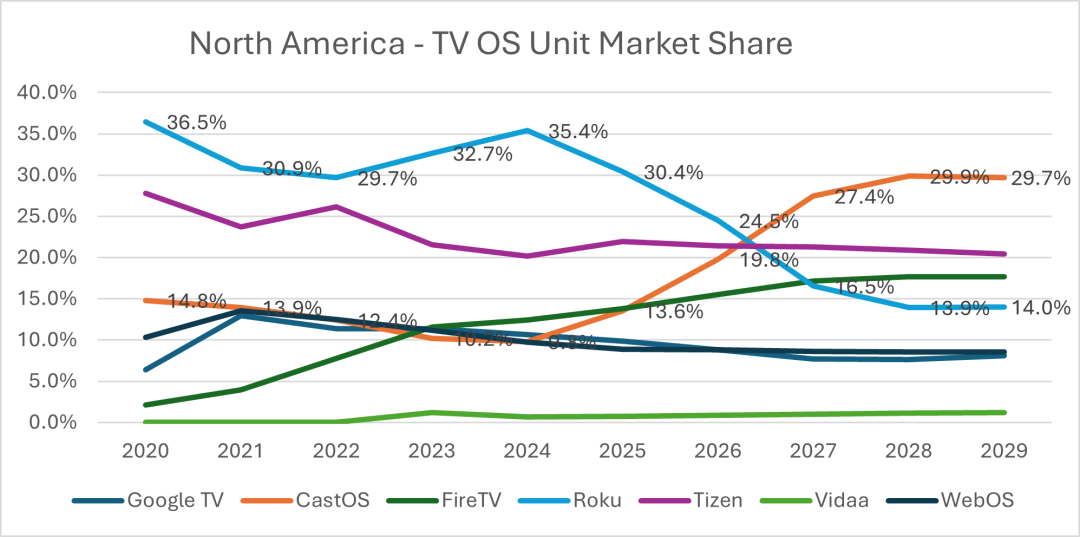
Omdia:至2029年零售商将控制北美电视操作系统市场份额的47%
Zhi Tong Cai Jing· 2026-02-02 02:55
Core Insights - Omdia's report predicts that by 2029, retailers will control 47% of the North American TV operating system (OS) market share, up from 27% in 2025, indicating a shift towards retail media advertising driven by e-commerce rather than traditional TV sales [1] - The global TV OS market is evolving into three distinct segments, with localized Android ecosystems in China maintaining a dominant 96% market share, while Google TV leads in other regions with a 40% share, which is expected to be gradually divided among competitors Vidaa, Titan, and TiVo [1] Group 1 - By 2027, North America is expected to reach a turning point, with Walmart's CastOS devices projected to ship 14 million units, benefiting from Walmart's acquisition of Vizio and the expansion of its CastOS platform [4] - Following the acquisition, Walmart is expected to increase Vizio's shipments from 4.8 million units in 2024 to 6.6 million units in 2025, a growth of 37.5%, while Amazon's FireTV shipments are projected to rise from 6.1 million units in 2024 to 6.8 million units in 2025, an increase of 11.5% [4] - By 2029, Walmart's CastOS devices are expected to reach 14.8 million units, while Amazon's FireTV is projected to reach 8.8 million units, resulting in a total shipment of 23.6 million units and a market size of 50 million units [4] Group 2 - At the 2026 CES, VIDAA OS will undergo significant changes, rebranding to V Home OS to reflect its broader role beyond just television, and announcing a partnership with Microsoft to integrate Copilot generative AI features into the platform [4] - Google has integrated Gemini AI into Google TV, launching interactive shoppable video features at CES, which aim to seamlessly connect viewing and purchasing experiences through AI recognition of products on screen [4] - The emphasis on "conversational shopping" allows users to inquire about products while watching, with the TV identifying brands and providing options to add items to a shopping cart, highlighting the growing importance of shopping functionalities across multiple TV OS platforms [4]





美股异动|Doordash股价再攀新高多重利好助推上涨3.88%
Xin Lang Cai Jing· 2025-10-06 22:45
Core Insights - DoorDash's stock price has seen a significant increase of 3.88%, marking three consecutive days of gains and reaching a new historical high [1] - The company has entered into a strategic partnership with Criteo to enhance advertising opportunities in the retail media sector, leveraging both companies' technological strengths for deeper integration in the digital advertising market [1] - DoorDash has completed the acquisition of UK competitor Deliveroo for approximately £2.9 billion, expanding its presence in the European market while allowing Deliveroo to operate as an independent brand [1] Technological Innovations - DoorDash has launched its first autonomous delivery robot, Dot, designed to improve local delivery experiences with efficient autonomous driving capabilities and the ability to handle diverse delivery tasks [2] - The introduction of Dot reflects DoorDash's ambition in the unmanned delivery sector and its commitment to enhancing delivery efficiency [2] Investment Considerations - DoorDash's diversified strategy and technological innovations indicate strong growth potential [2] - Investors are advised to monitor competitive dynamics in international markets and the practical application of technological developments, as these factors will directly impact DoorDash's long-term market performance [2]

Maplebear (CART) - 2025 Q1 - Earnings Call Transcript
2025-05-01 21:00
Financial Data and Key Metrics Changes - In Q1, the company delivered Gross Transaction Value (GTV) at the top end of guidance, growing 10% year over year, driven by a 14% increase in orders, marking the strongest order growth in ten quarters [11][12] - Average order value decreased by 4% year over year due to the addition of restaurant orders and a reduction in minimum basket size for Instacart Plus members [12][52] - GAAP net income was $106 million, a decrease of $24 million year over year, primarily due to the lapping of stock-based compensation reversals [12][13] - Adjusted EBITDA of $244 million exceeded guidance, growing 23% year over year [13] - Operating cash flow increased by $193 million year over year to $298 million, driven by strong operational performance [13] Business Line Data and Key Metrics Changes - Advertising and other revenue increased by 14% year over year, outpacing GTV growth, with strong contributions from both large and emerging brand partners [12][13] - The company reported a strong performance in its advertising segment, with over 7,000 brands onboarded and spending [21][22] Market Data and Key Metrics Changes - The company reached 98% of households in North America, with consistent customer engagement across geographies and income levels [6][11] - Demand remains robust across various use cases, including weekly grocery trips and higher frequency restaurant orders [6][11] Company Strategy and Development Direction - The company is focused on accelerating online grocery adoption and driving growth through deep retailer partnerships and innovative solutions [4][7] - The acquisition of Windshop is aimed at enhancing the company's enterprise strategy and powering storefronts for more retailers [7][49] - The company is leveraging AI to improve efficiency and customer experience, with 87% of code developed with AI assistance in Q1 [9] Management's Comments on Operating Environment and Future Outlook - Management noted that despite macroeconomic uncertainty, there have been no unexpected changes in consumer behavior [6][15] - The company expects Q2 GTV to be between $8.85 billion and $9 billion, representing year-over-year growth of 8% to 10% [15] - Management expressed confidence in the company's ability to navigate current macro conditions and continue to grow through uncertainty [15][16] Other Important Information - The company has approximately $1.8 billion in cash and similar assets on its balance sheet and has initiated a share buyback program [13][14] - The company continues to focus on affordability initiatives, including a $10 minimum basket for Instacart Plus members, which has led to increased order frequency and user engagement [40][41] Q&A Session Summary Question: Can you unpack what you're seeing from both core CPG advertisers and the contribution from the longer tail? - Management reported strong Q1 performance driven by both large and emerging brands, with over 7,000 brands onboarded [21][22] Question: What changes are needed on the shopper end to economically execute the $10 minimum basket? - Management indicated that high order density allows for economic execution of the $10 minimum basket, increasing batching opportunities [27][28] Question: How do you ensure your ad platform works well for the long tail of ad buyers? - Management highlighted the development of self-serve tools and inspiration ads to enhance discovery for emerging brands [36][37] Question: Are you seeing any common themes in the type of retailers benefiting from small basket orders? - Management noted widespread growth across various retailers, with no specific trends identified [57] Question: How do you think about investments if the economy were to slow down? - Management emphasized a strong balance sheet and the ability to adjust investments based on market conditions [89][90]