无人配送

Search documents
顺丰同城(09699):内外双向发力推动业绩高增,无人物流布局稳健推进
GOLDEN SUN SECURITIES· 2026-04-01 07:43
Investment Rating - The report maintains a "Buy" rating for the company [6] Core Insights - The company achieved a revenue of 22.9 billion RMB in 2025, representing a year-on-year growth of 45%. The net profit reached 280 million RMB, up 110% year-on-year, while the adjusted net profit was 410 million RMB, reflecting a 184% increase [1] - The company is actively expanding its same-city delivery and last-mile services, with significant growth in revenue and order volume, particularly in the food delivery and instant retail sectors [2] - The integration of artificial intelligence into operations is a key focus, enhancing efficiency and service quality, with a robust deployment of unmanned logistics solutions [3] Financial Performance - In 2025, the company reported a net profit margin of 1.2%, an increase of 0.4 percentage points year-on-year, and an adjusted net profit margin of 1.8%, up 0.9 percentage points [1] - The company anticipates adjusted net profits of 530 million RMB, 750 million RMB, and 970 million RMB for 2026, 2027, and 2028, respectively, with corresponding adjusted EPS of 0.58, 0.82, and 1.05 RMB per share [3] - The projected revenue growth rates for the next few years are 20.2% in 2026, 19.8% in 2027, and 18.5% in 2028 [5] Business Growth Drivers - The company has seen a 72% increase in active merchants and an 11% increase in active consumers, indicating strong market penetration [1] - The same-city delivery revenue for 2025 was 135 billion RMB, a 48% increase year-on-year, with a significant rise in order volume exceeding 55% [2] - The last-mile delivery revenue reached 94 billion RMB in 2025, growing by 42% year-on-year, driven by deep collaboration with major clients [2]
激光雷达“一哥”交卷!禾赛ADAS主雷达市占率超40%,全年GAAP盈利创行业先河
市值风云· 2026-03-24 14:09
Core Viewpoint - The humanoid robot sector is experiencing a significant surge, with laser radar technology becoming essential for advanced driving systems and robotics applications [1][31]. Group 1: Laser Radar Market Dynamics - Level 3 autonomous driving regulations are being implemented, necessitating reliable perception systems, with laser radar proving indispensable in challenging conditions [4][5]. - Major automotive manufacturers are now equipping flagship models with laser radar, indicating a shift from "whether to use" to "how well to use" this technology [5][6]. - Hesai Technology (NASDAQ: HSAI; HKEX: 2525) holds over 40% market share in the global automotive laser radar sector, significantly outperforming competitors [7][8]. Group 2: Company Performance and Growth - In 2025, Hesai's market share increased by 18 percentage points within 11 months, reflecting strong demand and market penetration [10]. - The company achieved a revenue of 3.03 billion RMB in 2025, marking a 45.8% year-on-year growth and nearly an eightfold increase since 2019 [21][26]. - Hesai is the first laser radar company to achieve profitability, with a GAAP profit of 440 million RMB in 2025, and has maintained positive operating cash flow for three consecutive years [26][29]. Group 3: Technological Advancements - Hesai has adopted a "full-stack self-research" approach, integrating multiple components into a single chip, significantly reducing costs and improving performance [16][19]. - The ATX laser radar, launched in 2025, has seen a 60% reduction in size and a 55% decrease in power consumption compared to its predecessor [17]. - The company holds the highest number of patents in the laser radar field, with 2,071 authorized patents and applications as of the end of 2025 [18]. Group 4: Expansion into Robotics - Hesai is expanding its laser radar applications beyond automotive to include humanoid robots, delivery drones, and industrial automation, with significant orders in these sectors [31][35]. - The company has secured a global supply contract for 10 million units of its JT series laser radar for robotic applications, demonstrating its leadership in the robotics market [31]. - In 2025, Hesai delivered 239,300 laser radars for robotics, a staggering increase of 425.8% year-on-year, outpacing its automotive sector growth [32].



对话禾赛佀新泉:无人配送行业提速,今年出货数十万颗激光雷达丨L4十人谈
雷峰网· 2026-03-17 07:40
Core Viewpoint - The unmanned delivery industry is expected to grow from thousands to hundreds of thousands of units by 2026, driven by technological advancements and market demand [2][4][44]. Group 1: Industry Growth and Trends - The unmanned delivery sector is projected to increase from 10,000 units to 100,000 units by 2026, indicating a significant market expansion [4][44]. - The industry has experienced a cycle of rise, stagnation, and resurgence, with companies like Hesai becoming major suppliers due to their early investments and partnerships [2][3][10]. - Cost reduction has been a critical factor in the industry's revival, with the shift from mechanical to ADAS laser radars significantly lowering expenses [3][32]. Group 2: Technological Advancements - Unmanned delivery vehicles are now required to operate on public roads, necessitating compliance with regulations similar to passenger vehicles, which has led to a convergence in technology and operational requirements [4][40][41]. - The technology used in unmanned delivery vehicles is increasingly resembling that of passenger vehicles, with laser radar configurations approaching L3 standards [4][41][42]. - The industry is witnessing a shift towards integrating ADAS laser radars into unmanned delivery vehicles, enhancing cost efficiency and operational viability [30][32]. Group 3: Market Dynamics and Competition - The growth of unmanned delivery vehicles is putting pressure on traditional commercial vehicle markets, prompting many manufacturers to explore partnerships and self-development in this area [7][37]. - The competitive landscape is evolving, with new entrants and established players vying for market share, leading to a more intense competitive environment [6][49]. - Companies are focusing on product quality and reliability rather than solely competing on price, as maintaining a healthy profit margin is essential for sustainable growth [18][21][20]. Group 4: Future Outlook and Challenges - The acceptance of unmanned delivery vehicles by consumers is crucial for scaling the industry, similar to the journey of laser radars in passenger vehicles [52][53]. - The anticipated demand for unmanned delivery vehicles is expected to drive significant growth, with companies preparing for increased production capacities to meet this demand [44][46]. - The industry is still in its early stages, with potential for new players to emerge and existing companies to adapt to changing market conditions [51].

无人配送专题报告:无人配送应用前景广阔,国内迎来加速期
CAITONG SECURITIES· 2026-03-04 04:30
Investment Rating - The report maintains a "Positive" investment rating for the industry [2] Core Insights - The industry of unmanned delivery is expected to accelerate in China starting in 2025, with significant increases in fleet delivery numbers and local policy support [5][20] - The market for unmanned delivery is vast, with potential applications in various sectors including express delivery, instant retail, and logistics, with express delivery alone projected to generate revenues of 1.5 trillion yuan by 2025 [5][35] - The industry is characterized by a diverse range of participants, primarily startups employing various business models, including vehicle sales, leasing, and logistics services [5][52] Summary by Sections 1. Unmanned Delivery Vehicles Address Delivery Challenges - Unmanned delivery vehicles can operate autonomously 24/7, significantly enhancing delivery capacity and efficiency while reducing costs [13][15] - The vehicles are designed to meet various logistical needs with standardized cargo designs [13] 2. Rich Downstream Applications with Trillion-Yuan Potential - Unmanned delivery vehicles are primarily used in express delivery, instant retail, urban logistics, and rural transportation [26] - The express delivery sector is projected to handle 1.99 billion packages and generate 1.5 trillion yuan in revenue by 2025, reflecting a substantial market opportunity [35] 3. Diverse Participants with Various Business Models - Key players in the unmanned delivery sector include startups like Neolix and Ninebot, as well as major internet companies like JD.com and Meituan [52] - The report highlights the rapid growth of these companies, with Neolix covering over 300 cities and deploying more than 16,000 vehicles by early 2026 [52] 4. Government Support and Policy Development - The Chinese government has issued multiple supportive policies for unmanned delivery, with a notable increase in local regulations since 2025 [5][20] - Local policies are becoming more detailed, addressing vehicle specifications, insurance, and operational requirements [5] 5. Investment Recommendations - The report suggests focusing on companies like Sutech, Bertley, and others in the unmanned delivery space, indicating a strong growth trajectory for the industry [5]

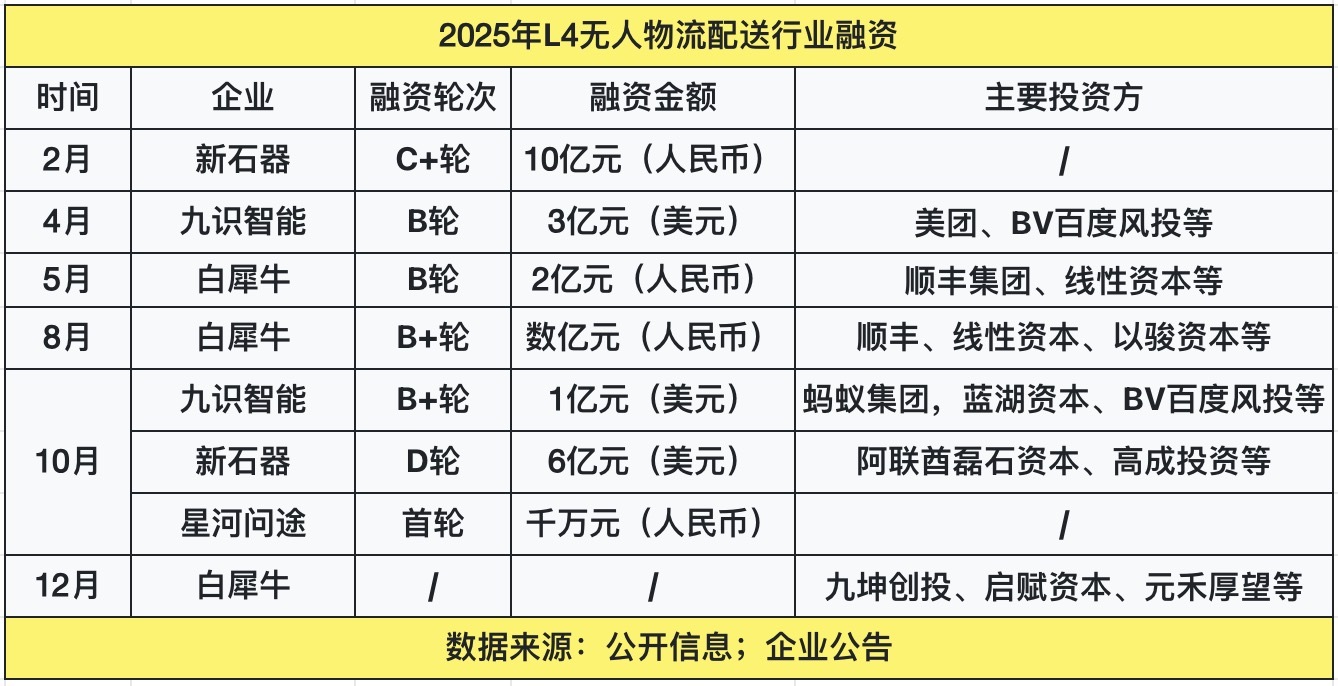
一年“吸金”近百亿!无人配送行业开启“加速跑”,路权、标准与长尾困境仍待突围
Mei Ri Jing Ji Xin Wen· 2026-02-26 12:51
Core Insights - The article highlights that Jiushi Intelligent has completed a new financing round exceeding $300 million, becoming the first unicorn in the RoboVan (L4 autonomous delivery vehicle) sector with a valuation over $10 billion, signaling a renewed focus on the burgeoning unmanned delivery industry [1] - Since 2025, leading companies like New Stone, Jiushi Intelligent, and White Rhino have raised nearly 10 billion yuan in total financing, while the cost of unmanned delivery vehicles continues to decline, with delivery volumes surpassing 10,000 units [1][2] Financing Trends - The unmanned delivery industry reached a pivotal turning point in 2025, with total financing for delivery companies nearing 10 billion yuan, transitioning from R&D to large-scale commercial operations [1] - Capital is increasingly concentrating on leading companies, with New Stone raising over 5 billion yuan in two rounds of financing in 2025, and Jiushi Intelligent securing a total of $400 million across two rounds [1][2] Delivery Volume Growth - The significant increase in delivery volumes serves as a strong indicator of the industry's shift towards scalability, with New Stone announcing over 10,000 L4 autonomous vehicles delivered by September 2025, and Jiushi Intelligent also surpassing the same milestone [2] Industry Entry and Competition - In September 2025, players in the upstream and downstream of the supply chain began entering the market, with companies like Desay SV and Youjia Innovation launching their own unmanned delivery vehicle brands [3] - The financing landscape in 2025 shows that leading companies with scalable delivery capabilities are favored by investors, while state-owned and industrial capital are replacing traditional financial institutions as key drivers of industry growth [3] Policy and Technological Advancements - In 2025, both central and local governments accelerated the introduction of supportive policies for unmanned delivery vehicles, with some regions starting regular operations [4] - The rapid iteration of technology, including advancements in chips, lidar, AI models, and smart driving technology, has led to significant cost reductions and performance improvements in unmanned delivery vehicles [4][6] Cost Reduction and Market Potential - The hardware costs for L4 vehicles have dramatically decreased, with a reported drop of over 80% from 2023 to 2025, and New Stone's vehicles achieving a cost reduction of approximately 30% with each iteration [6] - Youjia Innovation anticipates sales reaching tens of thousands of units in 2026, with projected revenue of approximately 400 to 500 million yuan and a gross margin of 20% to 30% [6] Challenges in Commercialization - Despite the accelerating commercialization of unmanned delivery vehicles, challenges remain in technology and ecosystem development, including technical bottlenecks for stable operation in various conditions [7] - The lack of unified standards and testing systems for unmanned delivery vehicles hinders the efficiency of technological iteration, with different companies adopting varied technical routes [7][9] Regulatory and Operational Hurdles - The industry faces obstacles related to urban governance and the adaptation of new logistics forms, particularly in mixed traffic scenarios regarding liability and road rights [9] - The absence of nationwide uniform entry thresholds and road rights management rules complicates cross-regional operations, increasing costs for companies [9] - Some companies are exploring new collaboration models to optimize resource utilization and reduce operational costs, such as partnerships with public transport companies [9] Market Forecast - Predictions indicate that unmanned delivery vehicle shipments could reach between 100,000 to 150,000 units in 2026, and 600,000 to 1 million units by 2030, with leading companies holding over 90% of the market share [9]
新石器无人车自动驾驶里程超1亿公里 无人配送迈入规模化商用时代
Jin Rong Jie· 2026-02-25 09:01
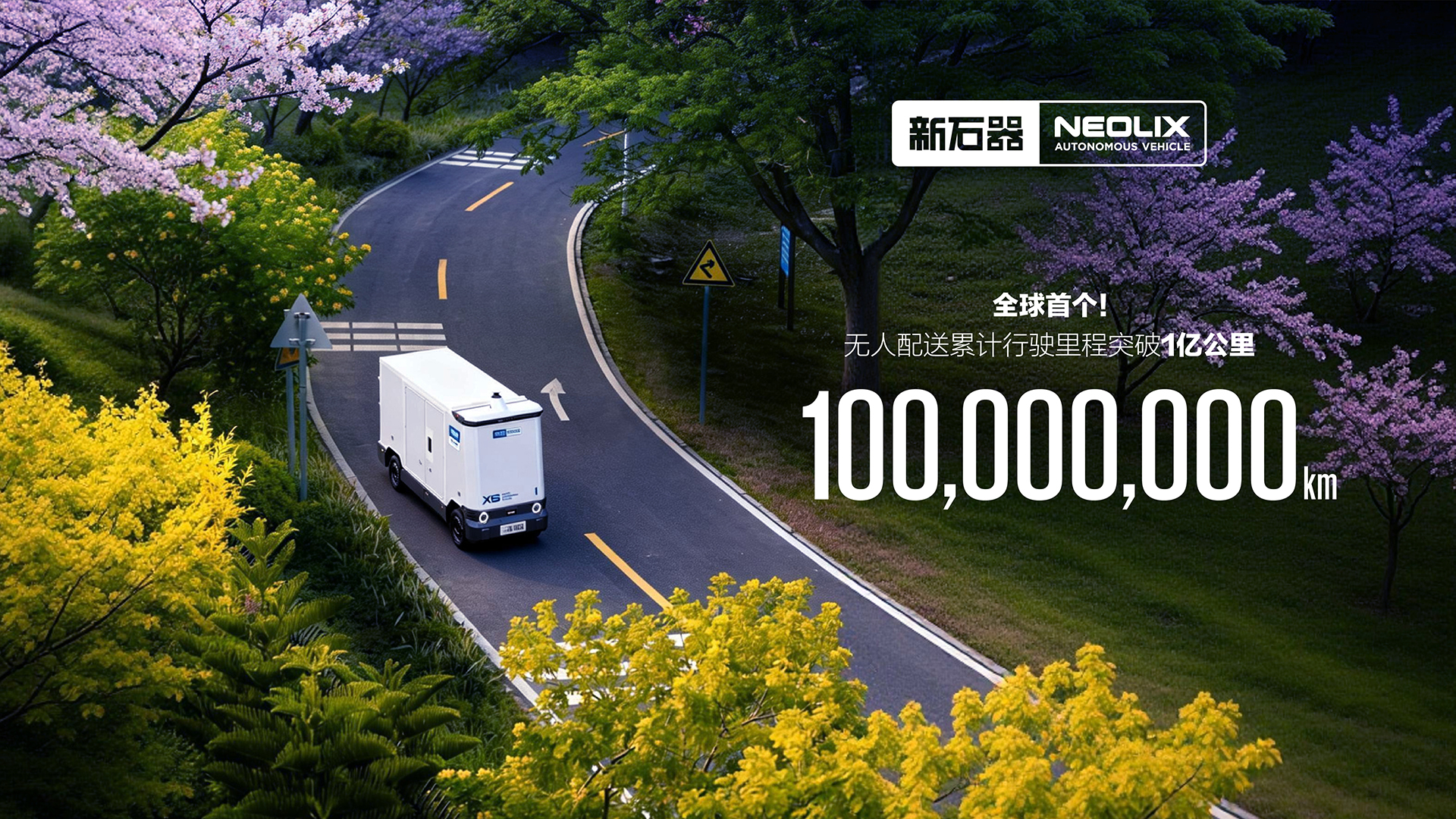
Core Insights - Neolix has achieved a significant milestone by surpassing 100 million kilometers in cumulative autonomous driving mileage, becoming the first company in the global unmanned delivery industry to reach this operational milestone, indicating a new phase in the scale, commercialization, and normalization of unmanned delivery [1][2] Company Overview - Neolix is the largest provider of L4-level unmanned urban delivery solutions globally, with an operational network covering over 300 cities across 15 countries, including China, UAE, Saudi Arabia, Japan, South Korea, Australia, and Portugal [1] - The company has validated its technology in diverse climates and complex road conditions, showcasing the strength of "Made in China" in leading the global adoption of unmanned delivery technology [1] Technological Advancements - Neolix plans to launch an industry-leading L4-level unmanned driving solution in 2025, significantly reducing reliance on high-precision maps and enabling "hour-level deployment" capabilities across regions [1] - The company utilizes a foundational model called "Neolix-VA," which achieves spatial understanding and decision-making capabilities in complex scenarios with a minimal sensor configuration of one LiDAR and twelve cameras [1] Operational Efficiency - Neolix's unmanned vehicles can reduce logistics costs by over 40% and improve efficiency by 30% compared to traditional transportation methods, making it a key supplier for major Chinese logistics companies [4] - In the Nantong home textile industry, Neolix has deployed over 260 unmanned vehicles, creating a logistics network covering nearly 3,500 service points and delivering over 100,000 home textile items daily [4] Market Impact - The achievement of the 100 million kilometer milestone is expected to accelerate the practical application of unmanned delivery across various industries, contributing to the digital transformation and efficiency enhancement sought by many sectors [12] - Neolix aims to continue focusing on technological innovation and large-scale operations, collaborating with global partners and regulatory bodies to build a sustainable logistics ecosystem [12]
“小黄蜂”穿梭航站楼,外卖直达登机口
Nan Jing Ri Bao· 2026-02-10 04:58
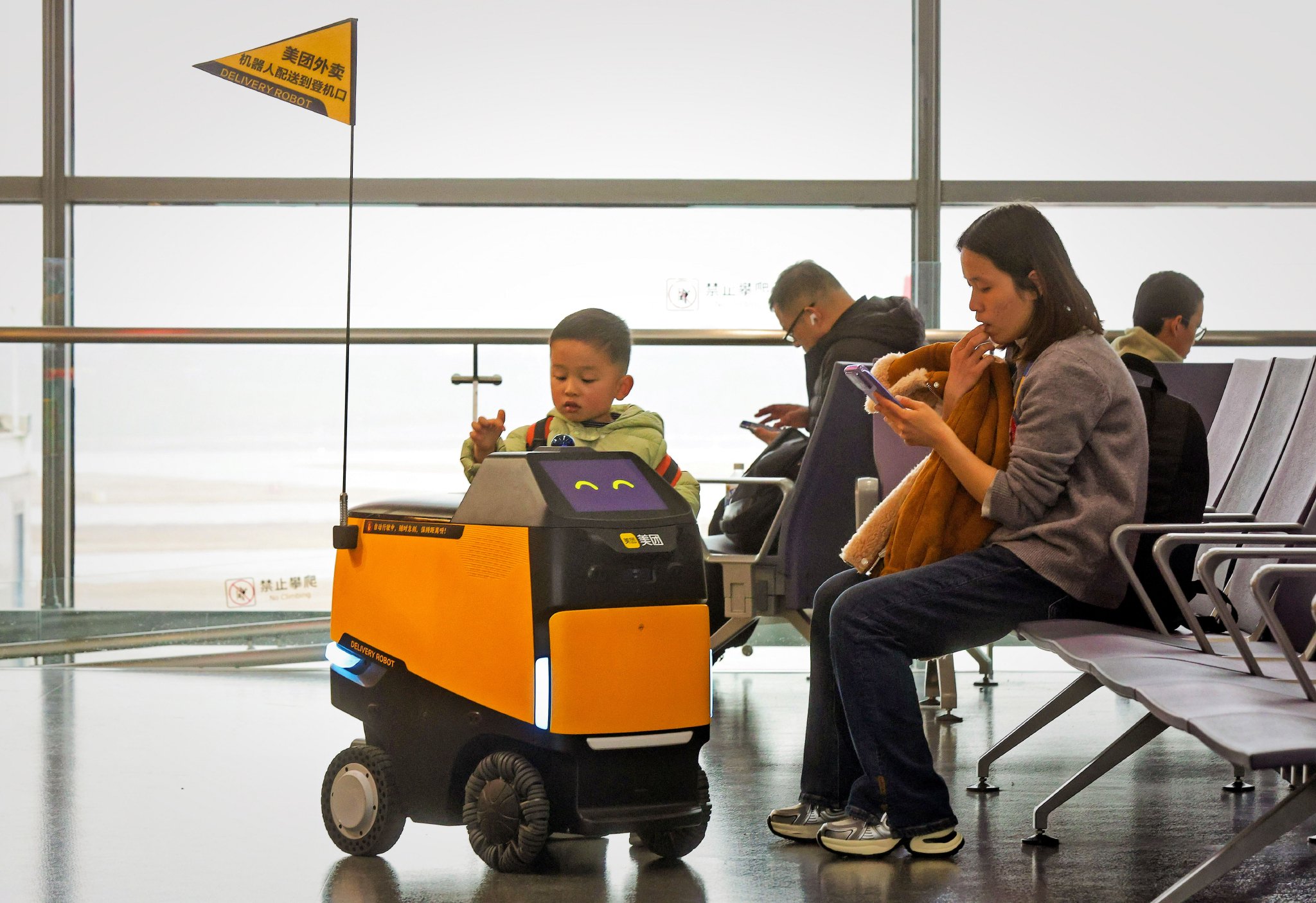
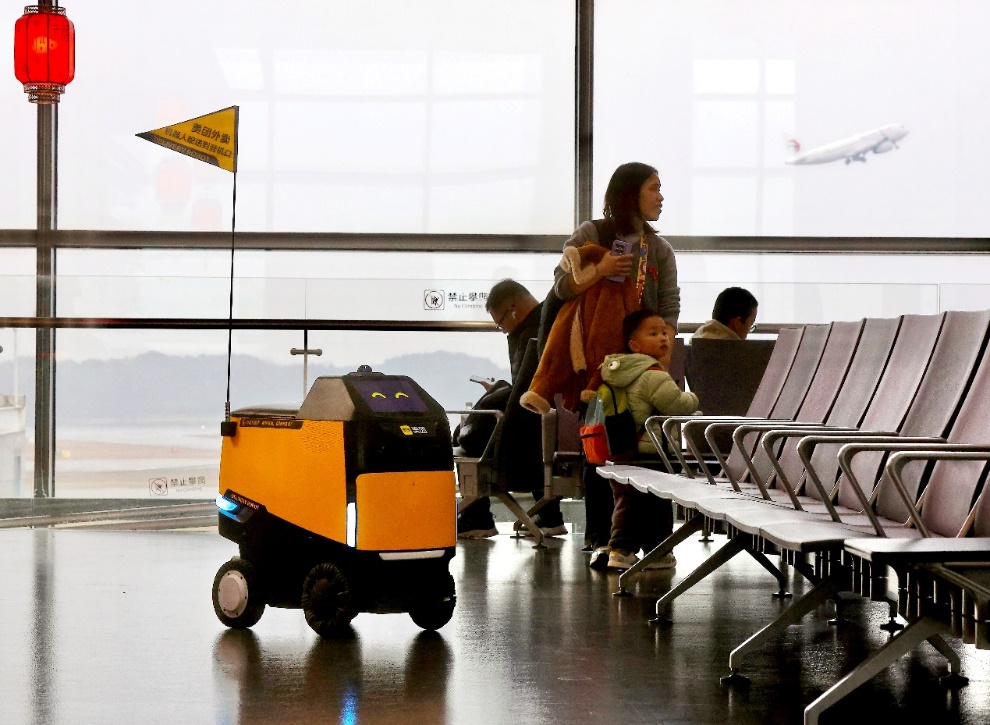
Core Viewpoint - The introduction of five "Little Bee" smart delivery robots at Nanjing Lukou International Airport marks a significant advancement in airport services, allowing passengers to order food directly to their boarding gates, enhancing convenience during the busy Spring Festival travel period [3][4][6]. Group 1: Implementation of Smart Delivery Robots - Five smart delivery robots, named "Little Bee," have been deployed at Nanjing Lukou International Airport's T1 terminal, providing food delivery services to passengers [3][4]. - This initiative represents the first implementation of Meituan's unmanned delivery service in an airport setting in East China [3][4]. - The robots are designed to navigate through crowds and deliver food from popular vendors like KFC and Starbucks directly to passengers at the boarding gates [3][4][6]. Group 2: Operational Efficiency and Passenger Experience - During the Spring Festival, the airport expects to handle approximately 3.8 million passengers, averaging over 95,000 daily [4]. - Passengers often face challenges in finding food options without straying far from their boarding gates; the robot service alleviates this issue by allowing them to order food without leaving their seats [4][7]. - The "Little Bee" robots can save passengers an average of 20 minutes in food retrieval time, effectively addressing the "last mile" delivery challenge in airport dining [6][7].

华东首例 南京机场“小黄蜂”机器人将外卖直送登机口
Zhong Guo Min Hang Wang· 2026-02-10 03:15
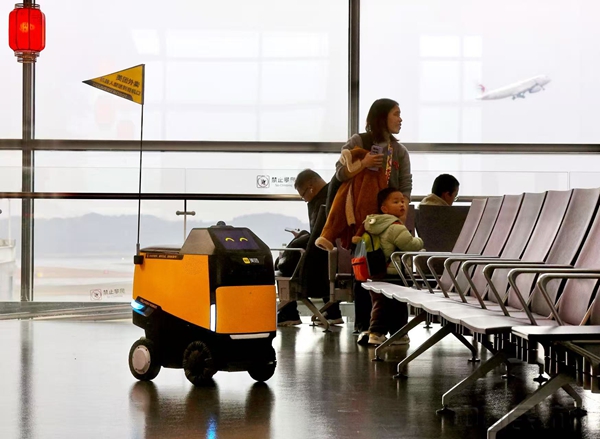
Core Insights - The introduction of Meituan's "Little Yellow Bee" smart delivery robots at Nanjing Lukou International Airport marks a significant advancement in the construction of "smart airports" in the East China region, enhancing end-service capabilities [1][4] Group 1: Implementation of Smart Delivery Robots - Five "Little Yellow Bee" robots have been deployed at the T1 terminal of Nanjing Lukou International Airport to provide instant delivery services for food from brands like KFC and Starbucks [1][2] - Passengers can place orders via the Meituan app, allowing the robots to autonomously navigate and deliver food to designated boarding gates, significantly improving the dining experience at the airport [2][4] Group 2: Benefits for Passengers - The introduction of these robots addresses common passenger issues during peak travel times, such as the inconvenience of purchasing food far from boarding gates [2][4] - On average, passengers can save nearly 20 minutes in food retrieval time, transforming the process from "people finding food" to "food finding people" [4] Group 3: Technological Validation - The deployment of the robots in a complex environment like an airport demonstrates the maturity and safety of Meituan's delivery technology, as it successfully navigates high foot traffic and dynamic conditions [4] - The successful operation of these robots at Nanjing Airport follows their implementation in two airports in South China, marking another milestone in Meituan's expansion [4] Group 4: Future Developments - Nanjing Airport plans to deepen its collaboration with Meituan to expand the range of merchants and service scenarios, aiming to enhance passenger travel experiences through technological empowerment [7]

华东首家!美团“AI智能体+机器人”上岗南京机场,春运旅客在登机口也能“点外卖”
Jin Rong Jie· 2026-02-09 04:11
Core Viewpoint - The introduction of Meituan's "Little Bumblebee" robots at Nanjing Lukou International Airport marks a significant advancement in smart airport services, enhancing passenger convenience during the busy Spring Festival travel period [1][2][10]. Group 1: Introduction of Smart Delivery Robots - Nanjing Airport has officially launched smart delivery robot services, making it the first airport in the region to implement such technology [2]. - The "Little Bumblebee" robots are designed for both indoor and outdoor use, integrating indoor positioning with instant delivery systems [4]. - This initiative represents a breakthrough in the construction of "smart airports," particularly in the last-mile delivery service [2][10]. Group 2: Passenger Experience Enhancement - Passengers can now order food from vendors like KFC and Starbucks directly to their boarding gates using their mobile devices, significantly reducing the time spent retrieving meals [2][4]. - The average time saved for passengers using the robot service is nearly 20 minutes, transforming the process from "finding food" to "food finding people" [4]. - The service is particularly beneficial for travelers with children, large luggage, or those in a hurry, making the travel experience more comfortable and less stressful [11]. Group 3: Technological Integration and AI Collaboration - The service features collaboration between Meituan's AI assistant "Xiao Mei" and the delivery robots, allowing passengers to place orders verbally while en route to the airport [8]. - This integration provides a seamless experience where the AI can accurately predict delivery times and manage orders, enhancing the overall convenience for travelers [8]. Group 4: Safety and Operational Challenges - Operating in an airport environment poses unique challenges due to high security, large crowds, and strict operational standards, which the robots must navigate effectively [9][10]. - The successful deployment of the "Little Bumblebee" robots at Nanjing Airport follows previous implementations in two airports in Southern China, indicating a milestone in the maturity and safety of unmanned delivery technology [10]. Group 5: Future Prospects and Innovations - Nanjing Airport plans to deepen its collaboration with Meituan, aiming to introduce more vendors and explore diverse service scenarios to further enhance passenger experiences [11]. - The initiative reflects a commitment to leveraging technology to create a more personalized and caring travel environment for passengers during the Spring Festival [11].
顺丰同城×顺丰速运机器人末端配送亮相南昌双子塔,覆盖外卖、急送、快递等全场景
Quan Jing Wang· 2026-02-06 13:36
Core Viewpoint - SF Express and SF City have launched a new end-to-end delivery service using building robots, starting operations at the Nanchang Twin Towers on February 5, focusing on solving last-mile delivery challenges in high-rise buildings [1] Group 1: Service Implementation - The service integrates delivery robots within the SF Express service center at the Twin Towers, aiming to create a one-stop living service hub that combines "intelligent delivery" and "specialized economy" [2] - The robot delivery system allows for seamless collaboration between delivery personnel and robots, enhancing delivery efficiency and user experience by autonomously completing the last 100 meters of delivery [2][3] - The service supports not only SF Express but also other courier and food delivery platforms, reducing wait times and improving operational efficiency by allowing robots to utilize elevators during off-peak hours [3] Group 2: Broader Logistics Strategy - SF City is expanding its unmanned delivery capabilities, developing a smart delivery ecosystem that includes unmanned vehicles, drones, and delivery robots for various scenarios, including medical emergencies and food delivery [4] - The collaboration between SF City and SF Express enhances last-mile delivery efficiency through shared resources and complementary services, improving the overall logistics experience [4] - The successful implementation of this robot delivery model in Nanchang serves as a reference for similar high-density spaces, with plans for expansion to more urban business districts in the future [5]