
非推理模型

Search documents
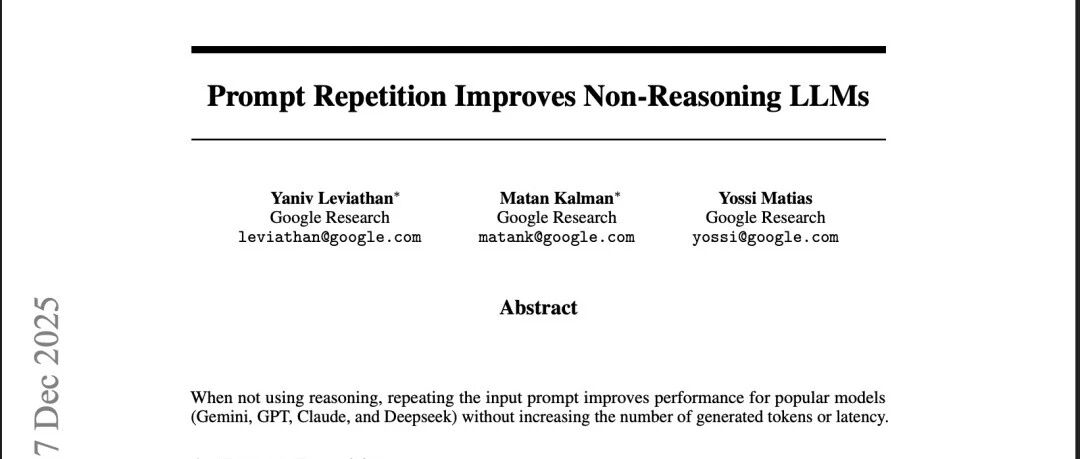
一个被忽视的Prompt技巧,居然是复制+粘贴。
数字生命卡兹克· 2026-01-22 03:09
Core Viewpoint - The article discusses a technique from a Google paper that shows how repeating prompts can significantly improve the accuracy of non-reasoning large language models (LLMs) from 21.33% to 97.33% [1][7]. Group 1: Experiment Overview - Google conducted experiments using seven popular non-reasoning models, including Gemini 2.0 Flash, GPT-4o, and Claude 3, to test the effectiveness of prompt repetition [13]. - The results indicated that this simple technique won 47 out of 70 tests, with no failures, demonstrating a clear performance improvement across all tested models [25]. Group 2: Mechanism of Improvement - The improvement is attributed to the nature of causal language models, which predict words sequentially. By repeating the prompt, the model can "look back" at the previous context, enhancing its understanding [28][30]. - This technique allows the model to have a second chance to process the information, leading to better accuracy in responses [39][40]. Group 3: Implications for Prompt Engineering - The article suggests that for many straightforward Q&A scenarios, simply repeating the question can be a powerful optimization strategy, rather than relying on complex prompt structures [50]. - Future directions mentioned in the paper include integrating this repetition technique into the training process of models, which could further enhance their performance [52].


智谱 GLM-4.5 团队深夜爆料:上下文要扩、小模型在路上,还承诺尽快发新模型!
AI前线· 2025-08-29 08:25
Core Insights - The GLM-4.5 model focuses on expanding context length and improving its hallucination prevention capabilities through effective Reinforcement Learning from Human Feedback (RLHF) processes [6][10][11] - The future development will prioritize reasoning, programming, and agent capabilities, with plans to release smaller parameter models [6][50][28] Group 1: GLM-4.5 Development - The team behind GLM-4.5 includes key contributors who have worked on various significant AI projects, establishing a strong foundation for the model's development [3] - The choice of GQA over MLA in the architecture was made for performance considerations, with specific weight initialization techniques applied [12][6] - There is an ongoing effort to enhance the model's context length, with potential releases of smaller dense or mixture of experts (MoE) models in the future [9][28] Group 2: Model Performance and Features - GLM-4.5 has demonstrated superior performance in tasks that do not require long text generation compared to other models like Qwen 3 and Gemini 2.5 [9] - The model's effective RLHF process is credited for its strong performance in preventing hallucinations [11] - The team is exploring the integration of reasoning models and believes that both reasoning and non-reasoning models will coexist and complement each other in the long run [16][17] Group 3: Future Directions and Innovations - The company plans to focus on developing smaller MoE models and enhancing the capabilities of existing models to handle more complex tasks [28][50] - There is an emphasis on improving data engineering and the quality of training data, which is crucial for model performance [32][35] - The team is also considering the development of multimodal models, although current resources are primarily focused on text and vision [23][22] Group 4: Open Source vs. Closed Source Models - The company believes that open-source models are closing the performance gap with closed-source models, driven by advancements in resources and data availability [36][53] - The team acknowledges that while open-source models have made significant strides, they still face challenges in terms of computational and data resources compared to leading commercial models [36][53] Group 5: Technical Challenges and Solutions - The team is exploring various technical aspects, including efficient attention mechanisms and the potential for integrating image generation capabilities into language models [40][24] - There is a recognition of the importance of fine-tuning and optimizing the model's writing capabilities through improved tokenization and data processing techniques [42][41]

马斯克旗下xAI:Grok 3,全球最强的非推理模型,在需要现实世界知识如法律、金融和医疗保健等任务中表现出色。
news flash· 2025-04-18 19:25
Core Insights - xAI, founded by Elon Musk, has introduced Grok 3, which is touted as the world's strongest non-reasoning model, excelling in tasks requiring real-world knowledge such as law, finance, and healthcare [1] Company Summary - xAI has developed Grok 3, emphasizing its superior performance in various sectors that demand practical knowledge [1]