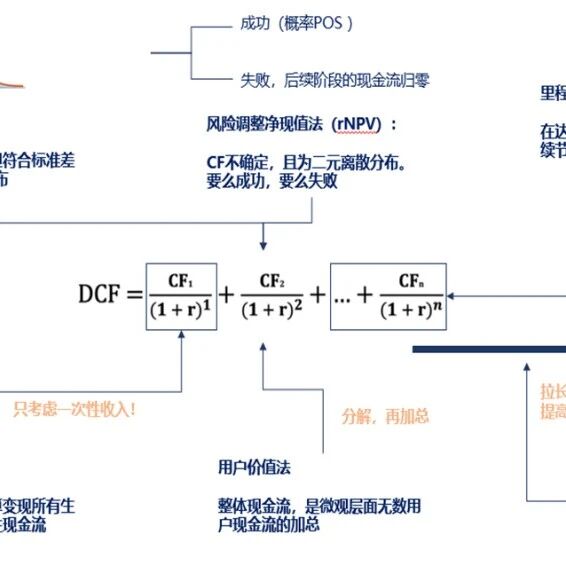
风险调整净现值法

Search documents
【申万宏源策略】敢问梦想价值几何?——构建申万宏源策略“未来产业定价体系”
申万宏源证券上海北京西路营业部· 2026-03-05 02:12
Core Viewpoint - The article discusses the ineffectiveness of traditional DCF models for valuing early-stage technology companies that are not yet profitable and have high uncertainty, proposing a "future industry pricing system" to standardize and replicate valuation methods for such firms [1]. Group 1: Future Industry Pricing Foundation - The foundation of future industry pricing consists of seven valuation sub-models, including absolute valuation models like real options, risk-adjusted NPV, milestone method, user value method, ecological niche valuation, and cost-based valuation, along with a relative valuation model [2]. - Each absolute valuation model has different implicit assumptions about future cash flows, with methods like real options assuming a continuous probability distribution of cash flows over time and space [3]. Group 2: Investor Behavior and Market Dynamics - The article categorizes investors into three types: industrial investors using cost-based methods for valuation during downturns, institutional investors focusing on high-frequency data with rNPV and user value methods, and visionary capitalists valuing long-term potential through real options and ecological niche methods [3]. - The fluctuation in stock prices reflects the varying valuation models employed by different investors, with market dynamics shifting between reality-based and dream-based valuations [3]. Group 3: Future Industry Pricing System Steps - The proposed pricing system involves three steps: selecting conservative, neutral, and optimistic valuation sub-models based on the company's context, setting pricing weights according to market temperature and investor behavior, and calculating the final valuation through weighted averages [4]. - The market temperature is categorized into nine levels, with investor risk appetite influencing the weight assigned to each model, particularly during market extremes [4][10]. Group 4: Case Studies - The article illustrates the application of the pricing system using SpaceX and OpenAI as examples, emphasizing the need for multi-faceted valuation approaches that consider different business lines and their respective life cycles [5][6]. - For SpaceX, the valuation of its Starlink business was anchored at $429.1 billion using comparable valuation methods, while its space computing business was valued at approximately $312.1 billion through real options, and the long-term Mars vision was assessed using cost-based methods [5]. - OpenAI's valuation was calculated using conservative, neutral, and optimistic models, resulting in a final valuation of $780.8 billion, closely aligning with its reported market valuation [6].