验证者悖论

Search documents
120 人砍到 25 人:大重组时代的人类生存指南
深思SenseAI· 2026-03-31 02:58
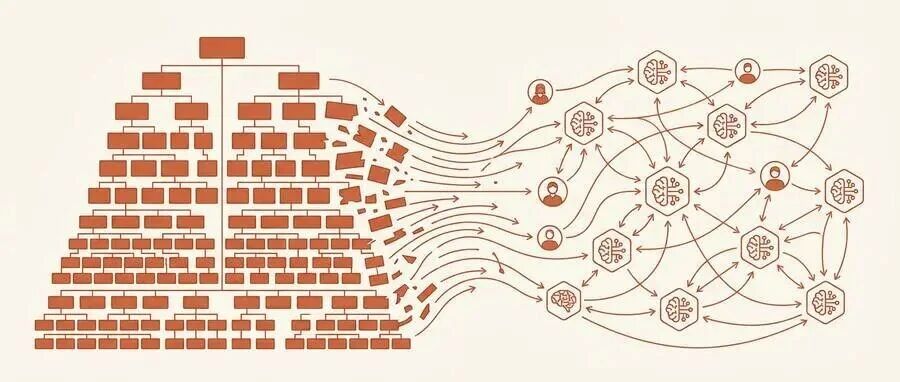
Core Insights - The core conclusion of the article is that the organizational structure of companies is being fundamentally redefined, rather than merely speeding up individual performance through AI [2][30]. Group 1: Data-Driven Changes - Companies are significantly downsizing their teams, with one engineering team reducing from 120 to 25 members [5][7]. - The ratio of engineers per microservice has decreased from 0.75 to 0.1, indicating a shift towards fewer engineers managing more services [3][7]. - The ratio of specialists to generalists is expected to change from 1:6 to 1:25, with a long-term goal of 1:100 [3][7]. Group 2: Role Evolution - Traditional roles in product, engineering, and design are merging into two new roles: Product Builders and Product Implementers [6]. - Four new human roles are emerging as AI takes over more tasks: Chief Accountability Officer, System Architect, Relationship Expert, and Validator [13][30]. Group 3: Organizational Transformation - The transition from steam to electricity in the 1890s serves as a historical analogy for the current shift towards AI, emphasizing that true efficiency comes from redesigning systems around new technologies [8][11]. - Many companies are still in the early stages of AI adoption, akin to "cars on dirt roads," where the underlying architecture has not yet adapted to leverage AI fully [10][12]. Group 4: Validator Demand - The demand for Validators is expected to follow a bell curve, peaking in 2-4 years as AI capabilities grow but still require human oversight [14][20]. - There is a concern that if AI takes over entry-level tasks, future generations may lack the necessary expertise to fill Validator roles [17][18]. Group 5: Market Signals - The article suggests that organizational structure is a form of technology that can be redesigned, indicating a shift in focus from management to a broader market signal [30][32]. - The emergence of new startups aimed at creating tools for human system architects and Validator platforms reflects the need for a complete overhaul of existing structures rather than mere optimization [28][29].