高原高速公路建设技术创新

Search documents
在“豆腐渣”里打洞,给路面“穿衣服”,为草甸“搬家”……闯三关 “绣”出一条最高“天路”
Si Chuan Ri Bao· 2026-01-03 01:37
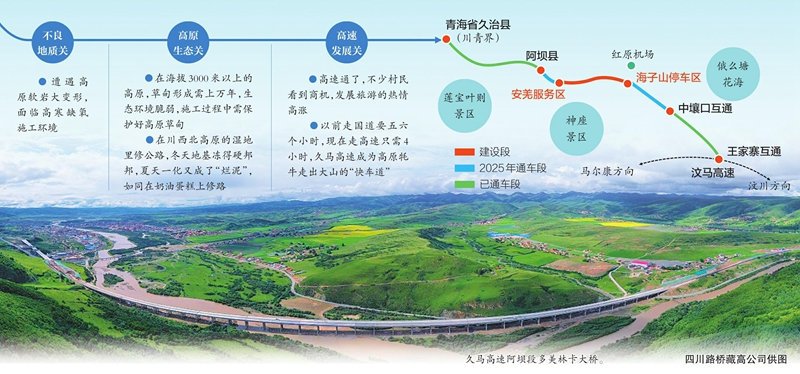
Core Viewpoint - The completion of the 87.5-kilometer section of the Jiuma Expressway significantly improves access to the Hongyuan Grassland in Aba Prefecture, reducing travel time from Chengdu to four hours, and marks the end of the region's lack of highway connectivity [3][10]. Group 1: Construction Challenges - The Jiuma Expressway is noted as the highest highway in Sichuan, with an average elevation of 3,300 meters, traversing complex geological structures [4]. - The construction faced significant challenges due to poor geological conditions, particularly in the control project, the Chazhenliangzi Tunnel, which is a rare high-altitude soft rock tunnel [5]. - Initial excavation progress was slow, with only 100 meters completed in the first two years, prompting a shift to a more efficient construction method that increased monthly progress from under 10 meters to 40 meters [5]. - The extreme high-altitude climate, with average temperatures around 1.4 degrees Celsius and extreme lows of minus 36 degrees Celsius, posed additional risks of road surface cracking [6]. Group 2: Environmental Considerations - The project included measures to protect the fragile high-altitude ecosystem, with a focus on relocating native grassland vegetation to minimize ecological disruption [6][7]. - A total of 690,000 square meters of native grassland was successfully relocated, achieving a survival rate of over 85% for the transplanted vegetation [7]. - Innovative techniques were employed to stabilize the roadbed in soft soil areas, ensuring minimal ecological impact while maintaining structural integrity [8]. Group 3: Economic and Social Impact - The Jiuma Expressway serves as a vital transportation route for local agricultural products, particularly facilitating the movement of highland yak from the mountains to markets, significantly reducing travel time [9][10]. - The highway is expected to boost local tourism, with plans for developing new tourist attractions and enhancing existing ones along the route, thereby promoting economic growth in the region [9][10]. - The expressway is part of a broader strategy to connect rural areas with urban centers, supporting rural revitalization efforts and improving local livelihoods [9].