高端化与定制化

Search documents
中国O型圈市场现状研究分析与发展前景预测报告
QYResearch· 2026-01-09 09:09
Core Viewpoint - The Chinese O-ring market is experiencing steady growth, driven by the expansion of high-end manufacturing industries and the acceleration of domestic substitution for imported high-performance O-rings. The market is expected to reach a sales revenue of $2,643.6 million by 2031, with a CAGR of 6.60% from 2025 to 2031 [6][7]. Market Overview - In 2024, the sales revenue of the Chinese O-ring market is projected to be $1,691.6 million, with static seals accounting for 73% of the sales volume and automotive applications representing 67% of the sales volume [7]. - Major manufacturers in China include NOK, DuPont, and Zhongding Group, with the top three companies expected to hold a 30% market share by 2024 [7]. Development Trends - The market is shifting from general-purpose O-rings to specialized products that are high-temperature resistant, clean, corrosion-resistant, radiation-resistant, and high-pressure resistant. Customization and collaborative development are becoming key strategies for companies to attract high-end clients [7]. - Government policies supporting the "strong chain and supplement chain" initiative are promoting technological advancements in the sealing industry, benefiting domestic brands [7][11]. Driving Factors - The demand for domestic substitution in high-end equipment manufacturing, particularly in aerospace, semiconductor equipment, and rail transportation, is increasing the requirements for sealing components [9]. - The expansion of industrial automation and hydraulic systems is driving the demand for dynamic sealing O-rings, particularly in engineering machinery and robotics [10]. - Policies encouraging "specialized, refined, and innovative" enterprises and advanced manufacturing are facilitating the rapid development of local O-ring companies [11]. - The rise of smart manufacturing, particularly in electric vehicles and battery thermal management systems, is creating new demands for high-temperature and pressure-resistant seals [12]. Constraints - The industry faces challenges due to reliance on imported high-end raw materials, such as FFKM and specialty fluororubber, which limits the entry of domestic O-rings into high-end markets [13]. - The low concentration of the industry, with many small and medium-sized enterprises, leads to intense competition and price wars [14]. - Many Chinese manufacturers lack international certifications and brand recognition, making it difficult to enter high-end international supply chains [15]. - Some companies still use traditional, inefficient molds and manual forming equipment, resulting in poor consistency and low automation levels [16]. Supply Chain Analysis - The upstream supply chain is heavily reliant on imported materials, particularly high-end fluororubber and specialty elastomers, which can lead to price fluctuations affecting downstream operations [17]. - Major domestic suppliers include Sinopec, PetroChina, and various small enterprises focused on rubber additives [17]. - The midstream market is dominated by a few leading companies and foreign brands, while local manufacturers are primarily located in manufacturing hubs such as Zhejiang, Jiangsu, Shandong, and Guangdong [17]. Conclusion - The Chinese O-ring market is poised for growth, driven by domestic demand and supportive policies, but faces challenges related to material sourcing, competition, and brand recognition. The industry is evolving towards high-end and customized solutions to meet the needs of advanced manufacturing sectors [6][7][9][11].

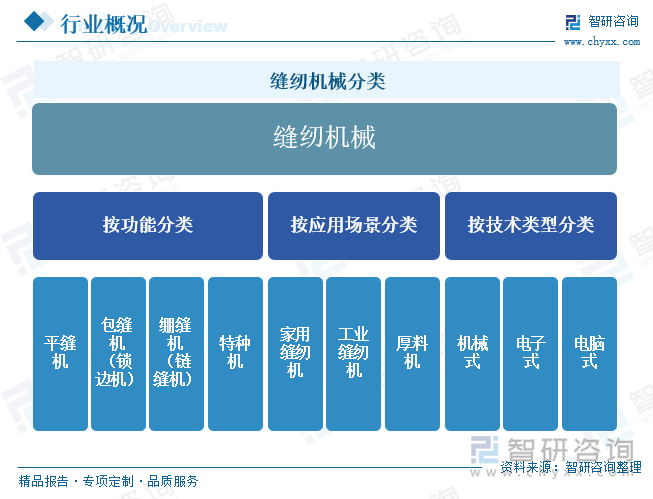
研判2025!中国缝纫机械行业产业链图谱、发展历程、发展现状、竞争格局、重点企业以及发展趋势分析:我国工业缝纫机及家用缝纫机产量均有所回升 [图]
Chan Ye Xin Xi Wang· 2025-04-30 01:14
Industry Overview - The production of industrial sewing machines in China has shown fluctuations, with a decline to 5.6 million units in 2023, but is expected to rebound to approximately 6.85 million units in 2024, representing a year-on-year growth of 22.32% [1][10] - The production of household sewing machines was around 3.8 million units in 2023, down 5% year-on-year, primarily due to weak domestic demand and a fragmented export market. In 2024, production is projected to reach about 4.7 million units, a year-on-year increase of 25.33% [1][11] Industry Chain Analysis - The sewing machine industry chain includes upstream raw materials and components supply, midstream equipment manufacturing, and downstream applications and supporting services, forming a complete value chain [4] - Upstream materials include metals like steel and aluminum, which are essential for manufacturing sewing machines, ensuring performance and stability [8] Development History - The Chinese sewing machine industry has evolved through four stages: initial reliance on imports, rapid development post-reform, global competition after joining the WTO, and the current phase of intelligent transformation driven by IoT and AI technologies [6] Current Industry Status - The industrial sewing machine sector is rapidly advancing towards automation, with many companies introducing machines with features like automatic thread cutting and tension adjustment [10] - The household sewing machine market remains stable, with a growing demand for high-end models featuring advanced functionalities aimed at mid-to-high-end consumers [11] Key Enterprises - Key players in the industry include Jack Sewing Machine, Shang Gong, and Standard Shares, each focusing on different market segments and product innovations [13][15][17] - Jack Sewing Machine is recognized for its competitive pricing and product diversity, while Shang Gong employs a multi-brand strategy to cover various market needs [15][17] Future Development Trends - The industry is moving towards intelligent development, with machines increasingly equipped with advanced sensors and control systems for enhanced efficiency and accuracy [19] - There is a noticeable trend towards high-end and customized sewing machines, catering to the growing demand for personalized products [20][21] - Green manufacturing and energy efficiency upgrades are becoming critical, with companies adopting eco-friendly materials and optimizing energy consumption in production processes [22]