高阶非平衡拓扑相

Search documents
【科技日报】高阶非平衡拓扑相首次在量子体系中实现
Ke Ji Ri Bao· 2025-12-01 03:29
Core Insights - The research team from the University of Science and Technology of China, in collaboration with Shanxi University, has achieved a significant breakthrough by realizing and detecting higher-order non-equilibrium topological phases using the programmable superconducting quantum processor "Zuchongzhi 2" [1][2] - This achievement marks an important step in quantum simulation, particularly in exploring complex topological states, and lays the groundwork for achieving quantum advantage in quantum simulation problems [1] Group 1 - The research successfully implemented quantum simulation and detection of both balanced and non-equilibrium second-order topological phases for the first time [2] - The team proposed theoretical designs for static and Floquet quantum circuits to address the challenges of constructing higher-order topological Hamiltonians in a two-dimensional superconducting qubit array [2] - A systematic optimization scheme for the processor was established, allowing for dynamic control of qubit frequency and coupling strength, leading to the successful execution of up to 50 Floquet periods of evolution operations on a 6x6 qubit array [2] Group 2 - The experiment successfully realized four different types of non-equilibrium second-order topological phases and systematically explored their energy spectrum, dynamical behavior, and topological invariants [2] - The realization of higher-order topological phases in quantum systems presents a significant scientific challenge and offers potential pathways for topological quantum computing based on non-Abelian statistics [1]
量子科技重要突破!我国科学家首次实现→
Shang Hai Zheng Quan Bao· 2025-11-29 06:30
Core Insights - The research team from the University of Science and Technology of China, in collaboration with Shanxi University, achieved a significant breakthrough by realizing and detecting higher-order non-equilibrium topological phases using the programmable superconducting quantum processor "Zuchongzhi 2" [1] Group 1: Research Achievements - The research marks an important advancement in quantum simulation, laying the groundwork for achieving quantum advantage in quantum simulation problems [1] - The team proposed static and Floquet quantum circuit design schemes for higher-order topological phases, addressing the critical challenge of constructing higher-order balanced and non-equilibrium topological Hamiltonians in a two-dimensional superconducting qubit array [1] - A universal framework for dynamical topological measurement was developed, enhancing the understanding of complex topological states [1] Group 2: Experimental Results - Researchers established a systematic processor optimization scheme, achieving dynamic control of qubit frequency and coupling strength through precise calibration [1] - In a 6×6 qubit array, the team successfully executed up to 50 Floquet periods of evolution operations, marking the first successful realization of four different types of non-equilibrium second-order topological phases [1] - The study systematically explored the energy spectrum, dynamical behavior, and topological invariants of the identified topological phases [1]
量子模拟在探索复杂拓扑物态方向上取得重要突破
Ke Ji Ri Bao· 2025-11-29 03:02
Core Insights - The research team from the University of Science and Technology of China, including Pan Jianwei, Zhu Xiaobo, Peng Chengzhi, and Gong Ming, in collaboration with Mei Feng from Shanxi University, has achieved a significant breakthrough by realizing and detecting higher-order non-equilibrium topological phases in a quantum system using the programmable superconducting quantum processor "Zuchongzhi 2" [1] Group 1 - The achievement marks an important advancement in quantum simulation, particularly in exploring complex topological states [1] - This research lays the groundwork for utilizing superconducting quantum processors to achieve quantum advantage in quantum simulation problems [1] - The findings were published in the international academic journal "Science" on November 28 [1]
中科大×山西大学合作发表最新Science论文
生物世界· 2025-11-28 10:00
Core Insights - The article discusses a significant breakthrough in the field of quantum simulation, specifically the realization and detection of higher-order nonequilibrium topological phases (HOTPs) using a programmable superconducting quantum processor [1][5]. Group 1: Research Background - Topological phases have emerged as a crucial research direction in condensed matter physics and quantum simulation, with higher-order topological phases challenging traditional bulk-boundary correspondence [3]. - The realization of higher-order topological phases in quantum systems has been a scientific challenge, with potential implications for revealing the quantum nature of topological states and enabling topological quantum computing based on non-Abelian statistics [4]. Group 2: Experimental Achievements - The research team successfully implemented quantum simulation and detection of both balanced and nonequilibrium second-order topological phases using the "Zuchongzhi 2" superconducting quantum processor [5]. - They developed theoretical designs for static and Floquet quantum circuits to construct higher-order topological Hamiltonians in a two-dimensional superconducting qubit array, addressing key challenges in the field [5]. - The experimental setup involved a 6×6 qubit array, where the team executed up to 50 Floquet periods of evolution operations, successfully realizing four different types of nonequilibrium second-order topological phases and exploring their energy spectra, dynamical behaviors, and topological invariants [5][7].


重要突破!我国科学家在量子体系中实现并探测高阶非平衡拓扑相
Yang Shi Xin Wen· 2025-11-27 19:50
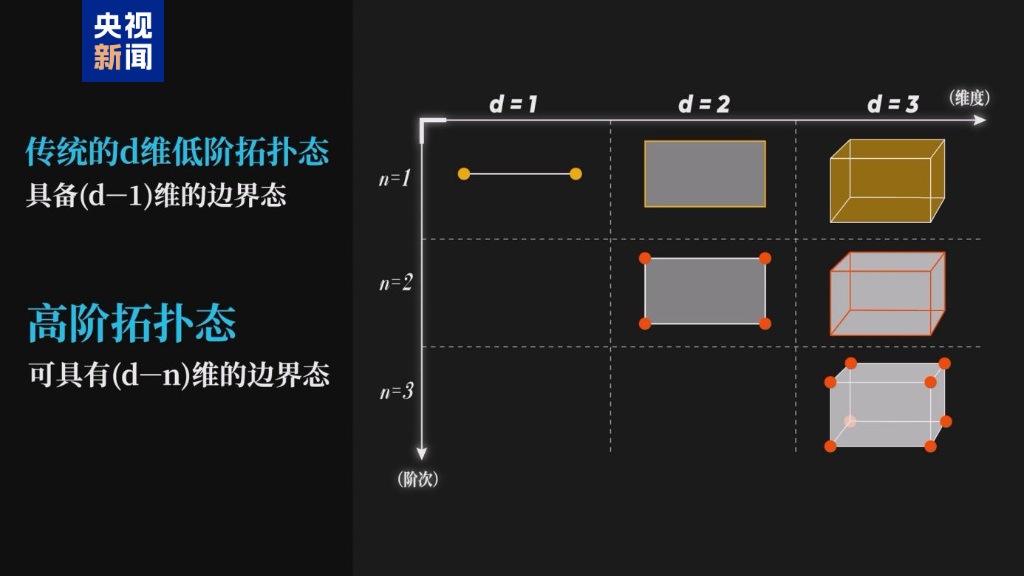
Core Insights - The research team from the University of Science and Technology of China, in collaboration with Shanxi University, has achieved a significant breakthrough by realizing and detecting higher-order non-equilibrium topological phases using the programmable superconducting quantum processor "Zuchongzhi No. 2" [1][3] - This achievement marks an important step in quantum simulation, paving the way for utilizing superconducting quantum processors to achieve quantum advantages in complex topological states [1][3] Group 1: Research Significance - Higher-order topological phases represent a crucial area of study in condensed matter physics and quantum simulation, differing from traditional topological phases by exhibiting localized states on lower-dimensional boundaries [3] - The realization of higher-order topological phases in quantum systems addresses a significant scientific challenge and has implications for revealing the quantum nature of topological states and potential pathways for topological quantum computing based on non-Abelian statistics [3] Group 2: Experimental Details - The experiment utilized a 6x6 two-dimensional qubit array to achieve periodic driving, successfully simulating and detecting both balanced and non-equilibrium second-order topological phases [5] - The research team developed static and Floquet quantum circuit design schemes to construct higher-order topological Hamiltonians in a two-dimensional superconducting qubit array, overcoming key challenges in the field [6] - A systematic optimization scheme for the processor was established, allowing for dynamic control of qubit frequency and coupling strength, leading to the successful execution of up to 50 Floquet periods and the exploration of various characteristics of the non-equilibrium second-order topological phase [6][7]