6G 卫星通信

Search documents
为什么中国要一口气申报20万颗卫星?
Xin Lang Cai Jing· 2026-01-13 11:27
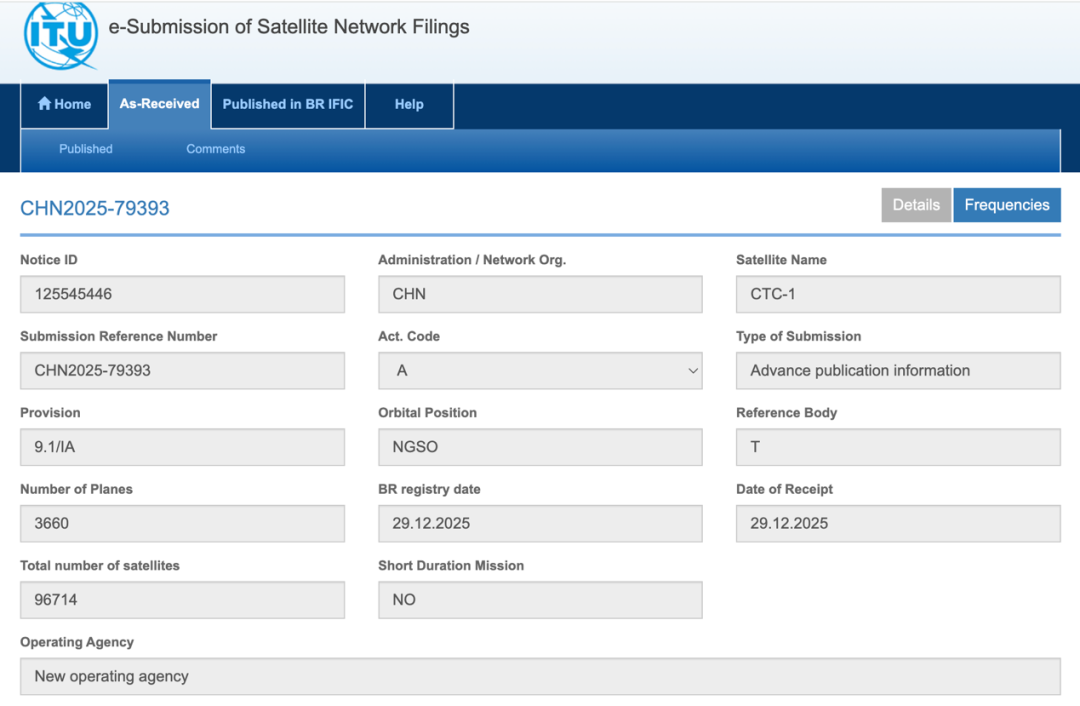
Core Viewpoint - China has submitted an application to the International Telecommunication Union (ITU) for approximately 203,000 satellites, covering 14 satellite constellations, which is nearly five times the scale of SpaceX's Starlink program, currently capped at about 42,000 satellites [1][21]. Group 1: Application Details - The application includes nearly 190,000 satellites from a newly established institution, the Radio Spectrum Development and Utilization and Technology Innovation Research Institute, which was registered on December 30, 2025 [2][21]. - The application features two massive constellations, CTC-1 and CTC-2, each requesting 96,714 satellites, along with additional constellations from China Mobile and other commercial space enterprises [4][22]. Group 2: Strategic Intent - The large-scale application aims to secure orbital and frequency resources early, preventing later entrants from occupying these resources, in line with the ITU's "first come, first served" principle [8][26]. - The application reflects a strategic shift in China's frequency resource layout, potentially covering traditional Ku and Ka bands, as well as future 6G communication bands [13][31]. Group 3: Competitive Landscape - The competition for low Earth orbit (LEO) satellites is intensifying, with the need for increased launch frequency and satellite manufacturing capacity becoming critical [9][28]. - SpaceX has demonstrated the ability to deploy nearly 10,000 Starlink satellites in a short time due to its reusable Falcon 9 rocket technology, significantly reducing launch costs [9][27]. Group 4: Industry Challenges - Achieving the deployment of approximately 19,400 satellites within nine years to retain frequency resources poses a significant challenge for China's space industry, requiring a substantial increase in launch capabilities [9][27]. - The theoretical limit for satellites in LEO is estimated at around 60,000, indicating a crowded orbital environment [10][29]. Group 5: Regulatory and Safety Concerns - The ITU's "milestone rules" require that satellite constellations must launch their first satellite within seven years of obtaining frequency resources, with subsequent deployment milestones [8][26]. - Recent close encounters between SpaceX's Starlink satellites and China's space station highlight the safety risks associated with increased satellite traffic in LEO [5][23].