800V高压平台与超充网络

Search documents
2026的造车新王,要登基了?
商业洞察· 2026-02-02 09:38
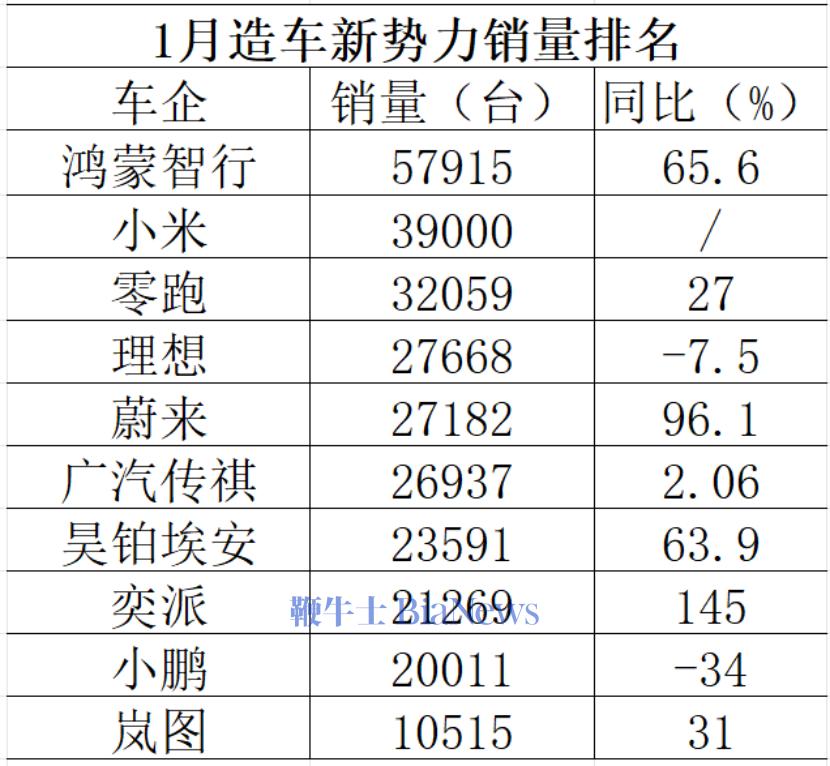
Core Viewpoint - The article discusses the sales performance of new energy vehicle manufacturers in January 2026, highlighting a general decline in sales compared to December 2025, influenced by changes in tax policies and seasonal trends. The competition among leading brands is intensifying, with significant shifts in sales rankings observed [4][5][12]. Sales Performance Overview - January 2026 saw a significant drop in the overall passenger car market, with retail sales down 32% year-on-year to 328,000 units, and wholesale sales down 40% to 381,000 units [4]. - Leading new energy vehicle manufacturers experienced varied sales results, with some showing growth while others faced declines. For instance, Li Auto's sales fell by 7.5% year-on-year [15]. Key Competitors and Rankings - The sales rankings for January 2026 are as follows: - Hongmeng Zhixing: 57,915 units, up 65.6% - Xiaomi: 39,000 units - Leap Motor: 32,059 units, up 27% - Li Auto: 27,668 units, down 7.5% - NIO: 27,182 units, up 96.1% - GAC Trumpchi: 26,937 units, up 2.06% - Aion: 23,591 units, up 63.9% - Yipai: 21,269 units, up 145% - Xpeng: 20,011 units, down 34% - Lantu: 10,515 units, up 31% [5][12]. Brand-Specific Insights - Hongmeng Zhixing reported a total of 57,915 units delivered in January, with a 35.3% decrease from December 2025 [6]. - Xiaomi's sales exceeded 39,000 units despite a decline from over 50,000 units in December, attributed to the transition to a new model [8][9]. - Leap Motor achieved a year-on-year growth of 27%, with a total of 596,555 units delivered in 2025, marking a 103% increase [12][15]. Market Trends and Challenges - The article notes a "Matthew Effect" where stronger brands continue to gain market share while weaker ones struggle. Li Auto's performance is highlighted as a concern, with a significant drop in sales and internal dissatisfaction among employees regarding the company's direction [15][16]. - The overall market is expected to slow down, with predictions of a decline in growth rates for new energy vehicles from 28% in 2025 to 15.2% in 2026, indicating a shift towards a more competitive landscape focused on existing market shares [19][20]. Future Outlook - Companies are urged to innovate in smart driving technology and cost management to remain competitive in a market that is increasingly focused on value rather than brand prestige [21][22].


2026的造车新王,要登基了?
Feng Huang Wang Cai Jing· 2026-02-01 13:03
Core Viewpoint - The sales performance of new energy vehicle manufacturers in January 2026 shows a significant decline compared to December 2025, with a reshuffling of the top rankings among these companies, indicating a competitive and changing market landscape [1][12]. Group 1: Sales Performance - In January 2026, the retail sales of passenger cars in China reached 328,000 units, a year-on-year decrease of 32%, while wholesale sales were 381,000 units, down 40% year-on-year [1]. - The top three new energy vehicle manufacturers by sales in January 2026 were Hongmeng Zhixing with 57,915 units (up 65.6% year-on-year), Xiaomi with 39,000 units, and Leap Motor with 32,059 units (up 27% year-on-year) [2][8]. - Leap Motor, which was the sales champion in 2025, faced competition from Hongmeng Zhixing and Xiaomi, indicating a potential shift in market leadership [1][12]. Group 2: Company Insights - Hongmeng Zhixing's January 2026 sales were primarily driven by its Wanjie brand, which sold 40,016 units, reflecting an 83% year-on-year increase [3]. - Xiaomi's sales were impacted by the transition to a new model of its main vehicle, the SU7, with January deliveries exceeding 39,000 units, down from over 50,000 units in December 2025 [5][6]. - Leap Motor's total deliveries for January 2026 were 32,059 units, marking a strong start despite being overtaken in the rankings, with a goal of exceeding 1 million annual sales [8][12]. Group 3: Market Trends - The competition among top manufacturers is intensifying, with a "Matthew effect" where stronger companies continue to gain market share while others struggle [12]. - Li Auto reported a decline in sales, with January 2026 figures at 27,668 units, down 7.5% year-on-year, highlighting challenges in maintaining growth [12]. - The overall market for new energy vehicles is expected to slow down, with a predicted growth rate dropping from 28% in 2025 to 15.2% in 2026, indicating a shift towards a more competitive environment focused on existing market share [12][16].
2026的造车新王,要登基了?
凤凰网财经· 2026-02-01 12:08
Core Viewpoint - The article discusses the sales performance of new energy vehicle manufacturers in January 2026, highlighting a general decline in sales compared to December 2025, influenced by factors such as the reduction of the new energy vehicle purchase tax from full exemption to half exemption. The competition among leading brands is intensifying, with significant shifts in sales rankings observed [1]. Group 1: Sales Performance Overview - In January 2026, the retail sales of passenger vehicles in China reached 328,000 units, a year-on-year decrease of 32%, while wholesale sales were 381,000 units, down 40% year-on-year [1]. - The sales ranking among new energy vehicle manufacturers saw a shift, with Hongmeng Zhixing and Xiaomi surpassing Leap Motor, which had been the sales champion in the previous year [1]. - Hongmeng Zhixing reported a total delivery of 57,915 units in January, a year-on-year increase of 65.6%, but a month-on-month decrease of 35.3% from December's 89,611 units [2][5]. Group 2: Individual Company Performance - Xiaomi delivered over 39,000 units in January 2026, despite a drop from over 50,000 units in December 2025, attributed to the upcoming model change of its main vehicle [5]. - Leap Motor achieved a total delivery of 32,059 units in January, marking a year-on-year growth of 27%. In 2025, Leap Motor's total deliveries reached 596,555 units, a 103% increase year-on-year [9]. - Li Auto's sales in January were 27,668 units, down 7.5% year-on-year, continuing a trend of decline from 2025, where it only achieved 63.4% of its adjusted annual target [12][13]. Group 3: Market Trends and Predictions - The article notes a "Matthew effect" in the market, where stronger companies continue to grow while others struggle, as seen with Li Auto's declining sales [12]. - The China Automobile Association predicts that the growth rate of the new energy vehicle market will slow from 28% in 2025 to 15.2% in 2026, indicating a shift towards a more competitive environment focused on existing market share [18]. - Companies are expected to focus on enhancing smart driving features and cost control to remain competitive in a market where consumers prioritize product quality over brand newness [19][20].