AI+mechanism

Search documents
IJRR 重磅,浙江大学机械工程学院Grasp Lab用AI 赋能机械革新:机器人抓取的新突破
机器人大讲堂· 2025-12-30 17:00
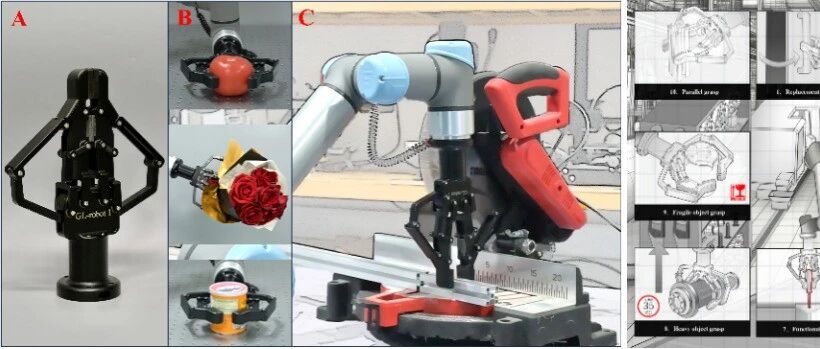
Core Viewpoint - The article discusses the innovative advancements of the GL-Robot developed by Zhejiang University's Grasp Lab, which integrates AI and mechanical design to overcome traditional challenges in robotic grasping and manipulation, particularly by decoupling dexterous hands from tactile sensors, enabling high-precision force control without the need for expensive tactile sensors [1][16]. Group 1: Mechanical Structure Optimization - The mechanical structure of GL-Robot is a key component, featuring a novel underactuated two-finger three-joint architecture that simplifies drive complexity while enhancing force transmission efficiency [2]. - The design incorporates a unique "stacked four-bar linkage decoupling mechanism" that allows for both coupled and decoupled joint movements, reducing actuator load and improving adaptability [2]. Group 2: Multi-Modal Sensing - GL-Robot achieves a breakthrough in force control without tactile sensors by utilizing a framework that maps motor current to external contact states, allowing for effective grasping without traditional sensor dependencies [9][11]. - The system employs Long Short-Term Memory (LSTM) networks to analyze current fluctuations during grasping, achieving force control precision as low as 0.1N and a maximum load capacity of 250N, demonstrating its capability to handle both delicate and heavy objects [11]. Group 3: Grasping and Operation Planning - GL-Robot features a hierarchical dual-mode strategy for intelligent grasping and operation planning, dynamically adapting to various task requirements through a combination of position and current-based control [12][15]. - The planning logic is deeply integrated with mechanical characteristics, allowing for stable grasping of a wide range of objects, from thin coins to large cubes, while preventing slippage [15]. Group 4: Core Value and Future Outlook - The integration of AI and mechanical design in GL-Robot not only reduces costs by eliminating the need for expensive force sensors but also enhances performance metrics such as load capacity and precision, positioning it as a competitive alternative to commercial grippers [16]. - The ongoing advancements in AI-driven design and control are expected to further enhance robotic grasping capabilities, expanding applications in industrial automation and service sectors [16].