AI智能体推理

Search documents
全面战胜ReAct,斯坦福全新智能体推理框架,性能提升112.5%
3 6 Ke· 2025-12-03 02:33
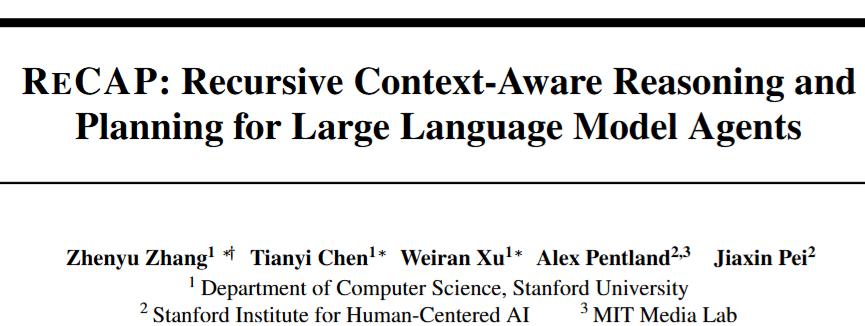
Core Insights - The research teams from Stanford and MIT have introduced a new AI reasoning framework called ReCAP, which significantly outperforms existing mainstream frameworks like ReAct in long-context tasks [1][10] - ReCAP addresses common issues in large language models, such as goal drift, context loss, and prompt explosion, through a unique recursive tree structure and three key mechanisms [1][11] Performance Metrics - ReCAP achieved a performance improvement of 84.2% (synchronous) and 112.5% (asynchronous) on the long-sequence embodied task Robotouille compared to the ReAct baseline [2][14] - In various benchmark tests, ReCAP demonstrated superior performance across multiple tasks, including achieving a 91% success rate in ALFWorld, which is higher than ReAct's 84% [14] Challenges in Long Context Tasks - Current large language models face three main issues: goal drift, where the model gradually ignores the original objective; context loss, where high-level planning information is lost during long sequence execution; and prompt explosion, where the reasoning cost increases exponentially with each recursion [3][4][6] Mechanisms of ReCAP - ReCAP integrates a memory and feedback-based recursive tree structure, employing three mechanisms: Recursive Task Decomposition with Plan-Ahead, Consistent Multi-level Context and Structured Injection, and Sliding Window Memory for efficient memory management [11][13] Cost-Benefit Analysis - The total computational cost of ReCAP is approximately three times that of ReAct, primarily due to its advanced planning mechanisms. However, the significant performance gains in critical tasks justify this increase in cost for applications requiring high accuracy [11] Future Implications - ReCAP represents a crucial step towards general reasoning systems in AI, with potential applications in complex decision-making tasks that require long-term context memory, such as literature review and software engineering [12][15]