ReAct

Search documents
震惊!27岁姚顺雨任腾讯首席AI科学家,95后罗福莉掌舵小米大模型!00后、95后站上AI舞台中央
Xin Lang Cai Jing· 2025-12-19 01:44
Group 1 - Tencent announced that Yao Shunyu, a scientist from OpenAI and a Tsinghua University graduate, has been appointed as the Chief AI Scientist in the CEO's office, reporting directly to Tencent's president Liu Chiping [2][52] - Xiaomi announced that 95后 AI talent Luo Fuli has been appointed as the head of the MiMo large model, reportedly with a salary of tens of millions [5][55] - Both individuals, aged 27 and under 30, are now at the forefront of China's AI landscape, sparking discussions among parents about the implications for their own children [6][56] Group 2 - The average salary for AI talent in Silicon Valley is at least $1 million, while in China it is around 1 million RMB, with top talent earning significantly more [8][63] - The disparity in salaries is stark, with AI talent earning 16.7 times more than the average graduate salary in China, which is around 6,000 RMB per month [24][66] - The trend of young individuals leading in AI is not an anomaly; many tech founders, including those of major companies, were under 30 when they started their ventures [14][60] Group 3 - Young people are able to create disruptive innovations due to their lack of "path dependency," allowing them to explore new ideas without being constrained by past successes [21][68] - The phenomenon of "getting obsessed" with new technologies is seen as a valuable trait, encouraging young individuals to fully engage with their interests [27][72] - The current wave of AI represents a significant technological shift, and those who engage with it early can become experts as the field evolves [32][77] Group 4 - To cultivate innovative talent in the AI era, it is essential to encourage children to pursue their passions and not to hinder their enthusiasm for new technologies [33][78] - Helping children "catch the first wave" of technology involves providing them with resources and opportunities to explore their interests deeply [39][80] - The market values the ability to solve real-world problems over academic credentials, emphasizing the importance of practical skills in the current job landscape [43][83]



挑战ReAct!MetaGPT团队提出ReCode智能体新范式
机器之心· 2025-12-04 06:10
Core Insights - The article discusses the limitations of current AI agent frameworks, particularly the fixed decision granularity that restricts adaptability and planning capabilities [2][3] - It introduces ReCode (Recursive Code Generation), a new paradigm that unifies planning and execution, allowing agents to switch between different granularities seamlessly [3][11] Current AI Agent Limitations - Existing frameworks like ReAct operate on a fixed, fine-grained observation-action loop, which can lead to inefficiencies in complex tasks [9] - Agents with planners separate planning and execution, which hampers dynamic adaptability and learning from execution feedback [10] ReCode Framework - ReCode proposes a unified code representation for all decisions, regardless of granularity, allowing for recursive breakdown of high-level plans into executable actions [12][14] - The workflow involves converting task instructions into a root placeholder function, which is then expanded recursively into specific actions [15][16] Performance Improvements - Experimental results show that ReCode outperforms ReAct, achieving an average performance increase from 47.4% to 60.8% across three environments [6][20] - ReCode also reduces reasoning costs by 79% and training sample requirements to 27% of what ReAct needs [6][23] Cost Efficiency - The average cost of a ReCode trajectory is 78.9% lower than ReAct, demonstrating significant cost advantages due to structured exploration [23][24] Training Efficiency - In the ScienceWorld environment, ReCode achieves 88.5% reward with only 3,500 training samples, compared to 12,833 samples required by ReAct [25] - ReCode's recursive structure generates hierarchical training data, enhancing learning efficiency [27] Future Directions - Future research may focus on enhancing the model's ability to understand recursive decomposition logic and optimizing planning strategies through learning [27]

全面战胜ReAct,斯坦福全新智能体推理框架,性能提升112.5%
3 6 Ke· 2025-12-03 02:33
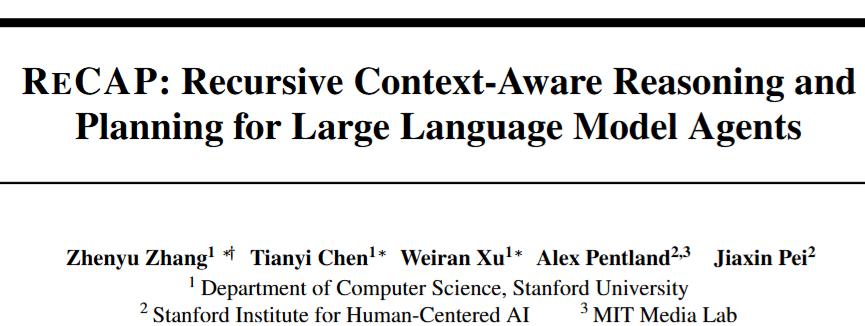
Core Insights - The research teams from Stanford and MIT have introduced a new AI reasoning framework called ReCAP, which significantly outperforms existing mainstream frameworks like ReAct in long-context tasks [1][10] - ReCAP addresses common issues in large language models, such as goal drift, context loss, and prompt explosion, through a unique recursive tree structure and three key mechanisms [1][11] Performance Metrics - ReCAP achieved a performance improvement of 84.2% (synchronous) and 112.5% (asynchronous) on the long-sequence embodied task Robotouille compared to the ReAct baseline [2][14] - In various benchmark tests, ReCAP demonstrated superior performance across multiple tasks, including achieving a 91% success rate in ALFWorld, which is higher than ReAct's 84% [14] Challenges in Long Context Tasks - Current large language models face three main issues: goal drift, where the model gradually ignores the original objective; context loss, where high-level planning information is lost during long sequence execution; and prompt explosion, where the reasoning cost increases exponentially with each recursion [3][4][6] Mechanisms of ReCAP - ReCAP integrates a memory and feedback-based recursive tree structure, employing three mechanisms: Recursive Task Decomposition with Plan-Ahead, Consistent Multi-level Context and Structured Injection, and Sliding Window Memory for efficient memory management [11][13] Cost-Benefit Analysis - The total computational cost of ReCAP is approximately three times that of ReAct, primarily due to its advanced planning mechanisms. However, the significant performance gains in critical tasks justify this increase in cost for applications requiring high accuracy [11] Future Implications - ReCAP represents a crucial step towards general reasoning systems in AI, with potential applications in complex decision-making tasks that require long-term context memory, such as literature review and software engineering [12][15]
张小珺对话OpenAI姚顺雨:生成新世界的系统
Founder Park· 2025-09-15 05:59
Core Insights - The article discusses the evolution of AI, particularly focusing on the transition to the "second half" of AI development, emphasizing the importance of language and reasoning in creating more generalizable AI systems [4][62]. Group 1: AI Evolution and Language - The concept of AI has evolved from rule-based systems to deep reinforcement learning, and now to language models that can reason and generalize across tasks [41][43]. - Language is highlighted as a fundamental tool for generalization, allowing AI to tackle a variety of tasks by leveraging reasoning capabilities [77][79]. Group 2: Agent Systems - The definition of an "Agent" has expanded to include systems that can interact with their environment and make decisions based on reasoning, rather than just following predefined rules [33][36]. - The development of language agents represents a significant shift, as they can perform tasks in more complex environments, such as coding and internet navigation, which were previously challenging for AI [43][54]. Group 3: Task Design and Reward Mechanisms - The article emphasizes the importance of defining effective tasks and environments for AI training, suggesting that the current bottleneck lies in task design rather than model training [62][64]. - A focus on intrinsic rewards, which are based on outcomes rather than processes, is proposed as a key factor for successful reinforcement learning applications [88][66]. Group 4: Future Directions - The future of AI development is seen as a combination of enhancing agent capabilities through better memory systems and intrinsic rewards, as well as exploring multi-agent systems [88][89]. - The potential for AI to generalize across various tasks is highlighted, with coding and mathematical tasks serving as prime examples of areas where AI can excel [80][82].

OpenAI姚顺雨1亿薪资加入腾讯?回应来了
21世纪经济报道· 2025-09-12 04:11
Core Viewpoint - Recent rumors about former OpenAI researcher Yao Shunyu joining Tencent with a salary exceeding 100 million have been officially denied by Tencent, labeling the reports as false [1][2][3]. Group 1: Yao Shunyu's Background - Yao Shunyu graduated from Tsinghua University and holds a PhD in Computer Science from Princeton University, joining OpenAI in 2024 [4]. - He was recognized as one of the "Innovators Under 35" in the China region by MIT Technology Review, being the youngest at 27 years old [4]. - Yao is a key contributor to OpenAI's early research, particularly in the development of language agents [4]. Group 2: Contributions to AI - Yao Shunyu proposed the ReAct method, which integrates reasoning and action in the development of language agents, establishing a foundational approach for creating versatile and scalable AI systems [5]. - The core idea of ReAct is to enable large language models to perform internal reasoning before making decisions, enhancing model controllability and expanding applicability across various fields [5]. - ReAct has become a mainstream method for constructing language agents, widely adopted in both academia and industry [5].
腾讯辟谣:OpenAI前研究员姚顺雨上亿薪资入职传闻不实
Sou Hu Cai Jing· 2025-09-12 03:42
Group 1 - The news about former OpenAI researcher Yao Shunyu joining Tencent for a salary exceeding 100 million is false, as clarified by Tencent's official account [1] - Yao Shunyu graduated from Tsinghua University and later obtained a PhD from Princeton University, where he developed the Tree of Thoughts framework and CoALA modular cognitive architecture [1] - He joined OpenAI in 2024 and contributed significantly to the development of intelligent agent products, being recognized as a core contributor [1][5] Group 2 - Yao Shunyu's ReAct method introduced a paradigm combining reasoning and action for intelligent agents, enhancing the controllability and applicability of large language models [5] - The AI talent competition is intensifying globally, with companies like Meta offering over $200 million in total compensation to attract top talent, including researchers from OpenAI [6] - In China, major internet companies are expanding their recruitment for AI-related positions, with a reported increase of over 10 times in new AI job postings compared to the previous year [6]

OpenAI姚顺雨1亿薪资加入腾讯?腾讯回应
2 1 Shi Ji Jing Ji Bao Dao· 2025-09-12 01:23
Group 1 - Recent rumors suggest that former OpenAI researcher Yao Shunyu has joined Tencent with a salary exceeding 100 million [1] - Tencent officially refuted the claim regarding Yao Shunyu's salary through its public account, labeling the report as a rumor [1] - Yao Shunyu, a graduate of Tsinghua University's Yao Class and a PhD in Computer Science from Princeton University, joined OpenAI in 2024 [1] Group 2 - Yao Shunyu introduced the ReAct method, which combines reasoning and action in the agent paradigm, laying the foundation for creating generalizable and scalable language agents [2] - The core idea of ReAct is to enable large language models to perform explainable internal reasoning before making decisions and actions, enhancing model controllability and expanding applicability across various fields [2] - ReAct has become the most mainstream method for constructing language agents globally, widely adopted in both academia and industry [2]
姚顺雨离职OpenAI,开启下半场
量子位· 2025-09-12 00:59
Core Viewpoint - The article discusses the career transition of Shunyu Yao, a prominent researcher from OpenAI, as he embarks on a new phase in the AI field, focusing on personal AI and the evolving landscape of AI development, which is now entering its "second half" [2][47]. Group 1: Background and Achievements - Shunyu Yao, a 29-year-old researcher, has an impressive academic background, including graduating from Tsinghua University and obtaining a PhD from Princeton, where he focused on natural language processing and reinforcement learning [4][22]. - His notable contributions to AI include the development of frameworks like Tree of Thoughts, SWE-bench, and ReAct, which enhance the reasoning and decision-making capabilities of language models [6][36]. Group 2: Career Transition - Yao's departure from OpenAI has been confirmed through various channels, and he is rumored to be considering entrepreneurship or joining another tech giant [3][51]. - His recent work emphasizes the shift in AI development from model-centric approaches to defining meaningful tasks and evaluating AI systems' performance in real-world scenarios [47][48]. Group 3: Philosophical Insights - Yao's approach to research is characterized by a cross-disciplinary perspective, drawing inspiration from various fields, which he believes is essential for innovation in AI [9][20]. - He advocates for the importance of language as a medium for reasoning and decision-making in AI, highlighting its role in enabling agents to generalize across different contexts [28][30].