AI Healthcare

Search documents
X3 Holdings (XTKG) Enters AI Healthcare Market Through Global Smartwatch Partnership
Yahoo Finance· 2026-02-25 10:44
Group 1 - X3 Holdings Co. Ltd. has entered the AI healthcare sector by partnering to manage global operations of an AI-powered healthcare smartwatch, aiming to shift healthcare from passive treatment to proactive management [1][3] - The smartwatch is designed as a neuro-digital health tool that monitors and regulates emotional and neurological balance, utilizing a non-invasive brainwave sensing chip and cloud-based AI analytics [2][3] - Clinical validation indicates high effectiveness in managing cognitive support, emotional health, and chronic discomfort, with revenue expected to start from a service contract in March 2026 [3] Group 2 - X3 Holdings provides software applications and technology services to corporate and government customers in China [4]

中国AI医疗专家观点:蚂蚁金服将重塑行业格局,阿里健康或将参与其中-China Healthcare China AI Healthcare Expert Call Take-away Ant A-Fu to Reshape the Landscape
2026-01-26 02:49
Summary of China Healthcare AI Expert Call Industry Overview - The online healthcare market in China is experiencing a significant transformation, moving from basic e-pharmacy services to integrated AI service platforms, with Ant Group's "A-Fu" emerging as a leading player in this space [1][2]. Key Insights - **Ant A-Fu's Dominance**: Ant A-Fu is rapidly becoming the dominant force in the online healthcare market, leveraging extensive data acquisition, a closed-loop ecosystem that includes payment and insurance, and substantial marketing expenditures [1][3]. - **Ali Health's Position**: Ali Health is positioned as a top pick in the online healthcare sector, expected to benefit from traffic referrals to its pharmacy business in the short term and potentially becoming a key player in the future AI online healthcare platform within the Alibaba/Ant ecosystem [1][7]. - **Shift in Market Dynamics**: The market is transitioning from competition based on drug sales to a focus on comprehensive patient and user health management systems, where Ant A-Fu is currently leading [1]. Growth Projections - The AI healthcare software market is projected to grow explosively at an estimated rate of 50% per annum, driven by government initiatives for regional data integration and significant investments in AI from hospitals [2]. Competitive Landscape - Ant A-Fu's rise is expected to reshape the competitive landscape, capturing user relationships at the consultation and management stages, which may diminish the traffic and loyalty of other players in the market [7]. - The relationship between Ant A-Fu and Ali Health is seen as complementary, with potential for deeper integration in the long term, possibly including cross-holding or a merger [7]. Business Model Evolution - Traditional internet healthcare models include drug sales, insurance sales, and advertising. A-Fu's key advantage lies in its ability to design innovative insurance products based on real-world data, particularly for individuals with pre-existing conditions [4][6]. Valuation Insights - The target price for Ali Health shares is set at HK$9.0, based on a sum-of-the-parts analysis, with specific valuations assigned to different business segments [8]. Risks - Ali Health shares are rated as high risk due to potential policy risks, including the need to maintain close ties with Alibaba Group, policy headwinds in the internet healthcare industry, and severe competition [9]. This summary encapsulates the critical insights and projections regarding the evolving landscape of the online healthcare market in China, particularly focusing on the roles of Ant A-Fu and Ali Health.

AI健康应用爆发 大模型“看病”是否靠谱?我们进行了实测
Xin Jing Bao· 2026-01-23 13:08
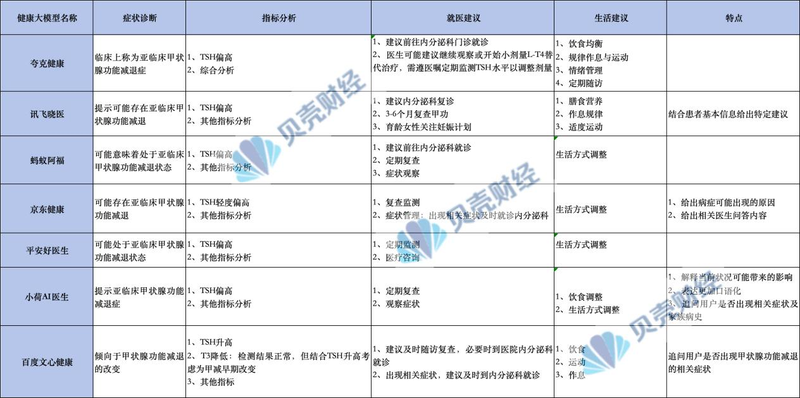
Core Insights - The AI health sector is experiencing a surge, marked by significant product launches from major companies like Ant Group, Baidu, OpenAI, and JD Health, indicating a growing interest and competition in AI healthcare applications [1][10] - Despite the advancements, AI applications exhibit cautious behavior in interpreting health data, with some instances of misinterpretation, highlighting the need for careful usage and potential limitations of AI in medical contexts [2][5] Group 1: AI Health Application Developments - Major AI health applications such as "Antifuku," "Wenxin Health Manager," and "ChatGPT Health" have been launched or upgraded, reflecting a trend towards integrating AI into healthcare [1][10] - The applications tested include features like photo recognition for health reports, AI consultations, and personalized health advice, showcasing their capabilities [2][3] Group 2: Performance and Limitations of AI Models - The evaluation of seven AI health applications revealed a cautious approach in symptom diagnosis, often using tentative language like "may" or "suggests," indicating a conservative stance on health assessments [2][4] - Instances of misinterpretation were noted, such as confusing TSH (Thyroid-Stimulating Hormone) with HCG (Human Chorionic Gonadotropin), which raises concerns about the reliability of AI health applications [5][6] Group 3: Regulatory Environment and Industry Response - Regulatory bodies are beginning to establish guidelines for AI in healthcare, emphasizing the importance of collaboration between medical professionals and AI technologies to ensure patient safety [6][10] - The emergence of AI health applications has prompted hospitals to advise patients against over-reliance on AI for medical advice, stressing the importance of professional medical consultation [6][7] Group 4: User Interaction and Market Trends - Users perceive AI health applications as supplementary tools rather than replacements for medical professionals, often using them for reassurance on minor health concerns [7][8] - The competitive landscape is evolving, with companies aiming to create "Super Apps" that integrate multiple functionalities, enhancing user engagement and retention [11][12]