AI factory

Search documents
黄仁勋对话 10 位开源 AI 掌门人:未来算力将向后训练倾斜,OpenClaw 开启了现代计算机的新想象|GTC 2026
AI科技大本营· 2026-03-20 00:56
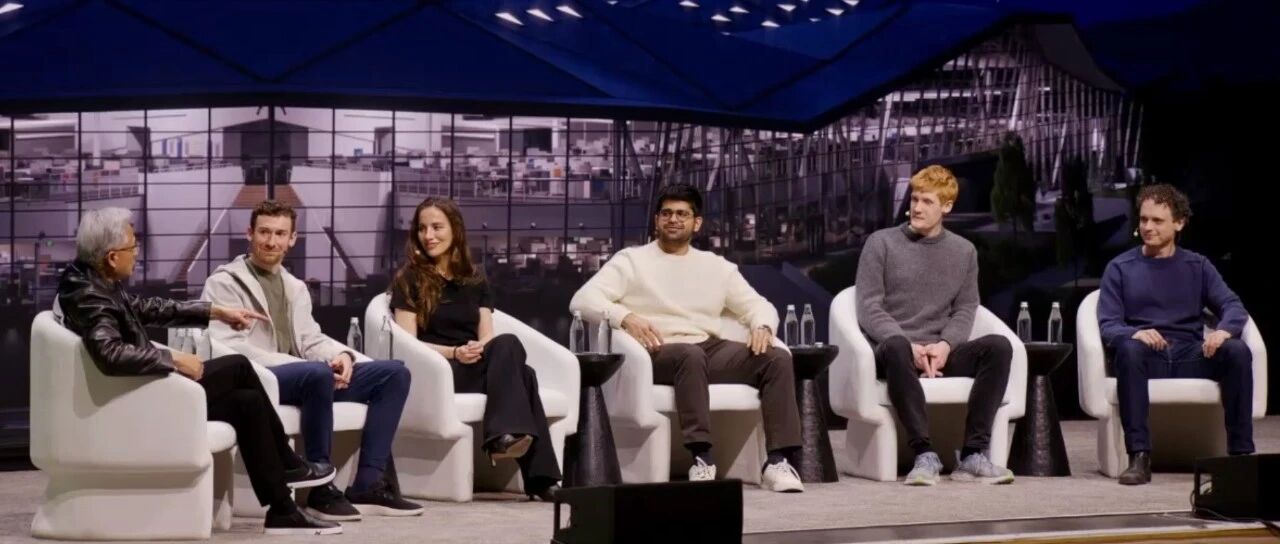
Core Insights - The future of AI is characterized by "harness engineering," which emphasizes the integration of models, tools, and systems rather than focusing solely on individual models [16][19][21] - Open models are becoming increasingly significant, potentially forming the largest model group across various industries and applications [5][6] - The discussion highlights a shift from viewing AI as merely models to understanding it as a complex system that includes agents, orchestration, and governance [10][12][26] Group 1: Open Models and System Integration - Huang Renxun emphasizes that open models collectively represent the second-largest model group globally, with the potential to become the largest in various applications [5][6] - The conversation shifts from a binary view of open vs. closed models to a more nuanced understanding of how models, tools, and governance create a new system [6][10] - The emergence of a third category of companies that utilize the best model APIs while developing their own tools and agents indicates a more complex software stack [11][12] Group 2: The Role of Agents - Agents are evolving from simple models to complex systems capable of handling multi-step tasks and integrating various resources [36][40] - The concept of "agentic systems" is introduced, where agents can continuously process tasks and maintain state over time, moving beyond traditional models [36][40] - OpenClaw is highlighted as a significant project that exemplifies the capabilities of agentic systems, showcasing a new paradigm in computing [38][39] Group 3: Governance and Trust in AI - The discussion emphasizes that the real challenge for enterprises is not whether agents can perform tasks, but how to govern and manage them effectively [52][56] - Trust in AI systems is crucial, with open models being preferred for their transparency and verifiability, which helps build confidence in their deployment [56][67] - The need for a governance framework that addresses data access, action capabilities, and accountability is underscored as organizations begin to integrate AI into their operations [52][56] Group 4: The Importance of Open Models - Open models are seen as essential for customization, control, and cost-sharing in AI development, allowing organizations to tailor solutions to their specific needs [66][68] - The potential for open models to facilitate the creation of specialized digital twins in various fields, such as healthcare, is discussed [68][70] - The conversation highlights the need for open infrastructure to support the ongoing development and deployment of open models, ensuring they remain viable in the long term [72][73] Group 5: Future Directions and Industry Impact - The integration of AI into various sectors, including coding, healthcare, and robotics, is expected to accelerate as agents become more capable and reliable [62][64] - The discussion points to a broader trend where AI is not just about creating powerful models but about developing systems that can operate effectively in real-world environments [88][89] - The emergence of AI factories or foundries is anticipated, enabling companies to access necessary computational resources without needing to own them outright [83][84]

英伟达、阿里重估AI,把FLOPS“扔进垃圾堆”
3 6 Ke· 2026-03-18 09:08
3月17日,黄仁勋在 英伟达GTC 2026 的舞台上穿着标志性皮夹克讲了两个多小时,会后,几乎全网都 在说"英伟达要做Token之王"。 但如果仔细听这场演讲,会发现黄仁勋真正反复锤打的,不是Token本身,而是 Tokens per Watt(每瓦 Token数)。他在展示推理性能图表时明确说出了这个概念,并直言:每一座数据中心、每一座AI工 厂,本质上都受限于电力,一座1GW的工厂永远不会变成2GW,这是物理定律决定的。在固定功率 下,谁的每瓦Token产出最高,谁的生产成本就最低,谁的收入曲线就最陡。 这句话才是整场 GTC 2026 真正的题眼。 舆论热衷讨论的是 Vera Rubin 比 Blackwell 强多少倍、Groq LPX 能把推理速度拉高35倍、英伟达要把 数据中心搬上太空。这些当然重要,但它们本质上都是同一个逻辑的不同表达:在能源约束下,最大化 每一瓦电力的智能产出。 当黄仁勋把"Tokens/W"作为衡量AI工厂产出的核心度量衡时,其实背后还有一层更重要的产业深意, 算力竞争的度量体系,正在从芯片走向系统,从峰值参数走向端到端能效,从谁的芯片更快走向谁可以 把能源转化成智能的效率 ...

DDN Powers Integrated Compute, Data, and Offload at Scale for NVIDIA Rubin Platform
Businesswire· 2026-01-06 16:00
Core Insights - DDN announces collaboration with NVIDIA to enhance AI factory architecture, focusing on eliminating data bottlenecks for improved performance and faster operationalization of large-scale AI [1][2][3] Group 1: Collaboration and Technology Integration - The partnership aims to ensure that advanced AI platforms powered by NVIDIA Rubin and BlueField-4 are supplied with data efficiently, leading to higher GPU utilization and faster inference [3][5] - DDN's platform is optimized for NVIDIA's latest hardware and software innovations, including Spectrum-X Ethernet and DOCA-accelerated services, ensuring consistent performance across demanding AI environments [5][6] Group 2: Performance Metrics and Benefits - The collaboration enables up to 99% GPU utilization in large-scale AI environments and a 20-40% reduction in time-to-first-token for long-context inference workloads [7] - Organizations can expect faster model deployment through simplified data pipelines and lower infrastructure overhead by reducing CPU load and inefficient data movement [7][8] Group 3: Future of AI Infrastructure - The unified architecture represented by NVIDIA Rubin and BlueField-4 signifies a shift towards integrated compute, networking, and data, allowing data to become a competitive advantage [8][9] - DDN's collaboration with NVIDIA is transforming AI infrastructure into AI factories that deliver outcomes faster and at scale, enhancing operational confidence [9][10]

AI is moving faster than ever, are your platforms keeping up?
DDN· 2025-12-01 21:58
There are three waves simulation AI and then you got quantum more and more data is coming in. What is an AI factory if someone asked you. >> So to me okay to me an AI factory is a tool a capability it could be physical as in a data center it could be a combination of physical in a data center and cloud but it's a way to generate and create business value business outcomes and financial outcomes for organizations who are looking at making investments in AI.So an AI factory for an enterprise, let's say financ ...
X @Ivan on Tech 🍳📈💰
Ivan on Tech 🍳📈💰· 2025-10-23 17:54
RT @levelsio (@levelsio)What in the F is an AI factory?I had to investigate what the unelected @EU_Commission is talking about todaySo according to them, it's some data centers (which they call supercomputers) in 6 different EU countriesI checked out the most powerful one: Karolina, a Czech data center, it mostly has CPUs though (see pic) not GPUs, so mostly useless for AIThe GPUs it does have are 72x 8x NVIDIA A100 GPU, so 576x A100, or equivalent of 240x H100s(H100 is about 2.4x the compute power of A100) ...
Navitas Supports 800 VDC Power Architecture for NVIDIA’s Next-Generation AI Factory Computing Platforms
Globenewswire· 2025-10-13 20:36
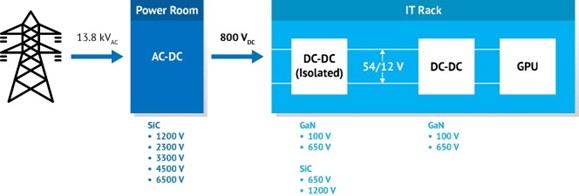
Core Insights - Navitas Semiconductor has introduced new 100 V GaN FETs, along with 650 V GaN and high voltage SiC devices, specifically designed for NVIDIA's 800 VDC AI factory architecture, achieving significant improvements in efficiency, power density, and performance [1][22]. Group 1: Product Development - The new 100 V GaN FETs are optimized for lower-voltage DC-DC stages on GPU power boards, focusing on ultra-high density and thermal management essential for next-generation AI compute platforms [8]. - The 650 V GaN portfolio includes high-power GaN FETs and advanced GaNSafe™ power ICs, which integrate various control and protection features to ensure robustness and reliability for AI infrastructure [10]. - GeneSiC™ technology offers a broad voltage range from 650 V to 6,500 V, demonstrating exceptional performance in high-power applications, including energy storage and grid-tied inverter projects [12]. Group 2: Industry Context - The emergence of AI factories necessitates a shift from traditional 54V power distribution to 800 VDC systems to meet the high power density requirements of modern computing platforms [3][5]. - The 800 VDC architecture allows for direct conversion from 13.8 kVAC utility power to 800 VDC, enhancing energy efficiency and system reliability by reducing conversion stages [4]. - The transition to 800 VDC is described as transformational, addressing the critical need for efficient, scalable, and reliable power delivery in next-generation data centers [13]. Group 3: Strategic Partnerships and Manufacturing - Navitas has established a strategic partnership with Power Chip to fabricate the new 100 V GaN FETs on a 200mm GaN-on-Si process, enabling scalable and high-volume manufacturing [9]. - The company emphasizes its commitment to innovation in wide bandgap technologies, with over 300 patents issued or pending, positioning itself as a leader in the semiconductor industry [18].