AI reasoning models

Search documents
The rise of AI reasoning models comes with a big energy tradeoff
Fortune· 2025-12-05 21:56
Core Insights - Leading AI developers are increasingly focused on creating models that mimic human reasoning, but these models are significantly more energy-intensive, raising concerns about their impact on power grids [1][4]. Energy Consumption - AI reasoning models consume, on average, 30 times more power to respond to 1,000 prompts compared to alternatives without reasoning capabilities [2]. - A study evaluated 40 open AI models, revealing significant disparities in energy consumption; for instance, DeepSeek's R1 model used 50 watt hours with reasoning off and 7,626 watt hours with reasoning on [3][6]. - Microsoft's Phi 4 reasoning model consumed 9,462 watt hours with reasoning enabled, compared to 18 watt hours with it disabled [8]. Industry Concerns - The rising energy demands of AI have led to scrutiny, with concerns about the strain on power grids and increased energy costs for consumers; wholesale electricity prices near data centers have surged by up to 267% over the past five years [4]. - Tech companies are expanding data centers to support AI, which may complicate their long-term climate objectives [4]. Model Efficiency - The report emphasizes the need for understanding the evolving energy requirements of AI and suggests that not all queries necessitate the use of the most energy-intensive reasoning models [7]. - Google reported that its Gemini AI service's median text prompt used only 0.24 watt-hours, indicating a lower energy consumption than many public estimates [9]. Industry Leadership Perspectives - Tech leaders, including Microsoft CEO Satya Nadella, have acknowledged the need to address AI's energy consumption, emphasizing the importance of using AI for societal benefits and economic growth [10].



The AI-boom's multibillion-dollar blind spot: Reasoning models hitting a wall
CNBC Television· 2025-06-27 12:49
AI Reasoning Models - AI reasoning models were expected to be the industry's next major advancement, leading to smarter systems and potentially superintelligence [1] - Major AI players like OpenAI, Anthropic, Alphabet, and DeepSeek have released models with reasoning capabilities [1] - These reasoning models aim to solve complex problems by breaking them down into logical steps [1] Research Findings - Recent research is questioning the effectiveness of these AI reasoning models [1]

X @TechCrunch
TechCrunch· 2025-06-26 16:18
Talent Acquisition - Meta hires key OpenAI researcher to work on AI reasoning models [1] AI Development Focus - Meta is focusing on developing AI reasoning models [1]

NVIDIA Dynamo Open-Source Library Accelerates and Scales AI Reasoning Models
Globenewswire· 2025-03-18 18:17
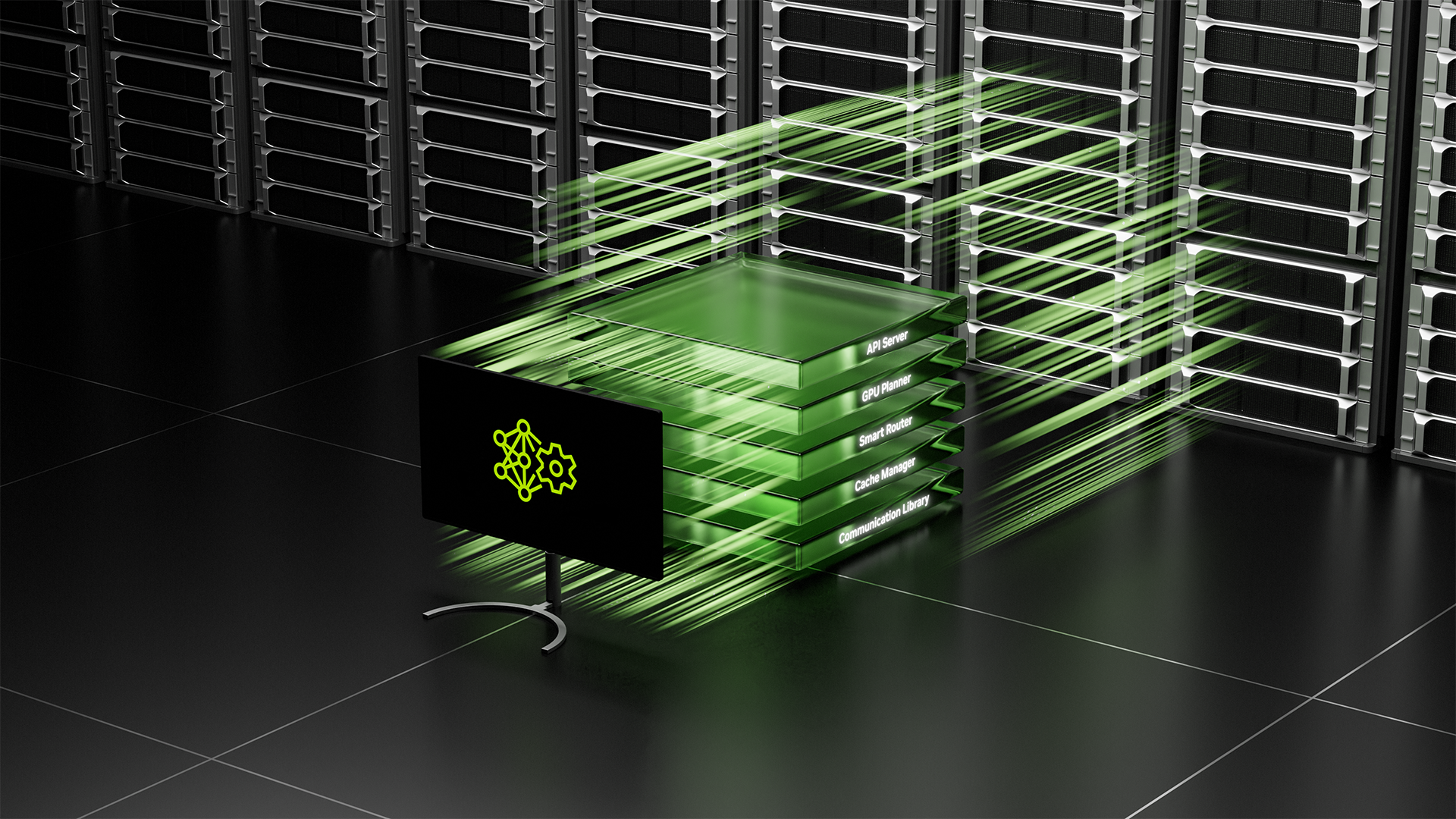
Core Insights - NVIDIA has launched NVIDIA Dynamo, an open-source inference software aimed at enhancing AI reasoning models' performance and cost efficiency in AI factories [1][3][13] - The software is designed to maximize token revenue generation by orchestrating inference requests across a large fleet of GPUs, significantly improving throughput and reducing costs [2][3][4] Performance Enhancements - NVIDIA Dynamo doubles the performance and revenue of AI factories using the same number of GPUs when serving Llama models on the NVIDIA Hopper platform [4] - The software's intelligent inference optimizations can increase the number of tokens generated by over 30 times per GPU when running the DeepSeek-R1 model [4] Key Features - NVIDIA Dynamo includes several innovations such as a GPU Planner for dynamic GPU management, a Smart Router to minimize costly recomputations, a Low-Latency Communication Library for efficient data transfer, and a Memory Manager for cost-effective data handling [14][15] - The platform supports disaggregated serving, allowing different computational phases of large language models to be optimized independently across various GPUs [9][14] Industry Adoption - Major companies like Perplexity AI and Together AI are planning to leverage NVIDIA Dynamo for enhanced inference-serving efficiencies and to meet the compute demands of new AI reasoning models [8][10][11] - The software supports various frameworks including PyTorch and NVIDIA TensorRT, facilitating its adoption across enterprises, startups, and research institutions [6][14]