AIoT融合

Search documents
趋势研判!2026年中国电源监控行业概述、市场现状、重点企业及行业趋势分析:“双碳”目标与新型电力系统建设持续深化,市场对电源监控需求攀升[图]
Chan Ye Xin Xi Wang· 2026-01-21 01:21
Core Insights - The "dual carbon" goals and the construction of a new power system are accelerating the demand for high-precision and reliable power monitoring systems, driven by the rapid deployment of smart grids, renewable energy generation, and energy storage projects [1][6] - The Chinese power monitoring industry is projected to reach a market size of approximately 1.057 billion yuan in 2024, representing a year-on-year growth of 6.02% [1][7] Industry Overview - Power monitoring is a comprehensive technology system for real-time monitoring, data collection, fault alarm, and remote control of power systems, aimed at ensuring stable power supply and preventing equipment downtime and data loss [2] - The system utilizes sensors, monitoring hosts, and communication networks to collect key parameters such as voltage, current, frequency, power, and temperature, identifying faults like overvoltage, undervoltage, overcurrent, and phase loss [2] Market Size - The market for power monitoring is expected to grow significantly due to the increasing requirements for precision and reliability in power monitoring systems, driven by the integration of AIoT technologies [1][7] - The demand for voltage transformers is also expected to rise, with the market projected to reach approximately 14 billion yuan in 2024, growing by 3.70% year-on-year [6] Key Companies - Major players in the power monitoring industry include Maoshuo Power, Oulutong, Hikvision, Dahua Technology, and others, each specializing in different aspects of power monitoring and control systems [2][8] - Maoshuo Power focuses on high-efficiency and high-stability power monitoring systems, while Hikvision integrates power monitoring into smart city solutions [9] Industry Development Trends 1. **Intelligent Upgrades**: The industry is shifting from passive monitoring to proactive prediction, leveraging AI and IoT technologies for predictive maintenance and operational optimization [10] 2. **Expanded Application Scenarios**: The market is evolving from traditional grid-side monitoring to a comprehensive energy ecosystem, including renewable energy sources and electric vehicle charging stations [10] 3. **Value Transition**: The competition is moving from hardware products to software-defined service platforms, emphasizing integrated solutions that combine smart hardware, analytical software, and cloud services [11][12]




RFID核心上市公司分析
Xin Lang Cai Jing· 2026-01-19 13:16
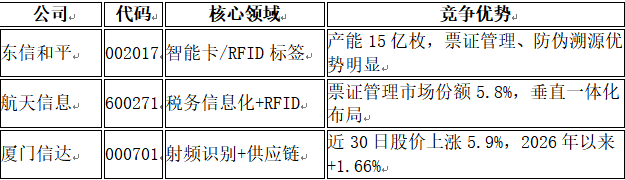
Industry Overview - RFID (Radio Frequency Identification) is experiencing a golden development period driven by both scenario expansion and technological upgrades, with a global market size expected to exceed 160 billion yuan by 2025, maintaining an annual growth rate of over 14%, and China's market growing even faster at over 20% [1][2] - The core bottleneck is the insufficient supply of specialized chips, with a domestic high-end chip localization rate of only 40%, and ultra-high frequency tag chips still reliant on imports [1][2] - The competitive landscape is intensifying, with AI empowerment becoming a key differentiator; leading companies are building barriers through vertical integration and technological innovation [1][2] Core Listed Companies Analysis 1. **$Yuan Wang Gu (002161) - RFID Absolute Leader** - Core advantage: The first RFID listed company in China, with over 50% market share in railway vehicle number recognition systems and deep layouts in retail, library, and logistics sectors [1][2] - Latest development: Plans to raise 691 million yuan for RFID production lines, chip process upgrades, and AIoT innovation centers, enhancing capabilities in large storage, encryption, high sensitivity, and wide temperature range chips [1][2] - Financial performance: Expected gross margin of 41.51% in 2024 (up 2.17 percentage points year-on-year), with a low net margin and still in loss after deducting non-recurring items; AI integration is anticipated to unlock value reassessment [3][4] 2. **$Fudan Microelectronics (688385) - Chip Design Leader** - Core advantage: Leading in RFID chip design in China, with rapid growth in security and identification chip businesses; antenna etching process reduces PET substrate waste below industry average [3][4] - Market position: Competing with international giants in the ultra-high frequency tag chip market, with product performance close to brands like NXP [3][4] - Technical highlights: Chip process transitioning from 90nm to 65nm, with power consumption reduced by over 40% and storage capacity increased by 50% [3][4] 3. **$Sichuan Medical (300078) - Smart Medical Segment Leader** - Core advantage: Leading in medical RFID solutions, embedding electronic tags in medical consumables and smart shelves, serving international clients like ZARA [3][4] - Growth logic: Accelerated medical informationization and smart hospital construction are driving the implementation of high-value RFID application scenarios [3][4] 4. **Other Key Enterprises** - **Dongxin Peace (002017)**: Focused on smart cards/RFID tags with a production capacity of 1.5 billion pieces, strong advantages in ticket management and anti-counterfeiting traceability [3][4] - **Aerospace Information (600271)**: Engaged in tax informationization and RFID, holding a 5.8% market share in ticket management with a vertically integrated layout [3][4] - **Xiamen Xinda (000701)**: Involved in RFID and supply chain, with a stock price increase of 5.9% in the last 30 days and a 1.66% rise since 2026 [3][4] Investment Logic and Key Insights 1. **Four Major Investment Themes** - **Chip Localization**: Shortage of specialized chips, supported by policies and technological breakthroughs driving import substitution, benefiting companies like Fudan Microelectronics and Yuan Wang Gu [2][3] - **AIoT Integration**: AI empowerment enhances RFID data processing capabilities, benefiting Yuan Wang Gu (AI innovation center) and Sichuan Medical [2][3] - **Scenario Expansion**: Retail digitalization, Industry 4.0, and smart medical needs are expected to explode, benefiting Yuan Wang Gu, Sichuan Medical, and Dongxin Peace [2][3] - **Vertical Integration**: Full industry chain layout reduces costs and enhances risk resistance, benefiting Yuan Wang Gu and Aerospace Information [2][3] 2. **Key Technical Breakthroughs** - Core function upgrades include large storage capacity (to address data volume surges), data encryption (for privacy protection), high sensitivity (to improve recognition accuracy), and wide temperature range operation (to adapt to industrial/outdoor scenarios) [2][3] - Cost reduction path: Scale production has reduced the unit cost of UHF tags to 0.21-0.25 yuan, which is 30% lower than the industry average [2][3] - AI integration direction: Combining RFID data with machine learning to achieve smart inventory management and predictive maintenance, among other value-added services [4] Focused Analysis - Yuan Wang Gu stands out as the industry leader with benefits from capital increase, expansion, and AI empowerment, with stable cash flow from the railway market supporting transformation and growth opportunities in consumer IoT [4] - Fudan Microelectronics showcases strong chip design capabilities, benefiting from domestic substitution; Sichuan Medical operates in a high-growth medical niche with significant earnings elasticity [4] - Configuration strategy: Short-term focus on the progress of capital increase and AI project advancement; long-term layout on the dual dividends of scenario expansion and chip localization, while avoiding low-value enterprises engaged in pure price competition [4]