Autonomous delivery

Search documents
Serve Robotics (SERV) CEO on White Castle Partnership & AI Expansion into Hospitals
Youtube· 2026-03-11 19:00
Core Insights - Serve Robotics has successfully launched 2,000 delivery robots across 20 municipalities in six metropolitan areas, meeting its previous commitment and expanding its operational footprint [2][3][27] - The company is exploring additional markets both domestically and internationally, with plans to introduce robots in Europe, Asia, Australia, and Canada [4][5] - Serve Robotics has established partnerships with major brands like White Castle and DoorDash, which provide access to a significant portion of the food delivery market in the U.S. [7][9] Market Expansion - The company aims to increase its presence in more cities within the U.S. and expand internationally, with expectations of launching robots outside the U.S. this year [4][5] - Partnerships with enterprise brands are a strategic focus, allowing Serve Robotics to deepen its market penetration and enhance service offerings [7][8] Supply and Demand - There is a current supply constraint for robots, with demand exceeding supply due to the efficiency and cost-effectiveness of the robots [12][15] - The company anticipates that supply constraints will persist in the foreseeable future, which is viewed positively as it indicates strong market demand [12][13] Technological Advancements - Serve Robotics has acquired Digent Robotics, which specializes in hospital delivery robots, creating synergies that can enhance operational efficiency in healthcare settings [16][17] - The robots utilize advanced AI and autonomous technology, with ongoing improvements to their capabilities and operational intelligence [20][21] Cybersecurity Measures - The company emphasizes the importance of cybersecurity, ensuring that all data collected by the robots is encrypted and protected, especially given its status as a public company [23][24]


Serve Robotics Q4 Earnings Call Highlights
Yahoo Finance· 2026-03-11 17:01
Core Insights - Serve Robotics is undergoing integration with Diligent Robotics, focusing on enhancing platform capabilities with Moxi robots, although the process will take time [1] - The company reported significant growth in its autonomous delivery fleet and diversified its business model to include advertising, software, data monetization, and healthcare robotics following acquisitions [5] Financial Performance - In Q4 2025, Serve reported revenue of $0.9 million, a 400% increase year-over-year, and full-year revenue of $2.7 million, exceeding prior guidance and reflecting a 46% growth compared to the previous year [6] - Fleet revenue in Q4 was $0.7 million, up 50% sequentially, while software revenue exceeded $200,000, with recurring software revenues making up approximately 70% of total software revenues [6] - The company ended 2025 with $260 million in cash and marketable securities, with capital expenditures of $16.5 million in Q4 related to the deployment of 2,000 robots [11] Operational Highlights - Serve deployed its 2,000th robot in mid-December 2025, with nearly 1,000 robots deployed in Q4 alone, and delivery volume increased by 53% quarter-over-quarter in Q4 and approximately 270% year-over-year [7] - The average daily operating hours per robot increased by 56% to over 12 hours compared to Q4 of the previous year, while cost per delivery trended down [8] Strategic Acquisitions and Market Expansion - The company completed four strategic acquisitions since early 2025 to strengthen its operational model, including Diligent Robotics, which adds healthcare capabilities with nearly 100 Moxi robots [3] - Serve is raising its 2026 revenue guidance to approximately $26 million, primarily due to the Diligent acquisition, and expects healthcare contracts to contribute roughly $7 million in revenue during 2026 [12] Future Outlook - Serve plans to deploy thousands more robots in the coming years, focusing on optimizing the current fleet's utilization before accelerating additional deployments [13] - The company is exploring international expansion opportunities but intends to prioritize U.S. markets in 2026, with international launches expected to be more prominent in 2027 [14]
Serve Robotics and White Castle Launch Autonomous Delivery via Uber Eats
Globenewswire· 2026-03-11 11:05
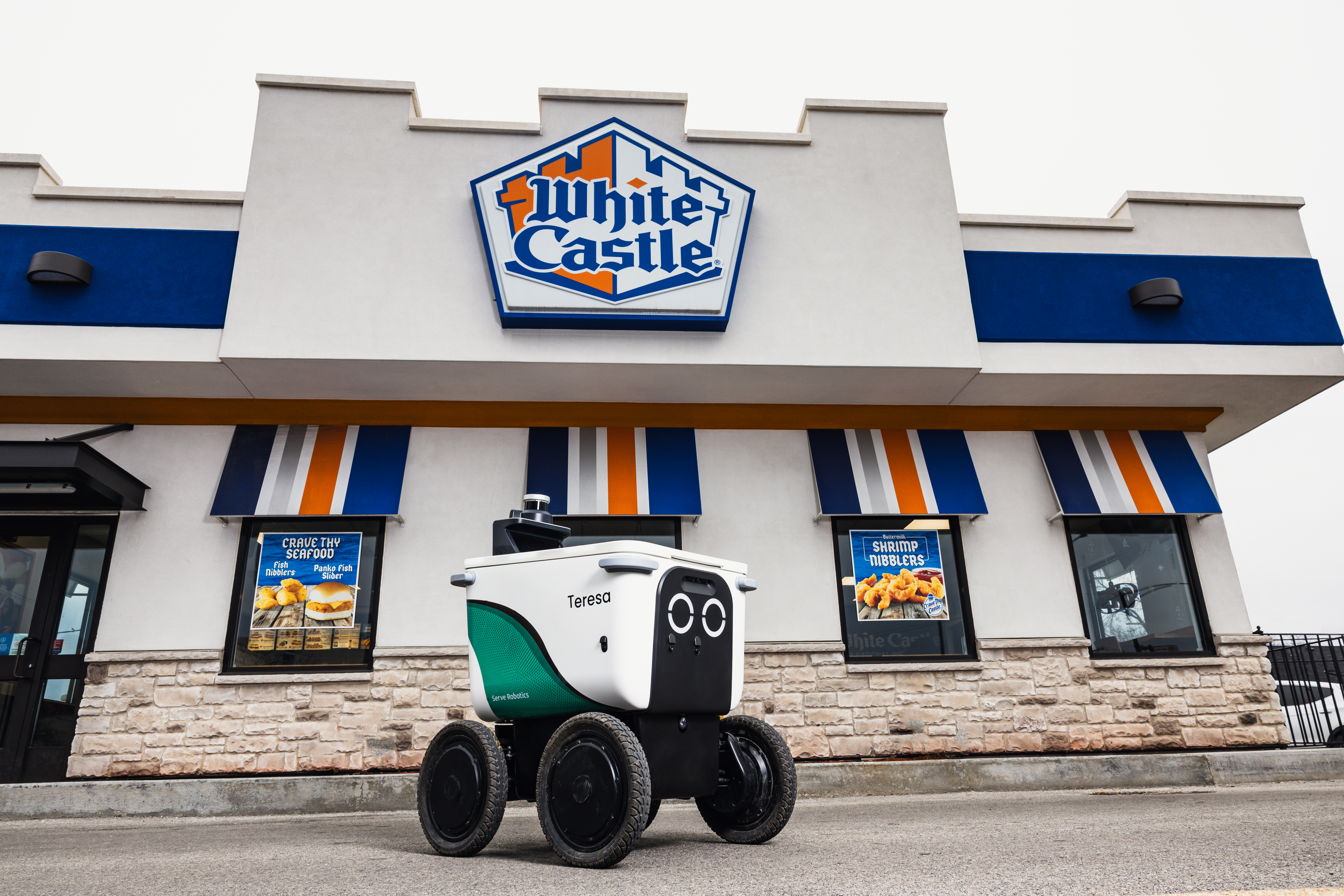
Core Insights - Serve Robotics and White Castle have partnered to deliver White Castle's menu items using Serve's autonomous delivery robots on the Uber Eats platform [1][2][4] Company Overview - White Castle is America's first fast-food hamburger chain, established in 1921, known for its iconic Slider and a variety of comfort food offerings [5][6] - Serve Robotics, which spun off from Uber in 2021, designs and operates autonomous robots, having deployed over 2,000 robots across the U.S. and supporting delivery for more than 3,600 restaurants [7] Partnership Details - The partnership allows customers in Serve's delivery zones to receive their White Castle orders via autonomous sidewalk robots, enhancing convenience and expanding Serve's presence on Uber Eats [2][4] - Serve's third-generation robots are designed to handle temperature-sensitive orders, ensuring the quality of items like Sliders and Chicken Rings during delivery [3] Market Expansion - Serve Robotics is expanding its operations into additional U.S. cities, reflecting the growing consumer demand for autonomous delivery services [2] - The collaboration with White Castle represents a strategic move to combine technology and convenience in the fast-food industry [4]
Should You Buy Doordash Stock Before Feb. 18?
The Motley Fool· 2026-02-15 18:45
Company Overview - DoorDash is experiencing a significant stock decline, dropping nearly 28% from approximately $230 to around $165 in six weeks [1] - The company reported Q3 revenue of $3.45 billion, a 27% year-over-year increase, and total orders surged 21% to 776 million [2] - Despite a Q3 earnings per share of $0.55 missing consensus, the miss was attributed to strategic investment spending rather than declining demand [3] Strategic Developments - DoorDash completed a nearly $4 billion acquisition of Deliveroo, expanding its operations into 45 global markets and handling approximately $90 billion in annual orders [5] - The company is aggressively expanding its grocery delivery services by partnering with major retailers like Kroger, which has around 2,700 stores [5] - DoorDash is piloting autonomous deliveries with Waymo in a 315-square-mile area of metro Phoenix and testing its own delivery robot, Dot, to reduce delivery costs [6] Market Context - The global online food delivery market is projected to reach $473 billion in revenue by 2026, driven by functional food trends and the globalization of tastes [9] - The cultural shift towards food delivery has been permanently influenced by the pandemic, making it a durable consumer behavior [8] Investment Perspective - Current stock prices present a rare opportunity for long-term investors to acquire a market leader at a significant discount [10] - The combination of new revenue streams and global expansion positions DoorDash as a potentially safe investment despite recent stock volatility [10]

Serve Robotics at a Premium Valuation: Should Investors Stay Away?
ZACKS· 2026-01-14 14:46
Core Insights - Serve Robotics Inc. (SERV) is trading at a forward 12-month Price/Sales (P/S F12M) ratio of 45.06, which is a premium of approximately 186% compared to the Zacks Computers – IT Services industry average of 15.75 [1] - The premium valuation is attributed to strong momentum in autonomous delivery adoption and rapid fleet expansion, with growing engagement from delivery platforms and restaurant partners [2] Financial Performance - SERV shares have declined by 17.6% over the past three months, underperforming the industry, broader technology sector, and the S&P 500 [4] - The company reported a GAAP net loss of $33 million in Q3 2025 and $67 million over the first nine months of 2025, indicating elevated losses due to high scaling costs [8] - The share count increased to 67.8 million by the end of Q3 2025 following multiple capital raises, increasing reliance on external funding [9] Earnings Estimates - Earnings expectations for SERV remain under pressure, with the Zacks Consensus Estimate for the 2026 loss per share widening to $1.83 from a previous estimate of $1.59 [10] Operational Developments - Serve Robotics is in a critical scaling phase, focusing on expanding sidewalk autonomy in urban environments while maintaining safety and reliability [13] - The company deployed over 2,000 autonomous robots, making it the largest sidewalk delivery fleet in the U.S., and reported sharp growth in delivery volumes [14] Strategic Acquisitions - The acquisition of Vayu aims to enhance autonomy performance and operational efficiency, contributing to a robotics-and-autonomy-as-a-service platform [15][16] Partnerships and Market Position - Partnerships with major delivery platforms like Uber and DoorDash are crucial for improving utilization and monetization, allowing robots to dynamically accept orders [17][18] - Collaborations with national restaurant partners support higher throughput and refine autonomy models, enhancing system-wide performance [18] Investment Perspective - Despite progress in autonomous sidewalk delivery and fleet expansion, SERV remains in an early stage of commercialization with profitability still distant [20] - The current stock valuation reflects optimistic long-term adoption expectations, suggesting limited margin for error [20]

Will Serve Robotics' Gen-3 Robots Drive Faster Unit Economics?
ZACKS· 2025-12-23 17:36
Core Insights - Serve Robotics (SERV) is focusing on its third-generation (Gen-3) delivery robots to enhance unit-level economics as it expands nationally, with early operational data supporting this strategy [1] Group 1: Gen-3 Platform Advantages - The Gen-3 platform significantly reduces production costs to about one-third of Gen-2 units, achieved through modular design, supply-chain optimization, and scaled manufacturing [2] - Gen-3 robots offer improved performance metrics, including higher speeds, longer ranges, extended operating hours, and enhanced autonomy, allowing for more deliveries with fewer human interventions [2] Group 2: Operational Metrics - In Q3 2025, Serve Robotics reported a 12.5% increase in average daily operating hours per robot, alongside lower intervention rates and a higher percentage of fully autonomous miles driven [3] - Improvements in speed and uptime are expected to compound, leading to increased delivery throughput and reduced cost per delivery [3] Group 3: Scale and Economic Leverage - With over 1,000 robots deployed and a target of 2,000 by year-end, Serve Robotics has reached a critical operational point where fleet density enhances routing efficiency and data collection [4] - Each robot is projected to pay for itself in under one year at full utilization, indicating strong economic leverage from the Gen-3 rollout [4] Group 4: Competitive Landscape - Uber Technologies (UBER) and Alphabet (GOOGL) are key competitors influencing the unit economics in autonomous delivery, with Uber being a significant partner and potential competitor for Serve Robotics [6][7] - Uber's focus on cost per delivery and maximizing courier utilization aligns with Serve Robotics' objectives, while Alphabet's Waymo emphasizes software and mapping, presenting a different approach to autonomy [8] Group 5: Financial Performance and Valuation - SERV's stock has increased by 0.4% over the past six months, outperforming the Zacks Computers - IT Services industry but underperforming the broader Computer and Technology sector [11] - The company trades at a forward price-to-sales ratio of 38.86, which is considerably higher than the industry average [15] - The Zacks Consensus Estimate for SERV's 2026 loss per share has widened to $1.83, indicating a larger loss compared to the previous year's estimate of $1.59 [17]

Serve Robotics (SERV) CEO on 2025 Growth, 99.8% Succes Rate & 2030 Picture
Youtube· 2025-12-12 18:30
Core Insights - Serve Robotics has achieved a significant milestone by launching its 2000th autonomous delivery robot, expanding its fleet from 100 to 2000 robots within a year, marking a 20x increase [2][3] - The company aims to scale its operations to a million robots in the coming years, indicating a strong belief in the future of autonomous delivery as a mainstream service [3][19] - Serve Robotics operates in dense urban environments, which presents unique challenges compared to simpler environments like homes or warehouses [6][7] Company Growth and Technology - The company has expanded its operations to six major U.S. markets, achieving a delivery reliability rate of 99.8% and an average delivery time of approximately 18 minutes [9][11] - The introduction of Gen 3 hardware has significantly improved capabilities while reducing costs, being one-third the cost of previous models and offering five times the computing power [12] - Partnerships with major delivery platforms like Uber Eats and DoorDash are crucial for rapid market entry and asset utilization, allowing Serve Robotics to onboard numerous merchants quickly [14][15] Market Trends and Future Outlook - The demand for autonomous delivery solutions is increasing, with deliveries growing over 40% quarter over quarter since 2022 [16] - The vision for urban delivery by 2030 includes widespread acceptance of delivery robots, similar to how mailboxes are perceived today, indicating a shift towards automation in last-mile delivery [17][18] - The company emphasizes the inefficiency of using large vehicles for small deliveries, advocating for a multimodal approach to urban delivery that includes robots to reduce traffic and safety risks [19][20]

Serve Robotics Expands Autonomous Delivery Network to Alexandria
ZACKS· 2025-12-11 15:41
Core Insights - Serve Robotics Inc. has expanded its autonomous sidewalk delivery service to Alexandria, VA, in partnership with Uber Technologies through Uber Eats, providing residents and businesses with new delivery options [2][9] - This expansion is part of Serve Robotics' 2025 plan to scale its last-mile delivery network, leveraging Alexandria's urban layout to deploy next-generation sidewalk robots [3][4] Market Expansion - The launch in Alexandria aligns with Serve Robotics' strategy to introduce autonomous delivery in dense urban areas, with plans for further market entries across the U.S. through 2026 [4][5] - The company has been actively adding new markets and enhancing access to automated last-mile delivery options [4] Autonomy Platform Development - Serve Robotics is enhancing its autonomy capabilities by integrating large-scale AI models and a simulation-based data engine, which are expected to improve performance and reduce operational complexity [6][7] - These technological advancements are aimed at lowering data costs and strengthening key performance metrics as the robot fleet scales [6][7] Stock Performance - Serve Robotics' stock has increased by 7.7% over the past year, contrasting with an 18.3% decline in the Zacks Computers - IT Services industry, driven by strategic acquisitions and rapid expansion [11] - The company is investing significantly in autonomy and robotics, highlighted by recent integrations with Vayu and Phantom Auto [11]

Serve Robotics Expands in South Florida, Launching Autonomous Deliveries in Fort Lauderdale with Uber Eats
Globenewswire· 2025-12-05 12:30
Core Insights - Serve Robotics Inc. has expanded its autonomous sidewalk delivery service into Fort Lauderdale, enhancing its presence in South Florida's delivery market [1][4] - The service allows customers in Downtown and Las Olas Boulevard to receive restaurant orders via AI-powered robots through Uber Eats, promoting sustainable and cost-efficient delivery options [2][3] Company Expansion - The launch in Fort Lauderdale is part of Serve's broader strategy to deploy 2,000 delivery robots across the U.S. by the end of the year, building on previous successes in cities like Los Angeles, Chicago, and Miami [4][5] - The company has completed over 100,000 deliveries for partners such as Uber Eats and 7-Eleven since its spin-off from Uber in 2021 [5] Market Potential - South Florida is identified as a strong market for autonomous delivery, with Fort Lauderdale's vibrant restaurant scene and tech-savvy community providing an ideal environment for the service [3][4] - The city is known for its diverse culinary offerings, which can enhance customer experiences and support restaurant partners [3]

SERV Stock Dips 17% Post Q3 Earnings: Is the Worst Already Priced In?
ZACKS· 2025-11-21 15:45
Core Insights - Serve Robotics Inc. (SERV) has experienced a significant stock decline of 17.1% since its third-quarter earnings release, raising questions about investor sentiment and underlying operational concerns [1][4][9] - The company aims to double its autonomous delivery fleet from 1,000 to 2,000 robots by year-end, while also pursuing aggressive revenue growth targets for 2026 [2][25] - Despite strong revenue growth of 209% year-over-year, the company reported substantial operating losses, highlighting the tension between rapid expansion and financial sustainability [9][11][19] Financial Performance - Third-quarter revenue reached $687,000, driven by fleet expansion and increased delivery volume, which grew 66% quarter-over-quarter [11][12] - Operating loss for the third quarter was $34.8 million, with significant costs attributed to R&D and market expansion efforts [13][19] - Analysts have revised EPS loss estimates for 2025 and 2026, indicating growing caution regarding the company's financial outlook [15][26] Market Position and Valuation - SERV trades at a forward price-to-sales ratio of 25.81X, which is above the industry average but below its one-year median [8] - The stock has seen a year-to-date decline of 35.7%, contrasting with positive performance in the broader technology sector and S&P 500 [4][9] - The company has a strong liquidity position with $210 million available, supplemented by an additional $100 million raised post-quarter [14][21] Operational Challenges - The complexity of operating autonomous delivery robots in diverse urban environments adds financial pressure and operational costs [20][21] - High capital intensity is a structural challenge, necessitating significant upfront funding for fleet expansion and technology development [21] - The company faces negative gross margins as it scales its operations ahead of demand, which is expected to improve as utilization increases [19][20] Growth Opportunities - Serve Robotics is leveraging partnerships with major platforms like Uber and DoorDash, which could enhance fleet utilization and revenue potential [12][24] - The introduction of the Gen3 platform is expected to reduce build costs by 65% and improve operational efficiency [23] - The company is beginning to monetize branding and software, indicating potential for high-margin revenue streams in the future [24]