Bond Market Investment

Search documents
IGIB vs. AGG: Which iShares Bond ETF is Better?
The Motley Fool· 2026-01-25 01:58
Core Viewpoint - The bond market is expected to continue strengthening in 2025, with two specific ETFs, IGIB and AGG, providing potential investment opportunities for exposure to the U.S. investment-grade fixed-income market [1]. Cost & Size Comparison - IGIB has an expense ratio of 0.04% and AGG has a slightly lower expense ratio of 0.03% - As of January 24, 2026, IGIB's 1-year return is 4.65% while AGG's is 3.2% - IGIB offers a dividend yield of 4.58%, compared to AGG's 3.88% - The assets under management (AUM) for IGIB is $17.6 billion, while AGG has a significantly larger AUM of $136.78 billion [2][3][4]. Performance & Risk Comparison - Over the past five years, IGIB experienced a maximum drawdown of -20.64%, while AGG had a drawdown of -17.83% - The growth of a $1,000 investment over five years would result in $883 for IGIB and $857 for AGG [5]. Portfolio Composition - AGG has a 22-year track record and tracks the total U.S. investment-grade bond market with 13,067 holdings, 74% of which are AA-rated bonds [6]. - IGIB focuses on U.S. dollar-denominated investment-grade corporate bonds with maturities of 5 to 10 years, with 44.29% of its holdings in A bonds and 49.18% in BBB bonds [7]. Investment Implications - Despite IGIB's higher dividend yield, AGG pays a higher monthly dividend due to its higher price - AGG's focus on higher-rated bonds makes it a less risky investment, while IGIB carries more risk due to its lower-rated bonds but offers higher potential yields [8][9]. - The choice between these ETFs depends on whether investors prefer a high-risk/high-reward strategy or a more conservative approach [10].


十年国债ETF(511260)持续吸金,当前规模近150亿元,三季度债市或有行情
Sou Hu Cai Jing· 2025-07-07 07:51
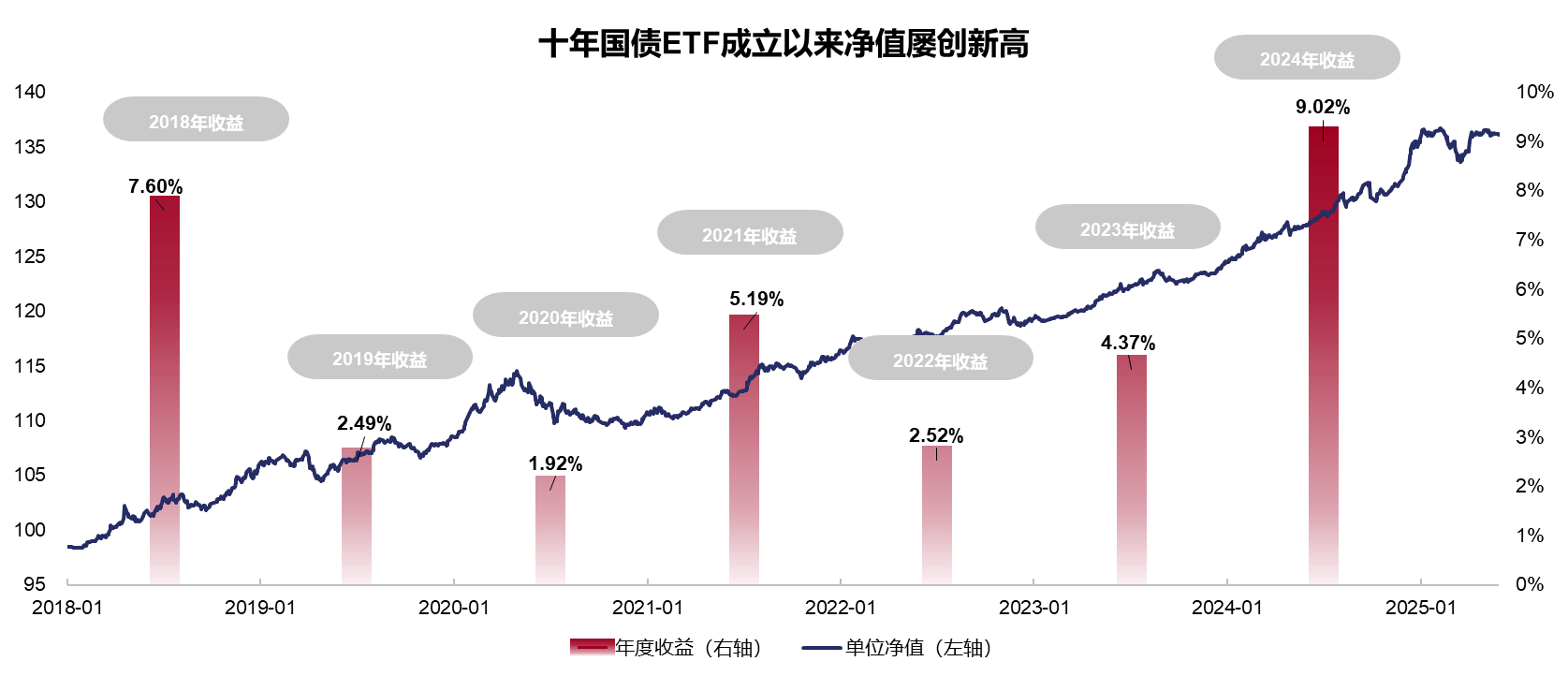
Core Viewpoint - Since 2025, the decline in fixed deposit rates has led investors to seek more stable and competitive returns, making the bond market a popular choice again [1]. Group 1: Bond Market Dynamics - Bond ETFs have seen significant growth, increasing from 174 billion to over 380 billion since the beginning of the year, with the ten-year government bond ETF (511260) attracting nearly 10 billion in net inflows [1]. - The macroeconomic environment shows continued weakness in domestic demand, with slow recovery in consumption and real estate investment, leading to persistent capital inflows into the bond market [1]. - The easing of the economic cycle between China and the U.S. and strengthened expectations for U.S. Federal Reserve rate cuts may open up space for domestic monetary policy easing, making bonds a favorable choice during this economic transition [1]. Group 2: Ten-Year Government Bonds - The ten-year government bond, backed by national credit, has a relatively low default risk and is directly linked to monetary policy adjustments, making it a preferred choice for many investors [1]. - The current yield on the ten-year government bond is approximately 1.65%, significantly higher than short-term bonds, providing better coupon protection [2]. - The ten-year government bond is positioned as a balance between short-term and long-term bonds, offering lower volatility risk and a smoother investment experience [2]. Group 3: Ten-Year Government Bond ETF (511260) - The ten-year government bond ETF tracks the Shanghai Stock Exchange 10-year government bond index, with an average duration of 7.6 years [3]. - Since its inception, the ten-year government bond ETF has consistently achieved positive returns each year, with a one-year return of 6.02%, a three-year return of 15.04%, and a five-year return of 19.26% [3][6]. - The ETF offers unique advantages such as T+0 trading, low transaction fees, transparent holdings, and the ability to pledge for repurchase, enhancing liquidity and investment flexibility [6][7][8]. Group 4: Market Outlook - Analysts from招商证券 expect that the economic fundamentals will not pose substantial risks to the bond market in the second half of the year, with GDP growth expected to stabilize [8]. - 信达证券 is optimistic about the bond market in July, anticipating a transition from quantitative to qualitative changes, which may lead to new lows in yields [8].