CMOS工艺

Search documents
全球首颗,复旦大学创新存储芯片登Nature,已流片
3 6 Ke· 2025-10-11 10:29
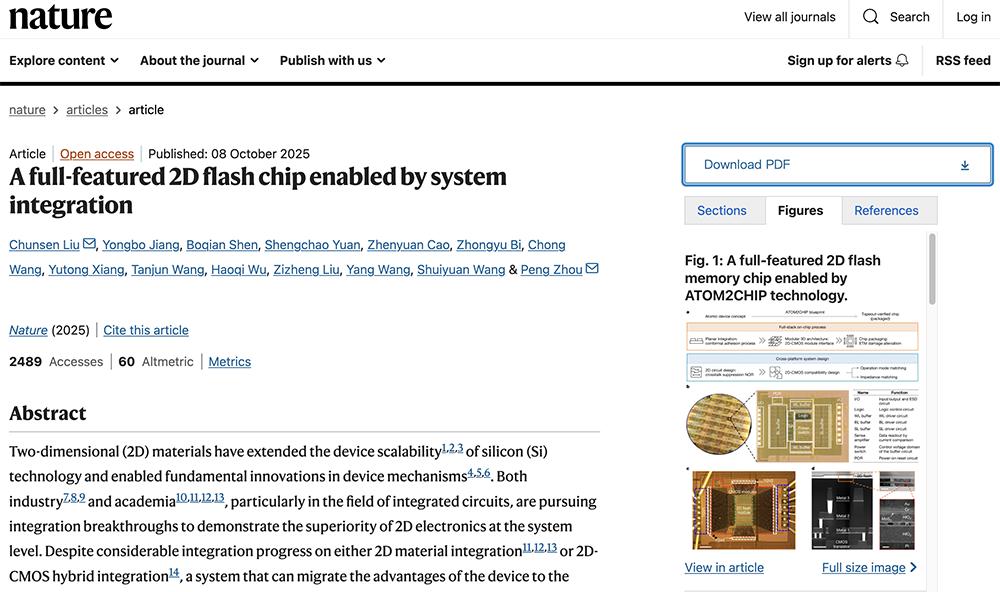
Core Insights - Fudan University has developed the world's first two-dimensional-silicon-based hybrid architecture chip, which was published in the prestigious journal Nature on October 8 [1][5]. Summary by Sections Research Breakthrough - The chip integrates two-dimensional (2D) ultra-fast flash memory with mature complementary metal-oxide-semiconductor (CMOS) technology, overcoming key engineering challenges in 2D information devices and addressing storage speed issues [5][10]. - The chip's performance significantly surpasses current Flash memory technology, achieving a high yield of 94.34% and supporting 8-bit instruction operations and 32-bit high-speed parallel operations [5][20]. Academic Contributions - The paper titled "Fully Functional Two-Dimensional-Silicon-Based Hybrid Architecture Flash Memory Chip" features contributions from researchers Liu Chunsen and Zhou Peng, among others [7]. - This achievement follows the earlier development of the "Dawn (PoX)" picosecond flash memory device, which set a record for the fastest semiconductor charge storage technology at 400 picoseconds [8][10]. Technical Innovations - The research team has proposed a cross-platform system design methodology, named "Changying (CY-01) architecture," which supports the integration of 2D NOR flash memory chips with CMOS circuits [20][22]. - The developed flash memory units can operate in 20 nanoseconds with a single-bit energy consumption as low as 0.644 picojoules [20]. Future Prospects - The team plans to establish an experimental base and collaborate with relevant institutions to lead engineering projects, aiming to scale the technology to a trillion-level within 3-5 years [22][23]. - The anticipated impact of this technology includes the potential to revolutionize traditional memory systems, providing faster and lower-energy data support for fields such as artificial intelligence and big data [23].