
Core PCE inflation

Search documents
Supreme Court Struck Down Trump's Tariffs - And Nvidia Earnings Playbook - Amazon.com (NASDAQ:AMZN), Alphabet (NASDAQ:GOOGL)
Benzinga· 2026-02-23 16:29
Macro - Q4 GDP growth was reported at 1.4%, significantly below the estimated 2.8%, primarily attributed to the government shutdown [1] - Full-year 2025 GDP growth decreased to 2.2%, down from 2.4% in the previous year [1] - Core PCE inflation remained steady at 3%, indicating that the Federal Reserve's monetary policy remains constrained [1] - Kashkari mentioned that interest rates are "pretty close to neutral" and criticized cryptocurrency as "utterly useless" [1] Geopolitical - The U.S. has established its largest air power presence in the Middle East since the 2003 Iraq invasion, according to the Wall Street Journal [2] - Ongoing negotiations regarding Iran's nuclear program remain uncertain [2] - Oil prices are currently around $66.50, contributing to gold prices exceeding $5,000 and defense stocks reaching new highs [2]



Supreme Court Struck Down Trump's Tariffs - And Nvidia Earnings Playbook
Benzinga· 2026-02-23 16:29
Macro - Q4 GDP growth was reported at 1.4%, significantly below the estimated 2.8%, primarily attributed to the government shutdown [1] - Full-year 2025 GDP growth decreased to 2.2%, down from 2.4% the previous year [1] - Core PCE inflation remained steady at 3%, indicating that the Federal Reserve's monetary policy remains constrained [1] - Kashkari mentioned that interest rates are "pretty close to neutral" and described cryptocurrency as "utterly useless" [1] Geopolitical - The U.S. has established its largest air power presence in the Middle East since the 2003 Iraq invasion, according to the Wall Street Journal [2] - Ongoing negotiations regarding Iran's nuclear program remain uncertain [2] - Oil prices are currently around $66.50, contributing to gold prices being above $5,000 and defense stocks reaching new highs [2]


美国经济:2025 年十大问题回顾-US Daily_ A Retrospective on 10 Questions for 2025
2026-01-26 02:49
Summary of Key Points from the Conference Call Industry Overview - The analysis focuses on the macroeconomic environment in the United States, particularly regarding GDP growth, consumer spending, labor market conditions, inflation, and monetary policy. Core Insights and Arguments 1. **GDP Growth**: - GDP growth in 2025 was forecasted at 2.4% on a Q4/Q4 basis, surpassing the consensus of 2.0%. Actual growth was 2.5% from Q1 to Q3, with an expected 2.4% in Q4 despite a 1.2 percentage point drag from a government shutdown [4][3]. 2. **Consumer Spending**: - Consumer spending growth was anticipated to be 2.3%, slightly above the consensus of 2%. Actual growth was 2.2% from Q1 to Q3, with an expected increase to 2.6% in Q4, maintaining the forecasted average [5][5]. 3. **Labor Market Trends**: - Contrary to expectations, the labor market softened, with the unemployment rate rising from 4.25% to 4.4%. This was attributed to slower job growth despite a decrease in immigration and labor supply growth [6][6]. 4. **Inflation Rates**: - Core PCE inflation was expected to fall below 2.4% year-on-year. The actual rate was projected at 2.98% in December, with tariffs contributing 62 basis points to this rate. The decline in inflation was linked to labor market rebalancing [8][7]. 5. **Federal Reserve Monetary Policy**: - The Federal Reserve was expected to cut rates by at least 50 basis points, which occurred with three cuts throughout the year. The median neutral rate estimate remained stable at 3%, contrary to expectations of an increase [11][12]. 6. **Immigration Trends**: - Net immigration was expected to remain positive but fell from an annualized pace of 1.5 million to around 0.5 million by year-end, slightly below previous forecasts [14][14]. 7. **Tariff Policies**: - The anticipated universal tariff was not implemented; however, substantial reciprocal tariffs were imposed, raising the effective tariff rate significantly more than expected. The effective tariff rate is projected to decrease slightly in 2026 due to new deals [15][17]. 8. **Primary Deficit**: - It was expected that Congress would not meaningfully reduce the primary deficit, which was confirmed as tariff revenues did not sufficiently offset new tax cuts [19][19]. Additional Important Insights - The analysis reflects on the unexpected outcomes of fiscal policies under the Trump administration, particularly regarding their impact on monetary policy and economic indicators. - The report emphasizes the complexity of predicting economic trends due to external factors such as tariffs and immigration policies, which have significant implications for the labor market and inflation [1][2].
美国经济-关税开始抑制实际支出-Tariffs start to cool real spending
2025-12-08 15:36
Summary of Key Points from the Conference Call Industry Overview - The conference call primarily discusses the **US Economics** sector, focusing on the impact of tariffs on real spending and inflation trends in North America [1] Core Insights and Arguments - **Core PCE Inflation**: Core PCE inflation rose by **0.20% month-over-month (m/m)** in September, slightly below expectations of **0.22%**. The annual pace was recorded at **2.83%**, which is above the target of **2%** [4][5] - **Goods Prices**: There has been a gradual passthrough of tariffs, with goods prices increasing, which has negatively impacted real goods spending. Real goods spending fell by **0.4% m/m** in September, while services spending rose by **0.2%** [4][21] - **Real Personal Spending**: Real personal spending was flat in September, with nominal spending increasing by **0.3%**. The overall consumption for Q3 is expected to rise by **2.7% quarter-over-quarter (q/q)** [21][22] - **Income Trends**: Real disposable personal income increased by **0.1%**, while nominal personal income rose by **0.4%**. Labor compensation also saw a rise of **0.4%** [26] Additional Important Insights - **Tariff Impact**: The total tariff push to PCE prices has been estimated at about **30 basis points (bp)** so far, with expectations of continued inflationary pressure from tariffs into Q4 and Q1 [7][27] - **Consumer Behavior**: Initial reports on Black Friday spending were better than anticipated, but these do not correlate well with overall spending data, indicating that prices likely influenced nominal sales [27] - **Sector Performance**: Within goods, real durable goods spending fell by **0.6% m/m**, with significant declines in auto spending and furniture. Nondurable goods spending also decreased by **0.3% m/m** [23][24] Conclusion - The overall economic outlook suggests a cooling in real spending due to higher prices driven by tariffs and slower income growth, with expectations of further deceleration in real consumption growth in Q4 [27]
美国经济:关税开始抑制实际消费支出-US Economics-Tariffs start to cool real spending
2025-12-08 00:41
Summary of Key Points from the Conference Call Industry Overview - The conference call primarily discusses the **US Economics** sector, focusing on the impact of tariffs on real spending and inflation trends in North America. Core Insights and Arguments - **Core PCE Inflation**: Core PCE inflation rose by **0.20% month-over-month (m/m)** in September, slightly below expectations of **0.22%** [2][3] - **Goods Prices**: There was an increase in goods prices, indicating a gradual passthrough of tariffs, which is expected to weigh on real goods spending, particularly in the fourth quarter (4Q) [2][5] - **Real Personal Spending**: Real personal spending was flat in September, with a tracking of **3Q real spending** up **2.7% quarter-over-quarter (q/q) seasonally adjusted annual rate (saar)** [2][19] - **Nominal Income**: Nominal income increased by **0.4%**, with labor compensation also up by **0.4%**. Real disposable personal income rose by **0.1% m/m** [2][24] - **Spending Trends**: Real goods spending fell by **0.4% m/m**, while real services spending rose by **0.2% m/m**. This indicates a shift in consumer behavior towards services amidst rising goods prices [20][21] Additional Important Details - **Tariff Impact**: The total tariff push to PCE prices has been estimated at about **30 basis points (bp)** so far, with expectations of continued inflationary pressure from tariffs into 4Q and 1Q [5][25] - **Housing Inflation**: Core services inflation decelerated, particularly in shelter inflation, which is believed to be exaggerated due to regional noise and seasonal factors [6][7] - **Airfares**: A slight underperformance in core inflation expectations was attributed to airfares, which accelerated less than anticipated [7] - **Future Projections**: The forecast for **4Q core PCE** is set at **3.0%**, slightly below the Federal Reserve's forecast of **3.1%** [8] Conclusion - The overall economic outlook indicates a cooling in real spending due to rising goods prices driven by tariffs, with expectations of slower consumption growth in the upcoming quarters. The data suggests a complex interplay between inflation, consumer behavior, and economic policy that will require close monitoring [25]
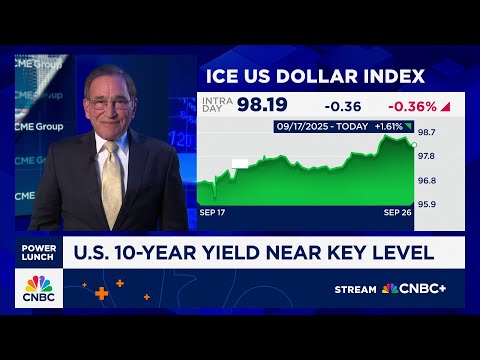
U.S. 10-year bond yield nears key level
Youtube· 2025-09-26 19:23
Group 1 - The Treasury market is currently hovering below a key level of 4.25%, but remains above the significant 4% level, indicating market stability despite inflation concerns [1][2] - Year-over-year core PCE inflation is reported at 2.9%, which is above the pre-COVID levels and indicates persistent inflationary pressures, well above the Federal Reserve's 2% target [2][3] - The Federal Reserve may reconsider aggressive easing strategies due to the persistent inflation and stable labor market, as evidenced by the tame claims data of 218,000 [3] Group 2 - The Treasury yields have increased, with a rise of seven basis points on the week for the 10-year and five basis points for the two-year, reflecting market reactions to recent economic data [4] - The dollar index has appreciated by approximately 1.6% since the Federal Reserve's easing on the 17th, indicating a strengthening dollar amidst the current economic environment [4]
U.S. 10-year bond yield nears key level
CNBC Television· 2025-09-26 18:43
Market Trends & Inflation - The Treasury market's tenure is hovering below a key level of 425 basis points (425%) [1] - Inflation remains sticky, with year-over-year core PCE inflation at 290 basis points (290%) [1][2] - Core PCE inflation is holding at slightly below 300 basis points (300%), well above pre-COVID levels, while the target is 200 basis points (200%) [2] Monetary Policy & Labor Market - The Fed should pause any aggressive easing strategy unless the labor market deteriorates [3] - Initial claims were at 218000, indicating a tame labor market [3] Treasury Market & Dollar Index - Treasury yields are up seven basis points (700%) on the week in a two-year and about five basis points (500%) in a 10-year [4] - Since the Fed's easing on the 17th, the dollar index is up about 160 basis points (160%) [4] Economic Sentiment - University of Michigan sentiment shows some deterioration [3]
美国:生产者价格指数数据显示 7 月核心个人消费支出通胀可能小幅加速-US_ PPI data suggest core PCE inflation likely accelerated modestly in July
2025-08-18 02:52
Summary of Key Points from the Conference Call Industry Overview - The conference call primarily discusses the **North American economic outlook**, focusing on **core PCE inflation** and **PPI data**. Core Points and Arguments 1. **Revised Core PCE Inflation Estimate**: The tracking estimate for July core PCE inflation has been revised up by 6 basis points to **0.307%** from a previous estimate of **0.243%** [2][9] 2. **June Core PCE Inflation Revision**: Backward revisions to PPI data suggest that June core PCE inflation will likely be revised up by **2 basis points** [2] 3. **Three-Month Annualized Core Inflation**: If the forecast materializes, the three-month annualized pace of core inflation is expected to increase to **3.22%** in July from **2.70%** in June [2][8] 4. **PPI Components Performance**: PPI's portfolio management and investment prices rose sharply by **5.4%** month-over-month, significantly higher than the forecasted **2.7%** increase [6][9] 5. **Airline Fares Impact**: The increase in portfolio management prices was only partially offset by a decline in airline fares, which fell by **2.3%** month-over-month [12][9] 6. **Federal Reserve Rate Cut Expectation**: The expectation remains for the Federal Reserve to deliver a **25 basis point** cut at the upcoming September meeting, despite the upside surprise in portfolio management prices [9][20] 7. **Core PCE Tracking**: Core PCE is tracking close to the Fed's year-end forecast of **3.1%**, allowing officials to focus on downside risks to growth and employment data [9][20] 8. **Inflation Above Target**: Inflation is currently running well above the Fed's **2%** target, making a **50 basis point** cut unlikely [21] Additional Important Insights 1. **Broadening Price Pressures**: There are signs of broadening price pressures beyond the components that directly feed into core PCE inflation [12] 2. **Final Demand Services Growth**: Final demand services grew by **1.1%** month-over-month, marking the largest advance since March 2022, primarily driven by margins for final demand trade services [13] 3. **PPI's Finished Consumer Goods Prices**: The price index for finished consumer goods continued to rise in July, consistent with factory survey reports [13][18] This summary encapsulates the critical insights from the conference call, highlighting the economic indicators and expectations surrounding inflation and Federal Reserve policy.
花旗:美国经济_服务业支出放缓,核心个人消费支出(PCE)低迷预示美联储将降息
花旗· 2025-07-01 00:40
Investment Rating - The report suggests a dovish outlook for the Federal Reserve, indicating potential rate cuts in September due to weak consumer spending and subdued core PCE inflation [1][8]. Core Insights - Consumer spending has shown signs of persistent weakness, particularly in services, with a nominal increase of only 0.1% MoM and flat real terms, leading to an overall decline in personal spending [5][7]. - Core PCE inflation increased by 0.179% MoM, slightly above expectations, but still subdued enough to support the case for rate cuts [4][8]. - The report highlights a significant decline in travel-related spending, particularly in air travel and hotel accommodations, which have seen declines every month this year [7][8]. Summary by Sections Consumer Spending - Personal spending fell by 0.1% MoM in nominal terms and 0.3% in real terms, with goods spending declining by 0.8% MoM [5]. - Services spending showed unexpected weakness, with a nominal increase of only 0.1% MoM and flat in real terms, indicating a broader trend of reduced consumer demand [5][7]. Inflation Metrics - Core PCE inflation was reported at 0.179% MoM, slightly stronger than consensus but still indicative of a soft inflation environment [4][8]. - The report suggests that weak consumer demand limits the ability of firms to pass through tariff price increases, reducing the risk of broad-based inflation [8]. Employment Implications - The report indicates that weaker consumer demand could lead to softer hiring, raising downside risks to the Federal Reserve's employment mandate [8].
