Currency swap

Search documents
Trump's $20 billion Argentina bailout, EXPLAINED
MSNBC· 2025-10-27 19:22
Geopolitical & Economic Analysis - The US Treasury provided a $20 billion USD currency swap to Argentina, a move considered unusual as it last occurred over 30 years ago [2] - The Argentinian economy's potential failure poses no direct economic threat to the US [3] - The US intervention occurred during a period of domestic budget cuts and shutdowns [3] Political Motivations - The currency swap was perceived as a bailout of Argentinian President Javier Milei, an ally of the previous US administration, during crucial midterm elections [5] - The intervention aimed to stabilize the Argentinian peso amidst economic challenges and widespread discontent, potentially influencing the election outcome [5][6] - Javier Milei was able to hold on to enough seats in Congress to continue pushing his agenda through [6] Opportunity Cost - The $20 billion USD used for the currency swap could have funded NASA for almost a year, the EPA for two years, or provided several months of food stamps [1]

X @Bitcoin Archive
Bitcoin Archive· 2025-10-16 15:43
JUST IN: 🇺🇸 Bessent says U.S. expects to finalize a trade deal with South Korea in next 10 daysSouth Korea wants an Argentina-style currency swap 💵 https://t.co/1cUyETuejd ...
Top South Korean official expresses optimism about US tariff talks, fuelling stock rally
Yahoo Finance· 2025-10-16 08:01
Group 1 - South Korea's chief presidential policy adviser expressed optimism about finalizing a trade deal with the U.S., indicating progress in negotiations that have positively impacted the stock market, particularly in the auto sector [1][2] - South Korean officials, including Finance Minister Koo Yun-cheol, noted "huge progress" in negotiations, with Foreign Minister Cho Hyun highlighting "positive signals" towards reaching a deal [2] - U.S. Treasury Secretary Scott Bessent stated that the countries are close to finalizing a trade deal, with an announcement expected within the next 10 days, coinciding with U.S. President Trump's upcoming visit to South Korea [3] Group 2 - Concerns in Seoul regarding foreign exchange implications and the structure of a $350 billion investment package from a preliminary deal have led to requests for safeguards, such as a currency swap line, to mitigate potential currency market impacts [4] - The KOSPI stock index rose 2.5% to a record high, with Hyundai Motor shares increasing by 8.3% and Kia by 7.2%, driven by expectations of reduced auto tariffs from 25% to 15% as promised in the July deal [5] - South Korea's top national security adviser indicated that there has been no progress in discussions with the U.S. Treasury regarding a currency swap, despite local media reports suggesting various tools for currency safeguards are being considered [6] Group 3 - An economist from Citi reported that the likelihood of a partial compromise has increased, contingent on three conditions: expedited timing for a deal, maintaining the $350 billion figure, and implementing safeguards to address currency risks rather than an unlimited central bank dollar swap line [7]
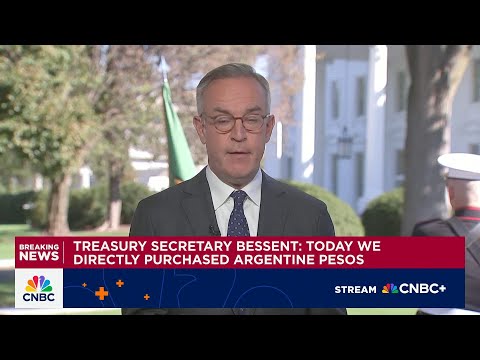
Treasury Sec. Bessent: Today we directly purchased Argentine pesos
CNBC Television· 2025-10-09 19:35
Government Support - US Treasury Secretary expresses strong support for the government of Argentina and its financial markets [1] - The international community, including the IMF, is unified behind Argentina [2] - US Treasury has directly purchased Argentine pesos [2] - A 20 billion currency swap framework with Argentina's central bank has been finalized [2] - US Treasury is prepared to take exceptional measures to provide stability to markets [3] Market Concerns - Argentina faces a moment of acute illiquidity [1] - The exact amount of Argentine pesos purchased by the US government is not specified [3] - The 20 billion currency swap is a finalized framework, not an executed swap [4] - The Treasury is prepared to take measures, but it's not confirmed they are currently taking them [5] - Potential concerns exist regarding Argentina's business engagement with China [5]
Analysis-Korea's wobbles over US trade talks awaken the won bears
Yahoo Finance· 2025-09-25 07:59
Core Viewpoint - South Korea's trade negotiations with the Trump administration are facing significant political uncertainties, leading to investor concerns about a potentially unfavorable deal or no deal at all [1]. Group 1: Currency and Economic Impact - The Korean won has fallen below the critical level of 1,400 to the dollar, indicating market fears and potential for further depreciation [1]. - President Lee Jae Myung indicated that South Korea would require a currency swap agreement with the U.S. if it agrees to invest $350 billion in the U.S., raising fears of a financial crisis similar to that of 1997 [2]. - KB Securities estimates that if South Korea channels $350 billion in direct investment to the U.S. without a currency swap, the won could depreciate by 100 won per dollar annually over the next three years [3]. Group 2: Trade Agreement Status - There is a deadlock between Seoul and Washington regarding the structure of a $350 billion investment fund, which is part of a broader trade deal that would cap tariffs on South Korean goods at 15% [5]. - If the trade deal is not finalized, South Korean imports could face tariffs as high as 25%, making them less competitive compared to goods from Japan and Europe, which would still face the agreed 15% tariffs [6]. Group 3: Historical Context and Current Challenges - The memories of the late 1990s foreign exchange crisis are influencing South Korean officials' reluctance to ease currency restrictions, despite some progress in making the won more globally accepted [7].
Global Markets See Records Amid Policy Shifts and Economic Concerns
Stock Market News· 2025-09-21 22:38
Group 1: U.S. Stock Market Performance - U.S. equities, including the Dow Jones Industrial Average, S&P 500, and Nasdaq Composite, reached record closing highs on September 19, 2025, following the Federal Reserve's first interest rate cut of the year [2][7] - The S&P 500 achieved its 26th new high of the year, with the Dow rising by 0.37% to 46,315.27, the S&P 500 gaining 0.49% to 6,664.36, and the Nasdaq Composite advancing 0.72% to 22,631.48 [3] - For the week, the S&P 500 climbed 1.2%, the Nasdaq surged 2.2%, and the Dow added 1.05%, driven by strong performance in technology stocks such as Nvidia, Oracle, and Apple [3] Group 2: UK Foreign Aid Policy Changes - The UK government announced a significant overhaul of its foreign aid policy, planning to reduce aid spending to 0.3% of gross national income (GNI) by 2027, down from 0.5% established in 2021 [4] - This strategic shift emphasizes a transition from traditional aid donations to a model focused on partnerships and investments, prioritizing funding through impactful multilateral organizations [4] - The decision has faced criticism, with concerns that aid cuts could enhance the influence of countries like China and Russia [4] Group 3: South Korea's Economic Strategy - South Korean President Lee Jae Myung has called for an "unlimited" currency swap agreement with the U.S. to mitigate economic crisis risks amid ongoing trade negotiations [5] - South Korea has committed to investing US$350 billion in the U.S. in exchange for a reduction in tariffs from 25% to 15%, raising concerns about potential destabilization of its foreign exchange market [5] - The importance of currency swap agreements has been highlighted, as South Korea has historically engaged in such agreements during financial crises [5]