
Data Observability

Search documents
2026 年数据与人工智能的 7 项预测
3 6 Ke· 2026-01-22 05:52
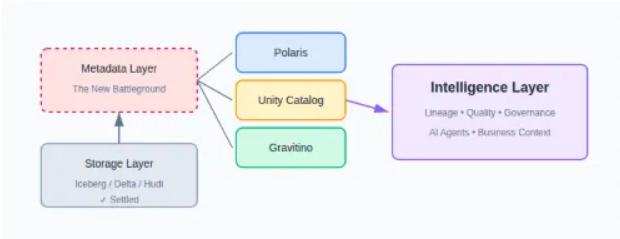
Core Insights - The infrastructure supporting artificial intelligence is undergoing a significant transformation, driven by the convergence of open formats, AI capabilities, and the unsustainable costs of integrating numerous tools [1][2]. Group 1: Importance of Fundamentals - Basic skills remain crucial as architecture changes can disrupt pipelines, and data quality issues continue to plague organizations, costing an average of $12.9 million annually due to poor data quality [2][11]. - The key challenge by 2026 will not be the existence of these issues but the speed and method of their detection and resolution [2]. Group 2: Metadata Layer as a Battleground - The storage layer competition has concluded with Iceberg, Delta Lake, and Hudi emerging as winners, while Parquet has become the common language for data storage [3][6]. - The focus is shifting upstream to the metadata layer, which is becoming the operational backbone of data management, encompassing data lineage, quality rules, access policies, and business context [6][20]. Group 3: Simplification of Data Stacks - Organizations are experiencing tool fatigue, managing an average of 15 to 30 different tools across various data functions, which is unsustainable [7][9]. - By 2026, the integration process will accelerate, with platforms like Snowflake and Databricks consolidating functionalities to streamline data operations [10]. Group 4: Data Quality as a Business Function - Data quality metrics will shift from engineering-focused indicators to business outcomes, with organizations increasingly linking data pipeline failures to revenue impacts [11][12]. - By 2026, 80% of organizations are expected to deploy AI/ML-driven data quality solutions, emphasizing the need for accountability through data contracts between producers and consumers [12]. Group 5: AI Agents Replacing Dashboards - The traditional model of data observability through dashboards is becoming obsolete, with AI agents expected to take over operational responsibilities by 2026 [13][15]. - These AI agents will be capable of understanding business context, automatically tracing issues, and applying fixes, fundamentally changing the approach to data observability [15]. Group 6: AI Reshaping Data Infrastructure - The initial design of data stacks was for dashboard services, not AI workloads, but AI is now a primary user of data [16]. - By 2026, two types of companies will emerge: AI-native architectures designed for AI workloads and traditional stacks with AI capabilities added later [16]. Group 7: The Rise of Semantic Layers - Semantic layers, previously seen as optional, are becoming essential for AI applications, providing necessary context for data interpretation and ensuring data quality [17]. - These layers serve as a bridge between technical data and business meaning, crucial for AI agents to function effectively [17]. Group 8: Common Theme - A common theme across the predictions is the shift from passive to proactive data infrastructure, where systems will not only store and visualize data but also understand, reason, and act based on interactions [18][19].


3 AI Stocks Perfect for Gen Z Investors to Add to Their Portfolios
The Motley Fool· 2025-09-30 07:57
Core Insights - The wealthiest 1% of Americans own nearly half of the stocks in the U.S, with baby boomers holding 53.5% of all stocks, while Gen Xers and millennials hold 21.9% and 8.5%, respectively [1] - Gen Z investors are often associated with speculative investments rather than blue-chip stocks, which may lead to short-term gains but are challenging to sustain long-term [2] Company Summaries Navitas Semiconductor - Navitas produces gallium nitride (GaN) and silicon carbide (SiC) chips, which are used in various applications including laptop chargers and EV chargers [4] - The company expects revenue growth from AI workloads processed using its chips, particularly after a deal with Nvidia, although significant revenue from this deal is not expected until 2027 [5] - Analysts predict a 42% revenue drop in 2025, but a CAGR of 40% from 2025 to 2027 as the company narrows net losses and benefits from increased adoption of its chips [6] SoundHound AI - SoundHound AI develops AI-powered audio and voice recognition tools, with significant growth coming from its Houndify platform [7] - The company serves diverse industries and has expanded through acquisitions, enhancing its ecosystem [8] - Analysts forecast a CAGR of 47% for revenue from 2024 to 2027, with adjusted EBITDA turning positive by the final year [9] Datadog - Datadog's platform helps IT professionals unify real-time data from various computing platforms, simplifying problem detection [10] - The company serves over 30,000 customers globally, positioning itself well in the expanding data observability market, which is expected to grow at a CAGR of 10.7% from 2024 to 2030 [11] - Analysts expect Datadog's revenue and adjusted EBITDA to grow at CAGRs of 22% and 19%, respectively, from 2024 to 2027 [12]





Acceldata Named to Forbes List of America’s Best Startup Employers 2025
Globenewswire· 2025-03-12 13:00
Core Insights - Acceldata has been recognized for the second consecutive year on Forbes' list of America's Best Startup Employers 2025, highlighting its commitment to an inclusive and innovation-driven workplace [1][2] - The recognition is based on evaluations of company reputation, employee satisfaction, and growth among 3,000 privately-held companies in the U.S. [2] Company Achievements - Acceldata has received multiple accolades from industry analysts, including being named a leader in Everest Group's Data Observability Technology Provider PEAK Matrix® Assessment 2024 and AIM Research's GenAI Observability Vendor Landscape [3] - The company is also recognized in the Gartner® Market Guide for Data Observability Tools and included in the Lazard VGB AI Infra 40, selected from over 2,000 companies in North America and Europe [3] - Additional industry recognitions include the CRN 2024 Big Data 100 list and DBTA 100, showcasing its status as a significant player in the data observability and DataOps sectors [3] Company Overview - Founded in 2018 and based in Campbell, CA, Acceldata specializes in data observability and agentic data management solutions, enabling organizations to gain actionable insights into their data infrastructure [4] - The company utilizes advanced AI technology to provide visibility into data pipelines, helping organizations optimize performance [4] - Acceldata's client base includes notable global companies such as Dun & Bradstreet, PubMatic, and PhonePe [4]
